Chapel Bay Fort: A Coastal Defence Battery in Wales


Site at a Glance
- Rating
- 4.6
- Popularity
- Low
- Country
- United Kingdom
- Primary era
- Modern
- External website
- Open
- Eras represented
- Modern
- Civilizations
- British
- Site type
- Military
- Remains
- Fort
On this page6 sections
History
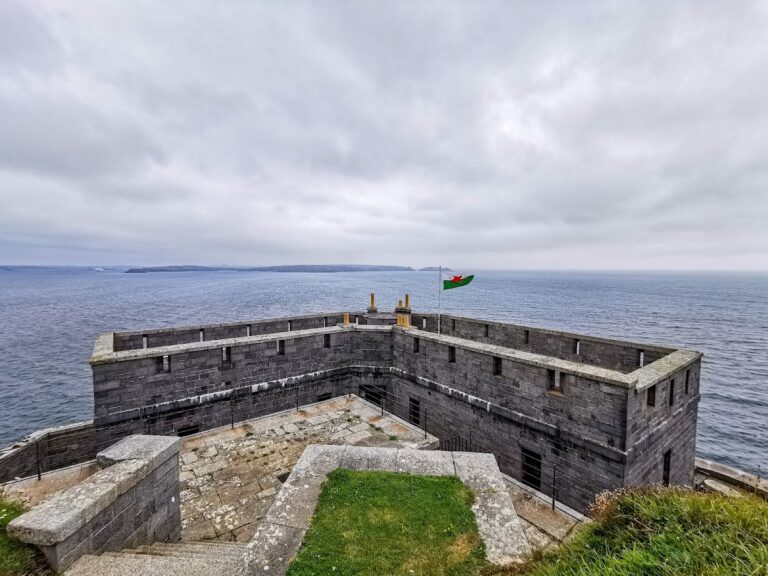
Chapel Bay Fort is a coastal defence battery in the United Kingdom, on the southern shore of the Milford Haven Waterway in Pembrokeshire, Wales, about 1 mile (1.6 km) from Angle. Built between 1890 and 1891, it formed part of the Haven’s inner line of defence created after the Royal Commission on the Defence of the United Kingdom, a British inquiry whose recommendations led to stronger coastal and harbour defences.
Construction and artillery changes
Construction began in 1890 and was completed the following year at a cost of £11,779. The battery was the first fortification in the area to be built from mass concrete. It could accommodate 91 men and included a mess room and a sick bay. Its original armament consisted of three 10-inch rifled muzzle-loading guns. These were loaded through the barrel, while internal rifling helped improve the accuracy of their projectiles.
Between June 1900 and August 1901, the battery was reconstructed for three 6-inch breech-loading guns. This newer artillery type was loaded from the rear of the barrel and reflected the changing requirements of coastal defence. The reconstruction altered the fort’s military function while retaining its place within the defensive system of the waterway.
Twentieth-century military use and later status
Chapel Bay Fort remained in military hands throughout the First World War and was decommissioned in 1920. It was sold to the Angle Estate in 1932. The site returned to military use during the Second World War, when a mining observation post was constructed there. Such a post monitored controlled underwater mines intended to obstruct access to a harbour or waterway.
The fort was later acquired privately and now functions as a museum. It is also a Grade II Listed Building, a statutory designation in England and Wales for buildings of special architectural or historic interest.
Remains
Concrete battery and surviving armament
Chapel Bay Fort survives as a mass-concrete coastal battery built to house artillery and its military personnel. Its facilities included accommodation for 91 men, a mess room for communal meals, and a sick bay. The original defensive arrangement was centred on three 10-inch rifled muzzle-loading guns, while the reconstructed battery was designed for three 6-inch breech-loading guns.
One of the original 10-inch guns has been remounted as part of the restoration. This surviving piece reflects the battery’s first armament and helps distinguish the earlier phase of the fort from the reconstruction carried out between 1900 and 1901.
Military observation post
A mining observation post was added during the Second World War. It formed part of the site’s later military use and was intended to monitor controlled underwater mines placed to obstruct movement through the Milford Haven Waterway.