Stack Rock Fort: A Victorian Sea Fort Defending Milford Haven


Site at a Glance
- Rating
- 4.6
- Popularity
- Very Low
- Country
- United Kingdom
- Primary era
- Modern
- External website
- Open
- Eras represented
- Modern
- Civilizations
- British
- Site type
- Military
- Remains
- Fort
On this page7 sections
History
Stack Rock Fort is a British sea fort on a small island in the Milford Haven Waterway, United Kingdom. Construction began in 1850, and the first fort was completed in 1852 to defend the estuary, the approach to Milford Haven, and the Royal Dockyard at Pembroke Dock.
Proposals and construction
The idea of fortifying Stack Rock had a long history. Thomas Cromwell submitted the first proposal in 1539, but it was not approved. After surveying Milford Haven in 1748, Lewis Morris recommended a small fort, and another survey followed in 1817. These proposals led to no construction for more than two centuries.
Work finally began in 1850 amid British concern about Napoleon III, emperor of France from 1852 to 1870. His foreign policy and military rhetoric contributed to fears that French naval power might threaten British coastal and dockyard installations. The completed fort never saw combat because the expected French intentions ultimately proved unfounded. In peacetime, its garrison consisted of one officer and thirty men.
Modernization in the nineteenth century
The arrival of the French ironclad La Gloire in 1858 made Stack Rock’s original guns obsolete. The first tower was therefore enclosed within a larger battery. Foundations for this expansion began in 1861, the new basements and magazines were completed in 1863, and the final scheme was finished in 1871.
The expansion plans changed after construction had started. The revised design used stronger granite piers to support heavy iron gun shields instead of relying mainly on limestone. The completed battery carried sixteen large 10-inch rifled muzzle-loading guns in front casemates and seven smaller 9-inch rifled muzzle-loading guns in two rear levels. A rifled muzzle-loading gun had spiral grooves in its barrel and was loaded from the front, improving the stability and accuracy of its projectile.
Wartime service and later history
During World War I, Stack Rock Fort monitored and protected the harbor. It controlled remotely operated anti-ship mines and operated large searchlights intended to defend against attacks at night. By this period, its armament had been reduced to two 12-pounder quick-firing guns, designed for a faster loading and firing cycle than older artillery.
The fort was decommissioned in 1929, placed on the market, and sold in 1932 for £160. During World War II, the Royal Air Force briefly used it as a military communications relay station. After its military service ended, the fort deteriorated and passed through several owners.
Possible trespasser activity near a nearby liquefied natural gas jetty led to security concerns in 2013. The fort was sold to a private owner in 2020 and then, in January 2021, to the community interest company Anoniiem for £191,000. A community interest company is a United Kingdom company structure intended for organizations whose activities primarily benefit a community rather than private shareholders. Stack Rock Fort is a Grade II* listed building and a registered scheduled monument, SAM number PE334.
Remains
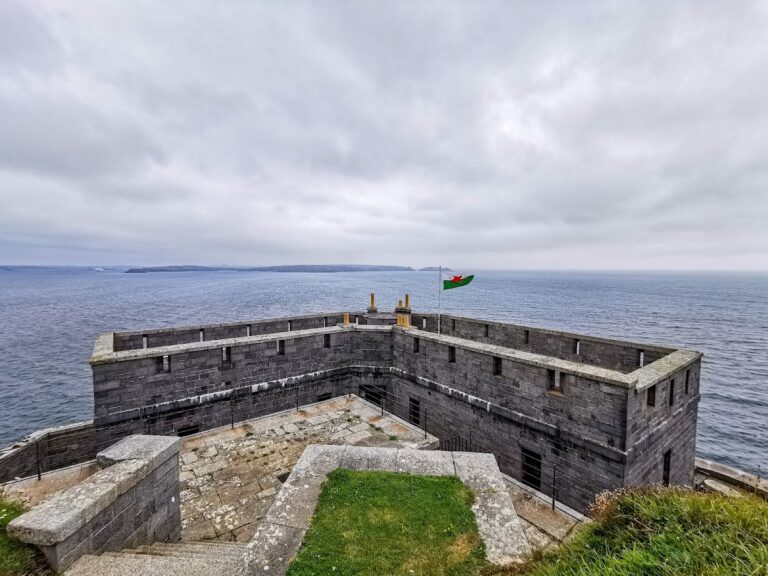
Stack Rock Fort occupies a small island and consists of an original elliptical gun tower enclosed by a much larger battery. Granite is the principal construction material, while limestone appeared in the initial expansion design before the plans were revised. The surviving arrangement reflects the fort’s transformation from a compact mid-nineteenth-century tower into a heavily armed coastal battery.
Original gun tower
The first fort was an elliptical tower measuring up to 55 feet (17 metres) across and 30 feet (9.1 metres) high. Its walls were about 3 metres thick on the exposed southern and western sides. Three smoothbore 32-pounder guns stood on the roof, while a further 12-pounder gun protected the dock walls. The basement contained magazines for ammunition, coal, and food, as well as a tank for collecting rainwater. Accommodation for the men occupied the first floor.
Enlarged battery
The later battery completely surrounded and encased the original tower. Its first plan called for two decks containing nineteen casemates, fortified chambers from which artillery could be fired, together with sixteen open-air guns above, giving a projected total of fifty-four guns. The revised construction used granite piers and heavy iron gun shields.
The final arrangement placed sixteen 10-inch rifled muzzle-loading guns in casemates on a single front floor. Seven smaller 9-inch rifled muzzle-loading guns occupied two floors at the rear, or gorge, the side conventionally regarded as the more vulnerable part of a fort and facing into the Haven. The upper floor provided accommodation for four officers and 152 men.
Three gun turrets were planned for the roof, each intended to carry two RML 12-inch 25-ton guns, but the weapons were never installed. The fort’s later World War I armament consisted of two 12-pounder quick-firing guns.