Caus Castle: A Norman Border Fortress in Shropshire
Site at a Glance
- Rating
- 3.7
- Popularity
- Very Low
- Country
- United Kingdom
- Primary era
- Medieval
- External website
- Open
- Eras represented
- Iron Age, Medieval
- Civilizations
- English, Norman
- Site type
- Military
- Remains
- Castle
On this page8 sections
History
Caus Castle is a ruined Norman castle and earlier hill fort in the United Kingdom, at Westbury in Shropshire. Built during the late eleventh century on the eastern foothills of Long Mountain, it guarded the route between Shrewsbury and Montgomery in Powys, close to the England–Wales border. Its position placed it within the Welsh Marches, the border territories where powerful lords exercised military and administrative authority.
Iron Age and Norman foundations
The site’s earliest outer earthworks are probably those of an Iron Age hillfort. The medieval castle was constructed during the Norman period as a motte-and-bailey fortress, with a raised mound supporting a defensive structure and an adjoining enclosed area. In 1069, William the Conqueror granted Roger le Corbet, also known as Roger Fitz Corbet, several Shropshire manors and the barony of Caus. The barony took its name from the Corbet estate in the Pays de Caux in Normandy. The Corbets owed fealty to Roger de Montgomery, the first Earl of Shrewsbury, and supported his control of the Welsh Marches.
Roger le Corbet built Caus as a high motte with a very small summit, a tower, and a strongly defended inner bailey. The Crown regarded the fortress as important enough to maintain, and Henry II stationed a garrison there in 1165. Llywelyn the Great, the Welsh prince who ruled much of Wales in the early thirteenth century, is believed to have spent part of his childhood at Caus after his widowed mother, Marared, remarried into the Corbet family.
Stone rebuilding and the medieval borough
In 1198, Roger Corbet rebuilt the tower, keep, and curtain wall in stone. A curtain wall was the defensive wall enclosing the castle compound. During the late twelfth century, a town or borough was established in the large outer bailey. A borough was an incorporated medieval settlement with defined legal privileges, and Caus developed into a community containing both religious and domestic features.
A royal grant of 50 marks in 1263 supported further building work, including the addition of D-shaped towers to the curtain wall. The borough contained St Margaret’s Church and the castle church of St Nicholas. Castle Street and St Margaret Street are also recorded. After Beatrice Corbet’s death in 1347, Caus passed to the Earl of Stafford. In 1349, when the borough was at its height, 58 burgesses were recorded as resident there. That year also coincided with the arrival of the Black Death in England.
Rebellion, violence, and decline
During the fifteenth-century rebellion led by Owain Glyndŵr, a Welsh nobleman who fought against English rule and claimed the title of Prince of Wales, Caus was garrisoned by Griffith ap Ieuan ap Madoc ap Gwenwys, its seneschal. A seneschal was a senior estate official who could also exercise administrative and military authority. After appeals from Welsh law graduates and students at the University of Oxford, Griffith changed sides and supported Glyndŵr. His family lands and position at Caus were forfeited in 1404, then restored by Henry V in 1419 after his sons, Ieuan ap Griffith and Sir Gruffudd Vychan, captured John Oldcastle for Lord Charlton of Powys.
On 10 August 1443, Sir Gruffudd Vychan killed his master, Sir Christopher Talbot, at Caus Castle by piercing his heart with a lance. Vychan was outlawed, a reward of 500 marks was offered for his capture, and his lands were transferred to John Sutton, 1st Baron Dudley, because the killing was not regarded as accidental.
The Earls and Barons Stafford rarely used Caus during the fifteenth and sixteenth centuries. In 1521 the castle was described as being in considerable decay, and in 1541 only two resident tenants were recorded. Henry Stafford, 1st Baron Stafford of the fourth creation, was recorded as dying there in 1563 and was buried at Worthen.
The Thynne estate and the Civil War
Caus was included in the marriage settlement of John Thynne and Joan Hayward, although Edward Stafford, 3rd Baron Stafford, disputed their ownership. After Joan and John forcibly ejected Stafford in 1591, Joan lived at Caus while John was based at Longleat in Wiltshire. Joan managed many aspects of the estate and is credited with defending the castle by keeping guns and gunpowder in her bedroom.
By the English Civil War, the conflict fought from 1642 to 1651 between Royalists supporting Charles I and forces supporting Parliament, Caus had become a minor Royalist garrison. It fell in June 1645, was destroyed, and was finally abandoned. The castle remained in ruins thereafter. Katherine Lowther is said to have been born there in 1653 into the Thynne family. Caus Castle is also known as Caux Castle or Cause Castle.
Remains
Castle earthworks and fortifications
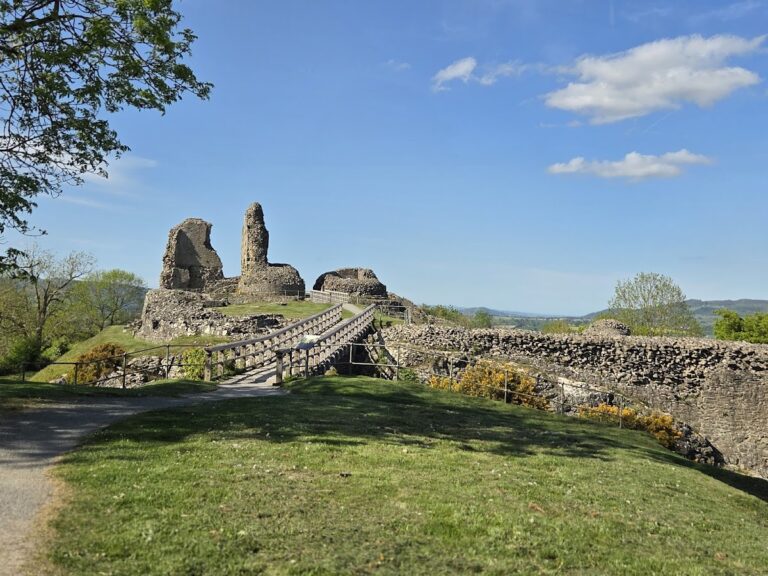
Caus Castle occupies the eastern foothills of Long Mountain at an elevation of approximately 223 metres. The surviving site combines the outer earthworks of a probable Iron Age hillfort with the remains of the medieval Norman fortress. The medieval arrangement centred on a high motte with a very small summit. A tower stood on the summit, while a strongly defended inner bailey formed the principal enclosed area around it.
The tower, keep, and curtain wall were rebuilt in stone in 1198. Later construction supported by the royal grant of 1263 added D-shaped towers to the curtain wall. These remains represent the principal defensive phases of the castle, from its Norman earthwork foundation through its stone rebuilding and later strengthening.
Outer bailey and settlement
The large outer bailey contained the borough that developed beside the castle. Its documented features included St Margaret’s Church, the castle church of St Nicholas, Castle Street, and St Margaret Street. The settlement therefore formed part of the wider fortified complex rather than existing separately from it. A fifteenth-century wooden screen from Caus Castle was later installed at Minsterley Hall, built by the Thynne family in 1581.