Maria am Wasser Church: A Late Gothic and Baroque Church in Dresden


Site at a Glance
- Rating
- 4.8
- Popularity
- Low
- Country
- Germany
- Primary era
- Early Modern
- External website
- Open
- Eras represented
- Medieval, Early Modern, Modern
- Civilizations
- Electorate of Saxony, Holy Roman Empire
- Site type
- Religious
- Remains
- Church
On this page12 sections
History
Maria am Wasser Church is an Evangelical Lutheran church in Hosterwitz, Dresden, Germany, built as a Late Gothic hall church in 1495. Hosterwitz began as a church village about 10 kilometers from Dresden, and the church remains associated with the religious and burial history of the community.
Medieval church and pilgrimage site
Local tradition holds that a wooden church stood in Hosterwitz soon after the area’s Christianization, around 1200. A priest in Hosterwitz is first documented in 1406. Dionysius von Carlowitz, a late-medieval German nobleman and patron, is traditionally credited with financing the present church himself in 1495.
Around 1500, the church received the name Maria am Wasser. Before the Reformation, the small building served chiefly fishermen and boatmen and attracted pilgrims. Its original form was low and short, with a rectangular plan, few windows, and no galleries. The church later became part of the Evangelical Lutheran tradition, the Lutheran branch of Protestant Christianity that developed from the Reformation and centers worship on preaching, scripture, and the sacraments.
Baroque rebuilding and eighteenth-century changes
By the late seventeenth century, the medieval church no longer met the needs of its congregation. During the pastorate of Christoph Rüdinger, who served in Hosterwitz from 1680 to 1724, the parish planned a Baroque remodeling. Baroque architecture is characterized by dynamic forms, elaborate decoration, and dramatic spatial effects. Fundraising began in 1698 for a project estimated to cost 1,700 thalers.
The planned work was interrupted by a violent theft. On 26 August 1702, the gang led by Lips Tullian broke into the church, where the parish funds were kept. The robbers stole the money and valuable church equipment and damaged parts of the building. The gang was captured in 1714 and its members were executed the following year.
The theft delayed the remodeling, which had been planned for 1704. Even after parish debts had been collected, roughly 1,000 thalers remained missing. That amount was borrowed in 1704 and was not fully repaid until 1732. Remodeling nevertheless began in 1704 and gave the church approximately its present form. The work enlarged the altar area, added the Baroque onion-shaped tower roof, and may also have included the sacristy.
Major roof and tower repairs followed in 1741. In 1774, the interior was reorganized substantially. The altar was moved into a newly added chancel, and the pulpit was transferred from the south side and joined to the altar. Parts of the earlier altar were lost during this alteration. The roof was renewed in 1790, with further restoration in 1822 and around 1900.
Modern preservation and parish life
The interior was restored in 1972 and 1973, when its original light-white color scheme was reinstated. Maria am Wasser escaped the bombing of Dresden in February 1945, although an incendiary bomb caused light damage three months later.
The Elbe flood of August 2002 placed the church under approximately two meters of water for several days. Donations and the work of many volunteers supported its restoration, and the church was rededicated on 31 August 2003. The flood severely damaged the organ as well. Its restoration, including reconstruction of the façade, was completed in 2004.
Since 2006, Maria am Wasser has belonged to the Community of the Cross of Nails, an international Christian reconciliation movement that originated in Coventry after the destruction of its cathedral during the Second World War. Together with the Weinbergkirche in Pillnitz, the church serves the Evangelical Lutheran parish of Dresden-Hosterwitz-Pillnitz. Its continuing uses include worship, concerts, and weddings.
The church and churchyard are legally protected monuments. As elements of the Cultural Landscape of the Dresden Elbe Valley, they formed part of the UNESCO World Heritage property from 2004 to 2009.
Churchyard and commemorated people
A churchyard probably existed from the time of the first Hosterwitz church, and it functioned as a village burial ground from around 1500. From 1734, a shortage of graves restricted burials there to members of the electoral court and parish pastors. A second cemetery was established west of the church in 1734, but frequent flooding led to its abandonment in 1867 and secularization in 1896. Since 1870, burials in Hosterwitz have taken place mainly in a third cemetery near Keppschloss.
The churchyard remains associated with several figures from Dresden’s artistic, intellectual, and religious history. It contains the grave monument of Christoph Ferdinand von Brandenstein, a silver page who drowned in the Elbe in 1788. A silver page was a court servant responsible for silverware and ceremonial service. Other burials include the architects Kurt Bärbig and Rolf Göpfert, the artists Wanda Bibrowicz, Irma Lang-Scheer, Ludwig von Hofmann, Heinrich Klemm, and Max Wislicenus, the writer Julius Hammer, the professor Ernst Alfred Mühler, and the pianist Amadeus Webersinke.
A plaque on the church’s exterior wall commemorates the former grave of the composer Julius Reubke. Created by Ole Göttsche, it was installed in 2015; Reubke’s grave itself no longer survives. Inside the church, a memorial plaque recalls Lieutenant Colonel Georg Wilhelm Trosche, who was first buried in the old Frauenkirche in 1694 and later reinterred in the Hosterwitz church crypt after that church was demolished. Abraham Steinbach, the Pillnitz palace preacher, was buried at Maria am Wasser in 1638. A monument commemorates Rosina Rüdinger, the first wife of Pastor Christoph Rüdinger, who died in 1641 at the age of 28.
Maria am Wasser is distinct from the nearby Catholic chapel Maria am Wege. That chapel was formerly the private chapel of the Wettin family beside the Hosterwitz royal summer villa.
Remains
Exterior and layout
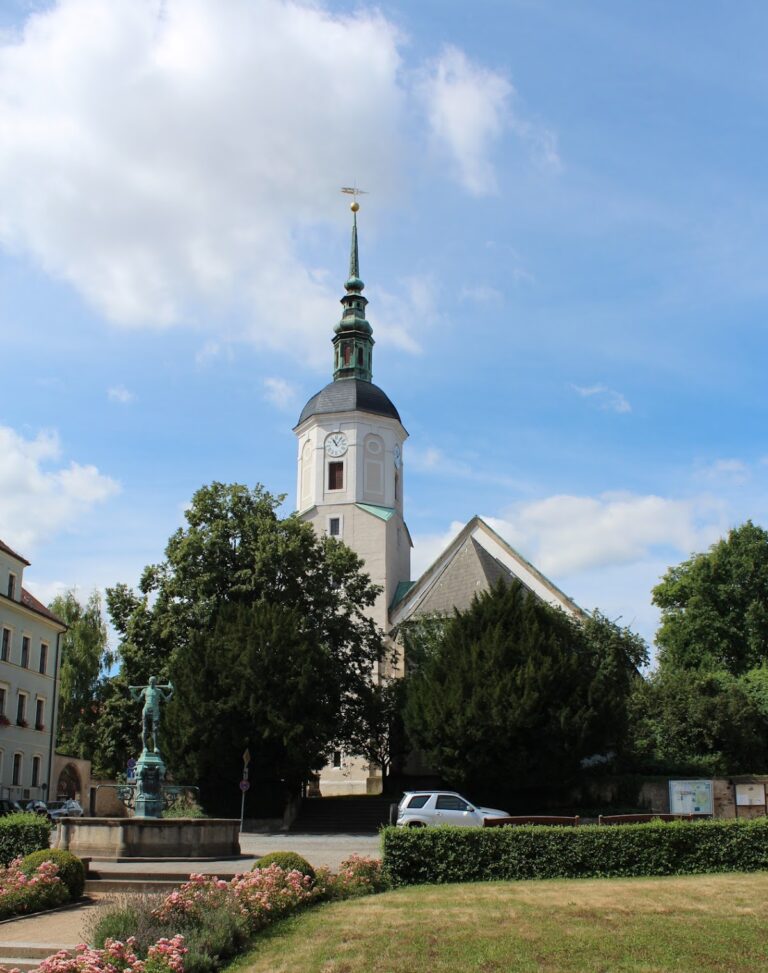
Maria am Wasser has a simple yellow exterior with white architectural accents. Plain pilaster strips mark the corners and continue upward into a strong main cornice. The principal entrance is on the north side, where a segmental-arched doorway has a frame decorated with a frieze of oak branches. Its keystone carries the inscription “JESUS,” and a colored crown rises above the entrance. An older round-arched doorway on the south, Elbe-facing side has been bricked up.
The church is a unified hall interior with a flat ceiling set above a high cove and a substantial cornice. Two-storey galleries from the first half of the eighteenth century occupy the north and south sides. Heavy, plain columns support them, while their parapets are divided into rectangular panels. The altar and font stand at the east end opposite the west organ gallery, and the church provides seating for 382 worshippers.
Bell tower and galleries
At the west end, an eight-sided bell tower rises above the gable. Its heavy Baroque forms lead through a concave transition to an onion-shaped roof, a characteristic Baroque tower termination influenced here by southern Baroque architecture. A weather vane crowns the tower, which reaches 27 meters in height. Three of the four bells were cast by Rincker in 1993. The four bronze bells hang in a frame fitted with oak yokes.
The west end originally held a two-storey gallery. The upper level contained the Grabner organ, while the lower level held glazed prayer boxes used by Herr, the owner of the Plantagengut estate. A double external staircase served the lower gallery. In 1863, the prayer boxes were removed to make room for a larger organ, and the present single-storey organ gallery was built. The external staircase was demolished in 1896, when a small vestibule was added at the west end.
Altar, pulpit, and baptismal fonts
Conrad Buchau created the sandstone altar in 1644. Its move into the chancel in 1774 brought it together with the wooden pulpit in a single pulpit-altar, a liturgical composition combining an altar with an elevated preaching platform. The probable central Crucifixion section was destroyed during the change. A relief of Jonah being spit out by the whale survives on the north wall of the altar area, while a high relief of the Last Supper occupies the predella, the lower section of an altarpiece often used for reliefs or painted scenes.
The crowning figure of Christ carrying a banner of faith was also considered part of the older altar around 1900. Seated figures of the Evangelists Mark and Matthew formerly stood near the gable above the pulpit, and statues of Simon Peter and John stood on consoles beside the columns framing it. The pulpit is two meters wide and seven meters high, with a basket divided into uniform panels. The portico pulpit-altar was renovated and partly renewed in 1930. All altar figures except the crowning Christ were removed, and the keystone from the former pulpit door, dated 1774, is now kept in the sacristy.
The older baptismal font probably dates from around 1500. Its Gothic basin is decorated with tracery, measures 53 centimeters in diameter and 30 centimeters in height, and rests on a supporting stem approximately 50 centimeters high. Although it has not been used since 1860, it was restored and returned to the church. The font now used was made in 1796 in the Empire style by a sculptor named Dost for the church in Lichtenstein. It stands on gilded lion claws and has putto heads on its basin. After its later restoration and transfer to Hosterwitz in 1930, it became the working font.
Windows and memorials
The side windows are basket-arched and have deep internal reveals, preserving a feature of the pre-Baroque arrangement. In 1774, substantial surrounds with keystones were added and later painted white. The three windows in the altar area also have deep reveals. Two large stained-glass windows date from 1896, while a small window image from 1555 depicts the Crucifixion.
A portrait of Pastor Gottfried Rüdinger in the altar area was painted in tempera and overpainted in oil after his death in 1680. Its elaborate wooden frame is painted green and gold, with laurel garlands overlaid by vine leaves. A sandstone drapery below the portrait carries Rüdinger’s life dates.
Beside the sacristy door stands a sandstone grave slab for a Bohemian religious exile who died in Hosterwitz in 1660. Farther west is the memorial plaque for Georg Wilhelm Trosche. On the south side, beneath the galleries, is Abraham Steinbach’s gravestone, inscribed “AS 1638.” Rosina Rüdinger’s sandstone monument measures 80 centimeters wide and 173 centimeters high. It depicts Christ on the cross with a kneeling woman at its foot, her hands resting against the cross.
Organ and musical history
The first recorded Hosterwitz organ was a small portable instrument in use around 1635. Under Pastor Gottfried Rüdinger, a replacement was commissioned from the organ builder Christian Grabner in 1680 and completed by 1682. It had eight manual stops and three pedal stops and remained in use until 1863, although it required repairs, particularly after the remodeling of 1704.
The present organ was commissioned from Urban Kreutzbach in 1862 and installed in 1863. Its façade displays 82 pipes in eight fields, while the instrument contains 970 pipes across 18 stops, with two manuals and a pedal. The original tin pipes were removed in 1917 for melting as part of a national metal collection and replaced with zinc pipes in 1926. Flood damage in 2002 led to restoration in 2004.
Churchyard monuments
The churchyard covers approximately 0.15 hectares, or 1,500 square meters, and contains about 150 graves. Two round-arched gates provide entry from the north. Among its surviving monuments is the substantial sandstone memorial to Christoph Ferdinand von Brandenstein. An inscribed column supports a weeping boy, who leans his right arm on a vessel pouring out water and lowers the torch of life into the water with his left hand.
A reproduction of an epitaph for the tame capuchin monkey Schnuff is concealed on the churchyard’s southwest outer wall. Schnuff was associated with the composer Carl Maria von Weber, and the original epitaph was made by the sculptor Joachim Zehme.