Cathedral of San Siro: Sanremo’s Romanesque-Gothic Co-Cathedral


Site at a Glance
- Rating
- 4.5
- Popularity
- Medium
- Country
- Italy
- Primary era
- Medieval
- Eras represented
- Medieval, Early Modern
- Civilizations
- Genoese
- Site type
- Religious
- Remains
- Cathedral
On this page13 sections
History
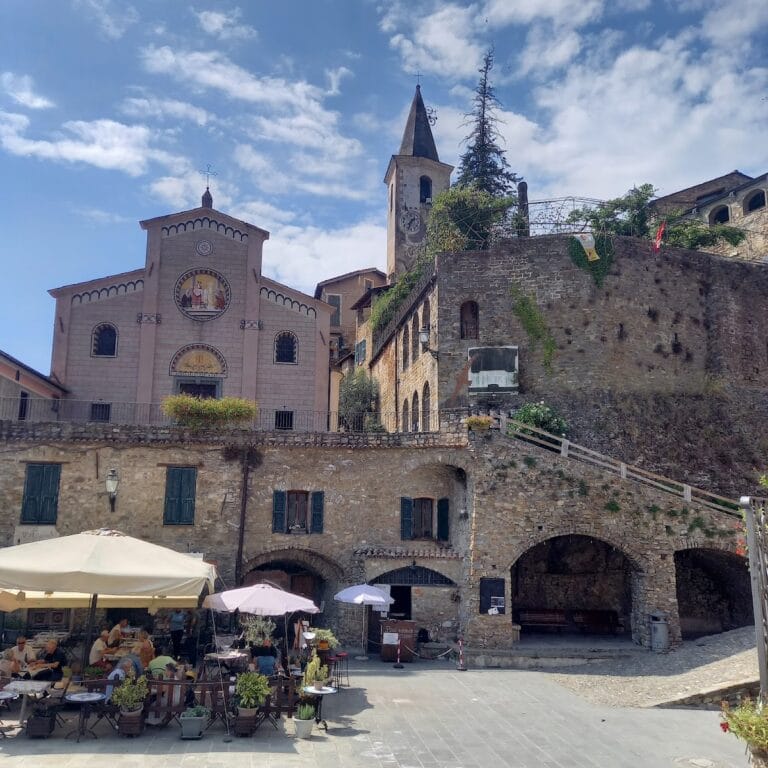
The Cathedral of San Siro is a Roman Catholic church in Italy, built by the medieval Magistri Comacini at the beginning of the twelfth century in a Romanesque-Gothic style. Standing in Sanremo’s historic center, it is the city’s oldest religious building and is dedicated to Saint Syrus of Genoa, a Christian bishop later venerated as a saint. The church belongs to the Diocese of Ventimiglia-San Remo and is also known as the Distinguished Basilica Collegiate Co-Cathedral of San Siro.
Early Christian and medieval origins
Local tradition places the first Christian church on this site in 811, where Bishop Syrus of Genoa was believed to have celebrated Mass. Saint Romulus of Genoa, a Christian saint traditionally associated with Liguria, was also thought to have been buried there for a time. The present medieval church was erected at the beginning of the twelfth century, and its existence is confirmed by written records drawn up by Sanremo’s municipal council in 1143. Its consecration took place during the same century.
The church became the setting for an important political ceremony on 6 June 1297. On that date, Jacopo da Varagine, the archbishop of Genoa and a medieval chronicler, formally transferred rights over Sanremo to the Doria and De Mari lordships. These prominent Genoese families controlled the city until 1319.
Collegiate church and seventeenth-century transformation
In 1530, the church was raised to the status of a distinguished collegiate church, meaning that it was served by a chapter of clergy. Fourteen years later, corsairs serving Khayr al-Din Barbarossa, an Ottoman corsair and admiral active in the Mediterranean, landed near Sanremo while seeking provisions. They raided the collegiate church, but the valuable objects had already been concealed within the city walls. The altar was destroyed.
Between 1619 and 1668, alterations to the Romanesque apses and presbytery changed the character of the medieval building. These works gave the church a Baroque appearance, the result of a later architectural style associated with the period. The transformation remained visible until the restoration campaign of the twentieth century.
Bombardment, revolt, and rebuilding
On 30 September 1745, a British naval formation commanded by Admiral William Rowley bombarded Sanremo. Part of the church roof and facade collapsed in the attack. Further upheaval came in 1753, when the bell known as “Bacì” summoned the citizens to revolt against the Republic of Genoa. After the revolt was suppressed, the Genoese commander Agostino Pinelli ordered the bell tower demolished as punishment.
The bell was carried to Genoa as war booty and displayed in the Palazzo Ducale. It returned to Sanremo in 1784 in broken pieces, while the bell tower was rebuilt in the prevailing Baroque style. The church’s exterior walls also suffered damage from soldiers’ campfires during the French Revolution.
Twentieth-century restoration and status
A campaign to recover the church’s Romanesque appearance began in 1901, after the municipal council approved the project prepared by engineer Antonio Capponi in 1898. Work stopped for lack of funds in 1902, resumed from 1926 to 1930, and was later delayed by disagreements about restoration methods. It restarted in 1947 and officially ended in 1948. Baroque additions were removed, valuable Baroque stuccoes were restored, and plaster was stripped from the naves. A commemorative plaque was placed on the church wall.
The restoration addressed both the medieval fabric and damage from later conflicts. The Baroque covering of the facade was demolished, and the Romanesque facade was restored where possible and reconstructed where necessary. The naves and roof were repaired between 1926 and 1930, with red larch used for the nave work and slate from Molini di Triora for the roof.
The bell tower presented a separate problem. A bombing raid in October 1944 left it seriously damaged and unstable. The restoration team debated whether to preserve its Baroque appearance or return it to a Romanesque design. The Baroque form was retained because of a 1940 directive from the Ministry of National Education and because that solution cost less. In 1947, the church became a minor basilica, an honorific status granted by the Catholic Church. In 1975, it also became a co-cathedral, sharing the cathedral status of the diocese with another cathedral.
The Black Crucifix tradition
The Black Crucifix is connected with a local miracle tradition dating to 7 August 1543. Shortly before a battle against a threatened Saracen raid, the crucified Christ was said to have radiated light and smiled benignly at the podestà Luca Spinola. Sanremo’s militia, led by Spinola, then defeated the Saracens near Verezzo in the Battle of Parà. Some traditions hold that the crucifix was carried into the battle as a standard.
Remains
Medieval church fabric
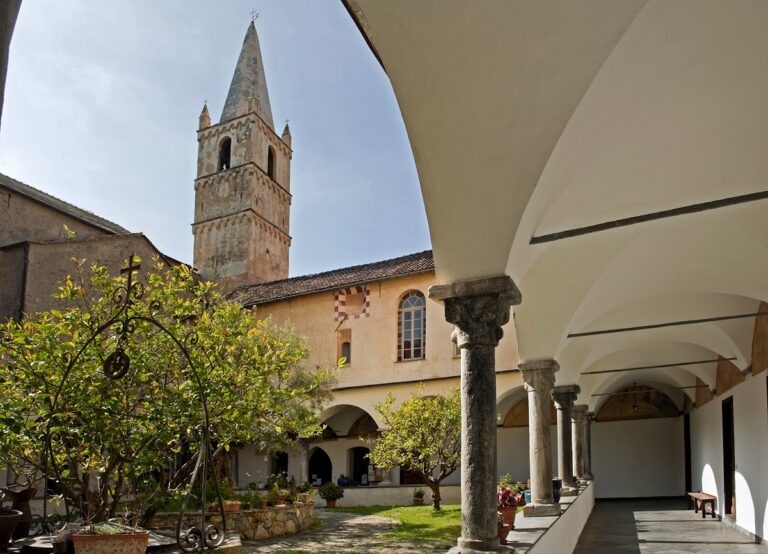
The surviving building is organized around Romanesque naves, a presbytery, three medieval apses, a facade, lateral entrances, and a separate bell tower. The church is regarded as one of the principal examples of Romanesque architecture in western Liguria, although its medieval structure acquired a substantially Baroque appearance before the modern restoration campaign. The naves retain their restored red-larch work, while the roof is covered with slate from Molini di Triora.
Lateral doors
The two lateral doors, including their bas-reliefs, are considered the oldest surviving parts of the church. Their sculptures were made by an unknown artist and were probably produced by stone-working marmorari, craftsmen who specialized in marble and other worked stone. The relief on the left door shows a donkey between two date palms, with a bishop’s cross behind it. On the right door, the Virgin and Child appear between Bishops Syrus and Romulus of Genoa.
A caper plant growing from the right-hand door gave it the traditional name “Caper Door.” Its abundant flowering was regarded as a sign of a fortunate year. The plant was removed in 1987 because it threatened the door’s stability; at that time, the door was estimated to be approximately three hundred years old.
Apses and earlier foundations
The three apses preserve medieval sections that were uncovered during work in 1975 after having remained concealed beneath plaster applied in 1948. Restoration of the bell tower in 1948 also revealed foundations and remains of an earlier church beneath it, dating from before the year 1000. These remains included a small apse made of white lime, positioned slightly below the main arch and oriented toward San Germano.
Bell tower and interior sculpture
Bell tower
The original form of the bell tower is unknown. It was probably built of exposed stone and was likely no more than slightly higher than the main body of the church. The present tower retains its Baroque appearance and contains twelve bells cast by Enrico Picasso and Bernardo Zam.
Crucifixes and devotional sculpture
Near the high altar are a life-size Crucifix and a statue of Our Lady of the Rosary by Anton Maria Maragliano, an Italian sculptor known especially for religious wooden sculpture. The statue shows the seated Virgin holding the Child, who offers a bunch of grapes to an angel.
The Black Crucifix, probably made in the fifteenth century by an unknown artist, stands in the right nave. It was regarded as a source of moral support for Sanremo’s population during difficult times, and its place within the church preserves the connection between the object and the local tradition surrounding the Battle of Parà.