Castello della Lucertola: Feudal Castle of Apricale, Italy

Site at a Glance
- Rating
- 4.4
- Popularity
- Low
- Country
- Italy
- Primary era
- Medieval
- External website
- Open
- Eras represented
- Medieval, Modern
- Civilizations
- Unclassified
- Site type
- Military
- Remains
- Castle
On this page9 sections
History
Medieval foundation and Doria rule
Castello della Lucertola is a feudal castle in Apricale, Italy, probably erected in the tenth century by the Counts of Ventimiglia as a defensive post protecting the settlement. The Counts were a medieval noble dynasty whose territories extended through western Liguria and the neighbouring Alpine region. The castle’s name means “Castle of the Lizard,” although the origin of the place-name remains uncertain.
The castle later came under the control of the Doria family, a prominent Genoese aristocratic house that ruled Dolceacqua and held extensive influence in Liguria. Successive alterations strengthened the building and transformed it into a fortress regarded as impregnable.
The siege of 1523
In 1523, Bishop Agostino Grimaldi captured the castle during a siege. He attacked in an effort to seize Bartolomeo Doria, who had taken refuge inside and was held responsible for the murder of Agostino’s brother. The assault partially destroyed the fortress. It was rebuilt afterward, but with less extensive military functions than before.
From Savoy property to private residence
Castello della Lucertola became the property of the Duchy of Savoy in 1634. This was a European dynastic state whose rulers controlled territories in the western Alps and later much of northwestern Italy. The castle returned to Francesco Doria in 1652. In 1806, the Doria family sold it to Stefano Cassini for 3,400 Genoese lire, after which Cassini converted the former fortress into a private residence.
During the twentieth century, Fruttuoso Cassini, a surgeon and heir to the castle, created two apartments inside the building. He later commissioned the painter Leonida Martini to decorate their interiors with frescoes, wall paintings made on fresh plaster so that the pigments become integrated with the surface. Cassini also created a roof garden and built a new retaining wall on the side facing the church.
Museum and civic cultural centre
After a period of abandonment, the castle passed to the Municipality of Apricale. It is now used for exhibitions, conferences, theatrical performances, and other cultural events, and houses the Museum of the History of Apricale. The building was recognized as Italian national heritage in 1933.
The museum contains seven thematic rooms with historical documents, archaeological materials, Renaissance memorabilia, and Apricale’s medieval statutes dated 1267. Its displays also include material concerning Emma Cristina Bellomo Della Torre, known as the “Countess of Apricale.” She was associated with political affairs involving France, Japan, and Russia, including the court of the Romanovs, the ruling dynasty of the Russian Empire until 1917.
Remains
Fortified position and surviving tower
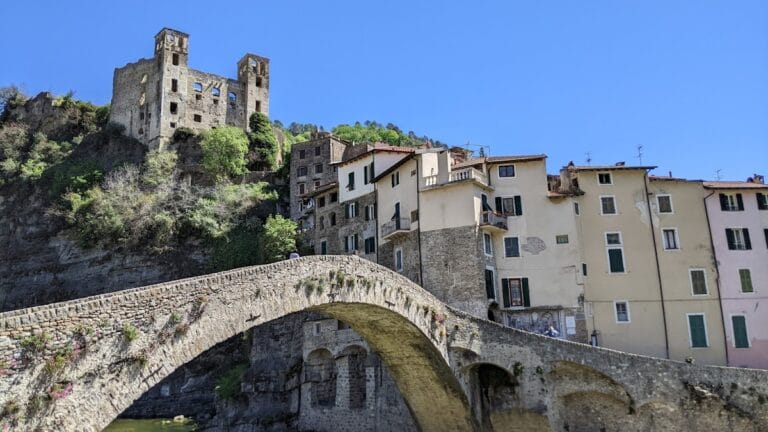
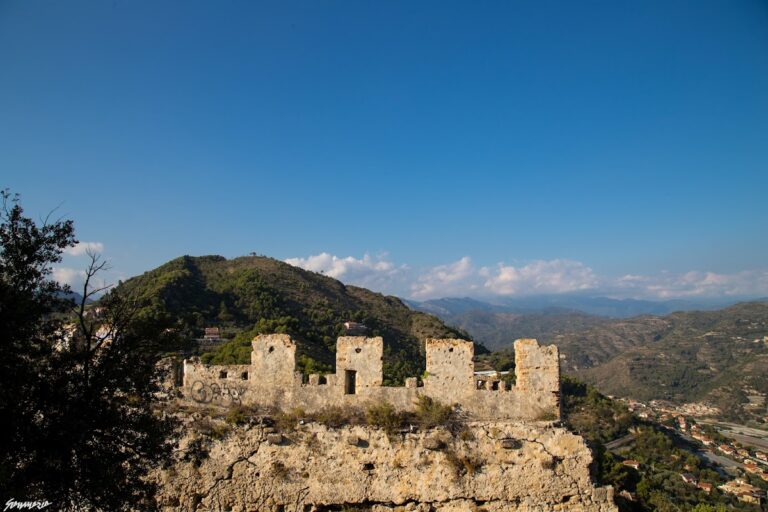
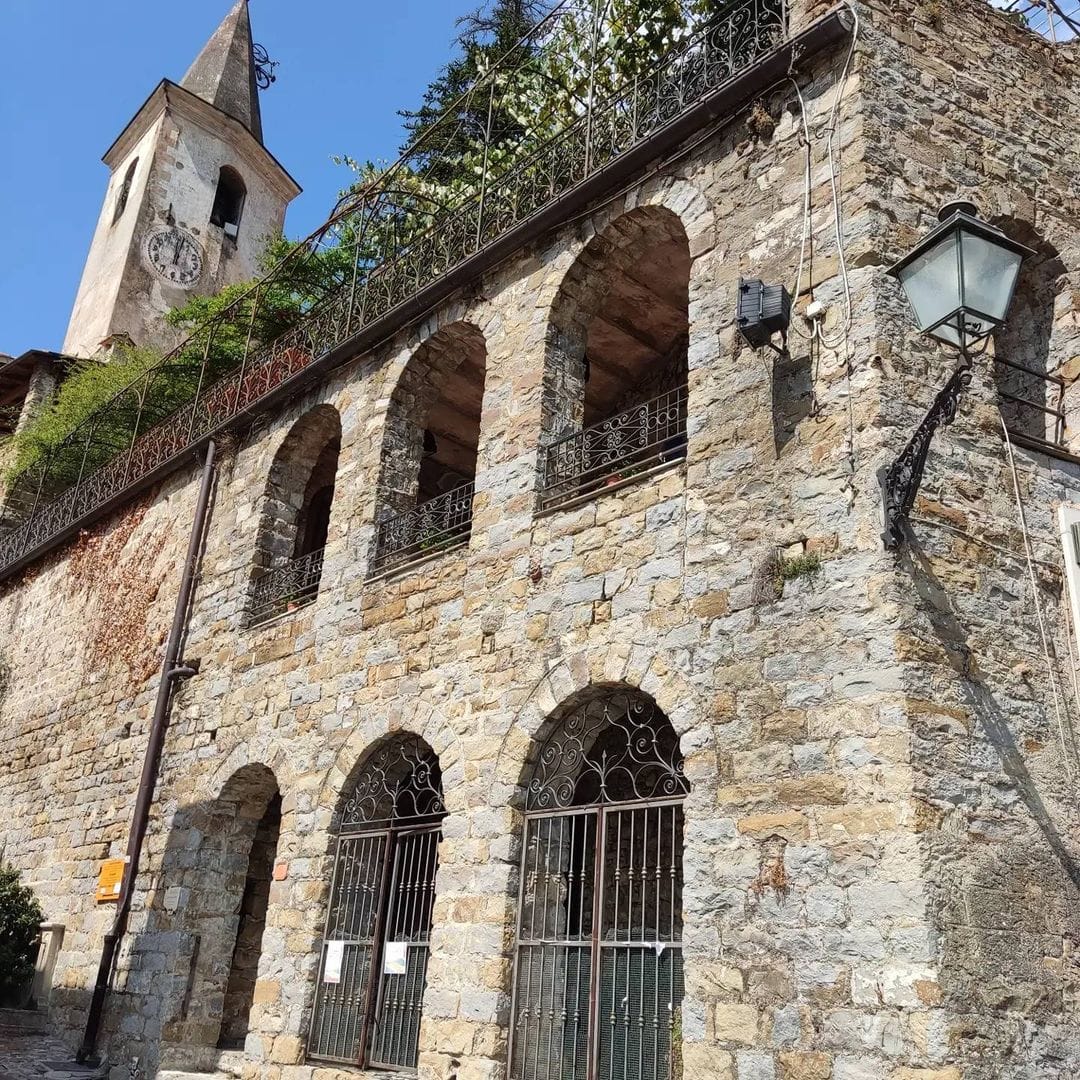
Castello della Lucertola occupies a rocky spur in Apricale’s historic village, between Piazza Vittorio Emanuele and Via al Castello, beside the Church of the Purification of the Virgin Mary. The position overlooks the saddle below. The original castle had two square towers and closely resembled the castle at Dolceacqua. One tower survives and was later converted into the bell tower of the adjoining church. The rest of the fortress reflects the partial destruction of 1523 and its subsequent reconstruction for more limited military use.
Residential alterations and roof garden
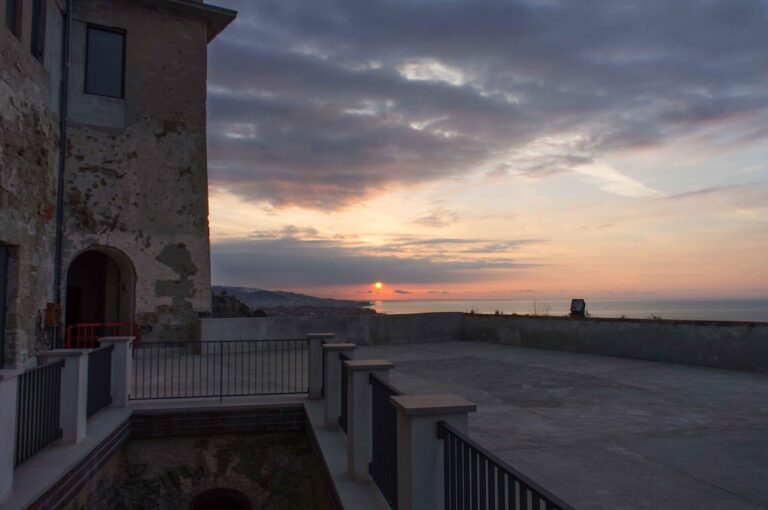
Twentieth-century work altered the internal arrangement by creating two apartments within the historic castle. Their rooms were later decorated with frescoes by Leonida Martini. The complex also includes a roof garden, a planted garden on a roof or raised terrace, and a retaining wall constructed toward the church. Sculptural installations by François Bouché and Georges Boisgontier are placed in the garden.
Theatre Gallery and museum collections
A corridor enclosed by the castle’s historic walls contains the Theatre Gallery. Created in collaboration with Genoa’s Teatro della Tosse company, it displays posters for cultural events held in the village from the 1990s onward. The gallery also preserves silhouettes of Tarot figures created by the Genoese artist Emanuele Luzzati.
Within the castle, the Museum of the History of Apricale preserves archaeological materials, historical documents, Renaissance memorabilia, and the medieval statutes of Apricale dated 1267. Together, these collections present the history of the settlement alongside the surviving spaces and later cultural uses of the fortress.