Fortaleza de Castrizán: A Fifteenth-Century Galician Fortress


Site at a Glance
- Rating
- 5
- Popularity
- Very Low
- Country
- Spain
- Primary era
- Medieval
- Eras represented
- Medieval
- Civilizations
- Crown of Castile
- Site type
- Military
- Remains
- Castle
On this page9 sections
History
Fortaleza de Castrizán is a Galician fortress in Spain, located at O Viso in the municipality of Redondela, Pontevedra. It was built between August and September 1477 on the orders of Alonso II de Fonseca, Archbishop of Santiago, to control the bishopric and pressure Pedro Madruga, Count of Camiña and owner of nearby Sotomayor Castle.
Construction during a political conflict
The fortress arose during a struggle between Pedro Madruga and Alonso de Fonseca. Pedro Madruga was the byname of Pedro Álvarez de Sotomayor, a Galician nobleman associated with the Portuguese nobility and Infanta Juana la Beltraneja. Fonseca, a senior church leader, was politically aligned with the Crown of Castile. The new stronghold on Monte de Peneda therefore served both as a military position and as an instrument of pressure against Madruga.
Assault and demolition
Several months later, between 1478 and 1479, Pedro Madruga attacked the fortress after his imprisonment in Castile. A nighttime assault by the count and 400 soldiers confronted Álvaro de Varcea, an ally of the archbishop. The siege ended with the demolition of Fortaleza de Castrizán.
Reuse after the fortress was destroyed
Stone and other debris from the demolished castle were later reused in private buildings in O Viso. The Chapel of Our Lady of the Snows was probably also built with material taken from the fortress, linking the surviving chapel on the summit of Monte de Peneda with the site’s later history.
Remains
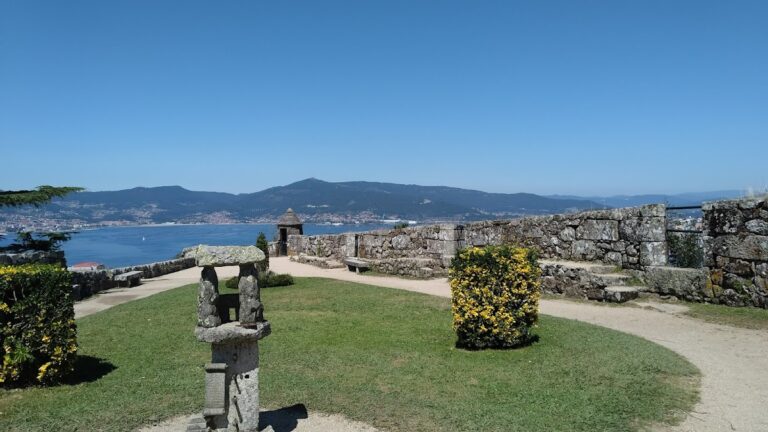
Fortaleza de Castrizán occupied the summit of Monte de Peneda, a small mountain peak 329 metres high. Its elevated position commanded the surrounding plain and provided broad views over the Vigo estuary, the Cíes Islands, the San Simón inlet, and the territories around Sotomayor Castle. The fortress was probably built from stone quarried on the mountain and enclosed by a defensive wall.
Fortified enclosure
Wall, battlements, and barbican
The enclosure included a defensive wall with battlements and a barbican, an outer structure protecting an entrance or vulnerable approach. These elements formed the castle’s principal defensive perimeter on the mountain summit.
Keep
A keep, the main fortified tower and command position within a castle, stood inside the enclosure rather than forming part of the wall. Its separate position was intended to allow control over the entire perimeter, including ground around the wall that was not completely protected from attack. The base of the keep is among the limited original remains visible today.
Chapel and reused stone
The Chapel of Our Lady of the Snows remains standing on the summit of Monte de Peneda. It was probably constructed with stone reused from Fortaleza de Castrizán, whose surviving physical fabric is otherwise ruinous and limited.
Nearby sites