Castle of Santa Cruz of A Guarda: A Cross-Border Fortress in Spain


Site at a Glance
- Rating
- 4.1
- Popularity
- Low
- Country
- Spain
- Primary era
- Early Modern
- External website
- Open
- Eras represented
- Early Modern
- Civilizations
- Spanish
- Site type
- Military
- Remains
- Fort
On this page8 sections
History
Construction and the Portuguese Restoration War
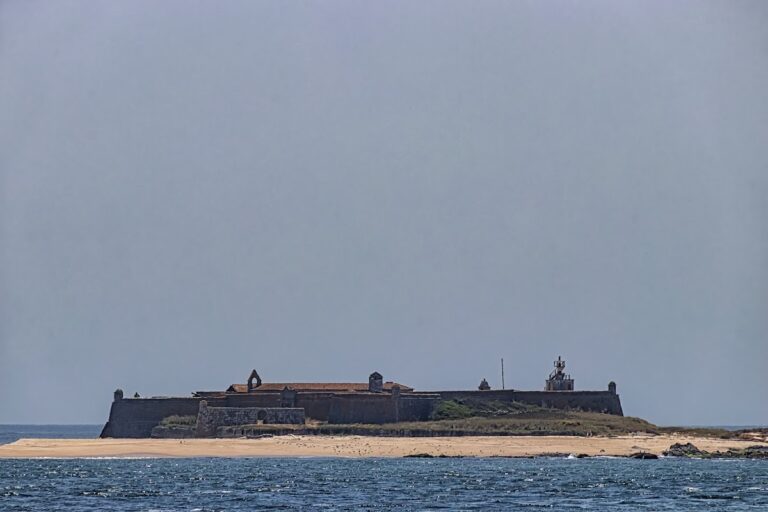
The Castle of Santa Cruz of A Guarda is a stone fortress in Spain, built by Spanish forces around 1664 as part of the defensive network along the lower Miño River. It was constructed during the Portuguese Restoration War, the conflict that followed Portugal’s 1640 revolt against Spanish rule and ended with recognition of Portuguese independence in 1668. The fortress formed a defensive bastion against a possible Portuguese advance.
Construction proceeded rapidly, and materials included stones taken from the medieval town wall. In 1665, the Portuguese army commanded by João Manso besieged the fortress for eight days and used mines to breach its walls. The garrison comprised a tercio, a Spanish infantry formation used in early modern warfare, numbering 500 men, together with 400 local residents and militiamen. Portuguese forces then occupied the fortress until 1668, when the Treaty of Lisbon established the Miño River as the border between Spain and Portugal and led to their withdrawal.
Abandonment and later use
After it fell out of military use and was abandoned, the fortress passed into private ownership during the nineteenth century. Its enclosure was subsequently adapted for industrial purposes, including use as a sausage factory and a ceramics factory.
The fortress was declared an Asset of Cultural Interest in 1995, after which ownership passed to the municipality of A Guarda. Restoration preceded its opening to the public in 2013. A purpose-built interpretation centre was installed within the enclosure to explain the network of cross-border fortresses along the lower Miño.
Remains
Fortified enclosure
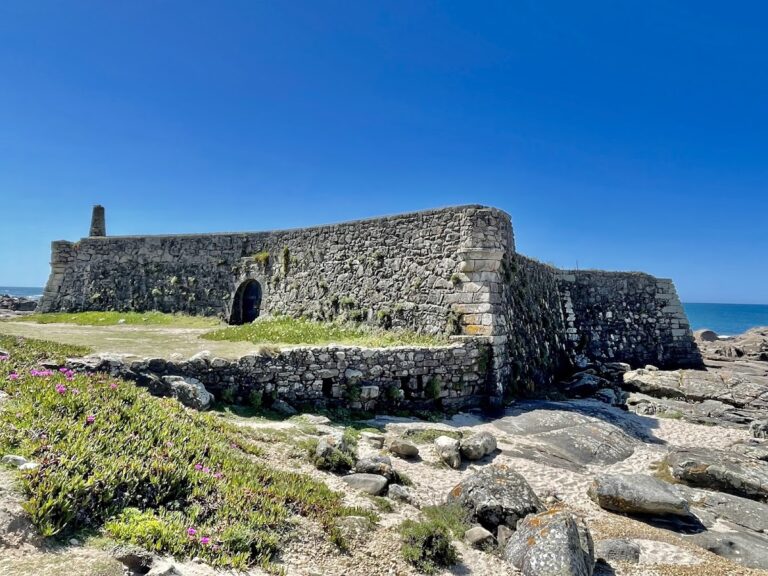
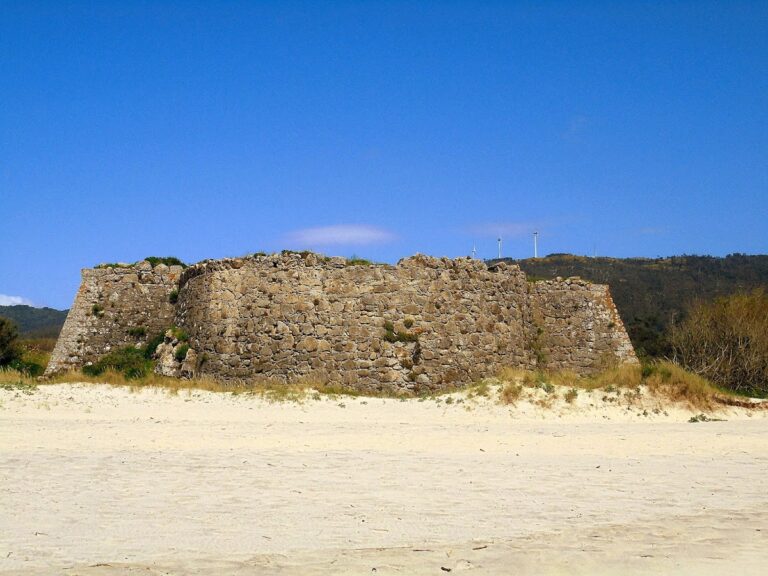
The enclosure occupies a rocky hill 73 metres above sea level, a short distance from the coast on the route from A Guarda toward Baiona. Its trapezoidal plan is defined by a surrounding wall and moat, a defensive ditch around a fortification. Later agricultural use has made the moat only partly perceptible.
Entrances
Two entrances provide access through the defensive enclosure: the Puerta de la Villa and the Puerta del Socorro.
Corner bastions
Four bastions, projecting parts of a fortification designed to permit defensive fire along the walls and across the surrounding ground, occupy the corners. They are the Baluarte de la Cruz, Baluarte de San Sebastián, Baluarte de Santa Tecla, and Baluarte de la Guía. Each contains circular sentry boxes, small covered guard positions, built in ashlar masonry and protected by vaulted roofs.
Interior grounds
The interior is landscaped with several tree species, notably camellias and eucalyptus. A botanical garden was planned but never fully completed. Some trees were planted, many in poor condition, and little taxonomic identification was provided for them.
The interior esplanade contains the interpretation centre dedicated to the cross-border fortresses of the lower Miño region.