Castle of San Julián: A Historic Fortification Guarding Cartagena’s Port


Site at a Glance
- Rating
- 4.6
- Popularity
- Low
- Country
- Spain
- Primary era
- Modern
- External website
- Open
- Eras represented
- Early Modern, Modern
- Civilizations
- English, Spanish
- Site type
- Military
- Remains
- Castle
On this page7 sections
History
Castle of San Julián is a historic military fortification in Cartagena, Spain, built on San Julián Mountain to protect the entrance to the city’s port. The mountain had already demonstrated strategic value for defending Cartagena before the present castle took shape.
From the War of the Spanish Succession to the nineteenth century
During the brief Austrian occupation of Cartagena in the War of the Spanish Succession, the early-eighteenth-century conflict over the Spanish monarchy, English forces commanded by Admiral John Leake built a cylindrical tower on the mountain in 1706. After the Bourbon victory associated with Philip V, construction and remodeling of the castle began around this tower.
The fortification developed through several later building phases. Construction records place additional works in 1796 and in 1812 and 1813. A further program followed an architectural project dated 12 July 1866, with works carried out between 1866 and 1869. Reforms continued until 1883, when the long process of creating the present castle was completed. Manuel Jácome y Bejarano is identified as the architect of the 1866 project.
Prison, rebellion, and military conflict
San Julián also became associated with political imprisonment. The liberal military officer and former guerrilla Juan Palarea y Blanes was held there after being accused of involvement in the 1841 pronunciamiento, a military declaration or uprising intended to force political change. He died at the castle in 1842, in circumstances that remained unclear to some observers.
During the Cantonal Rebellion, a federal republican uprising in Spain in 1873 and 1874, the fort was renamed “Froilán Carvajal” in honor of a martyr of the federal republican movement. On 10 January 1886, followers of the same movement led by Antonete Gálvez seized San Julián. When military governor Luis Fajardo approached to negotiate, they mortally wounded him.
An accidental explosion in the powder magazine on 20 May 1898 killed ten soldiers. During the Second Republic and the Civil War, the castle served as a military prison for members of the armed forces imprisoned for participation in different uprisings. Those held there included José Cavalcanti and Miguel García de la Herrán after the failed 1932 military coup known as the Sanjurjada, and Enrique Pérez Farrás and Fernando Condés after the Revolution of 1934.
Twentieth-century reuse and heritage status
Under Francisco Franco’s dictatorship, which ruled Spain from 1939 to 1975, the castle again served a penitentiary function. Between April and November 1939, it formed part of the concentration-camp complex operated by Francoist repression in Cartagena.
Ownership later passed from the Ministry of Defence to Telefónica. Parts of the castle were then used for telecommunications equipment and antennas shared with Radio Nacional, Spain’s national public radio service, the National Police, and other users. Castle of San Julián was declared a Spanish Asset of Cultural Interest, classified as a historic monument, on 7 August 1997. It was added to the Heritage Red List on 27 May 2021 and identified there as “castillo-san-julian.”
Remains
Mountain fortification
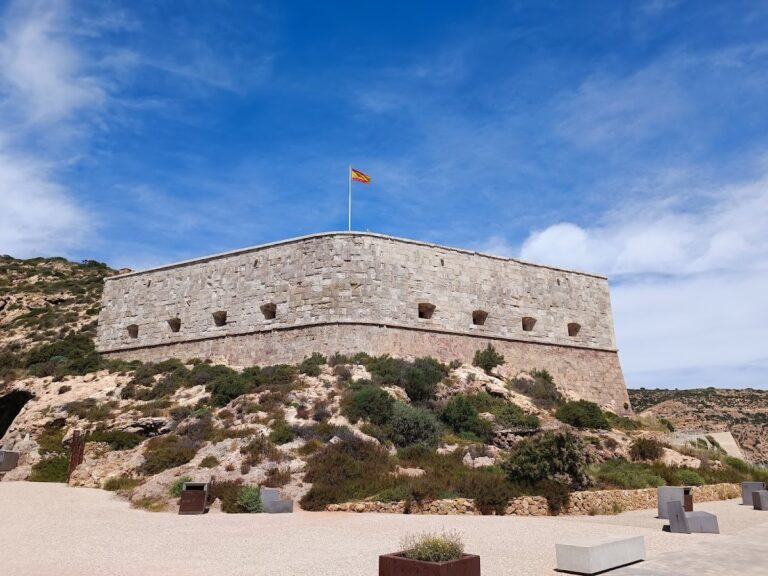
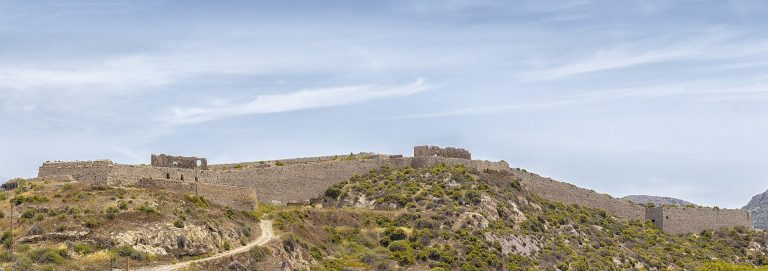
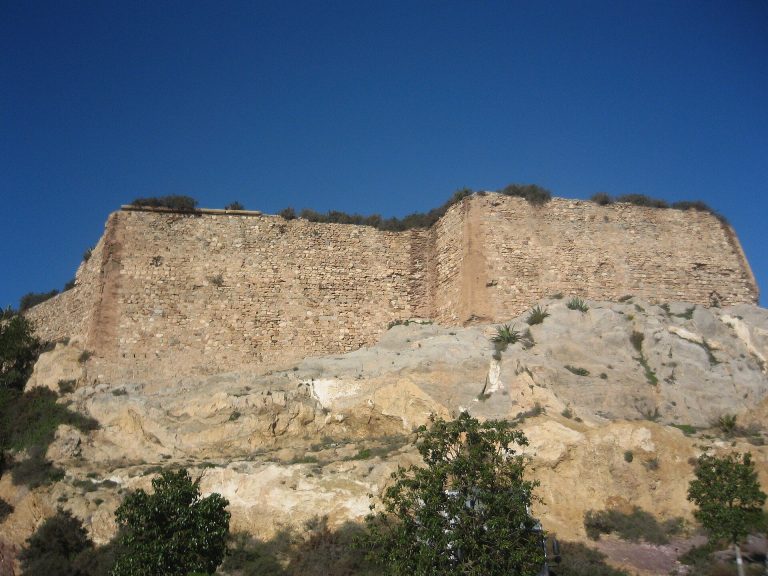
Castle of San Julián occupies San Julián Mountain at an elevation of approximately 293 metres above sea level. Its position and construction were intended to defend the entrance to Cartagena’s port. The present fortification grew around the cylindrical English tower built in 1706, incorporating later works and reforms into a larger defensive complex.
The castle has an eclectic neoclassical treatment associated with the French-influenced Spanish school. This architectural language appears on the northwest, northeast, and southern fronts. The eastern front has a polygonal configuration and includes a caponier, a covered defensive passage or projecting work used to protect a ditch or the approaches to a fortification.
Entrances and defensive fronts
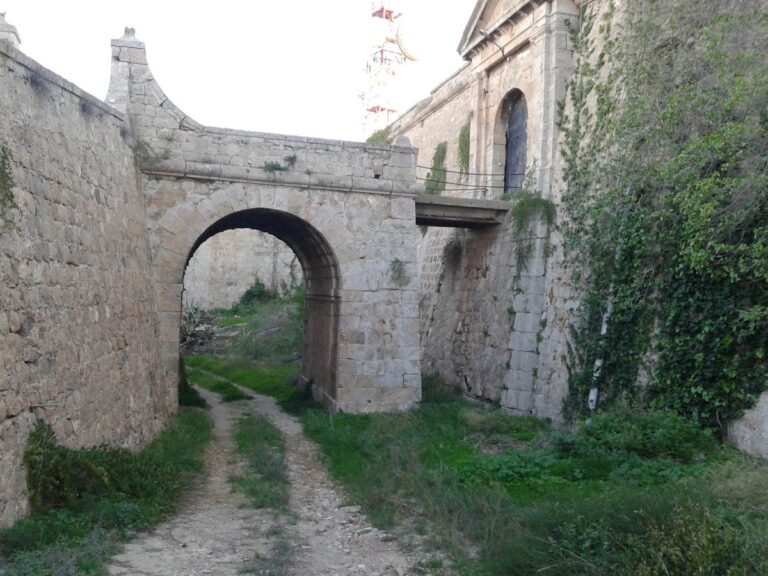
The southwest front protects the entrance and drawbridge through a tenaille system, a projecting V-shaped defensive arrangement placed before the main fortified front. It has two orders of fire, meaning two levels or lines from which weapons could be used in defence. Telecommunications equipment and antennas occupy parts of the castle alongside installations associated with Radio Nacional, the National Police, and other users. The site is identified as being in a threatened or endangered condition.