Castle of Los Moros: An Eighteenth-Century Defensive Work in Cartagena


Site at a Glance
- Rating
- 3.8
- Popularity
- Very Low
- Country
- Spain
- Primary era
- Early Modern
- Eras represented
- Early Modern
- Civilizations
- Spanish
- Site type
- Military
- Remains
- Fort
On this page5 sections
History
Strategic Hill and Bourbon Defense
Castle of Los Moros is an eighteenth-century military fortification in Cartagena, Spain, built between 1773 and 1778 in the Neoclassical style of the French-influenced Spanish school. Its construction formed part of the military improvements carried out in Cartagena during the reign of Charles III, King of Spain from 1759 to 1788. The castle was designed by the military engineer Juan Martín Cermeño, while the works were directed by Mateo Vodopich.
The hill had already served as a defensive position before the castle was built. During the War of the Spanish Succession, an early-eighteenth-century conflict over the Spanish throne, artillery supporting Philip of Anjou used the hill in 1706. Under the command of the Duke of Berwick, a French-born commander serving Philip, the artillery helped end resistance from supporters of the Austrian claimant at the nearby Castle of La Concepción.
The later fortification was intended to protect Cartagena’s bastioned front, a fortified section with angular projections that allowed overlapping defensive fire, around the Naval Hospital and the San José Gates. The gates were one of the city’s three monumental entrances. By this period, Cartagena had been reduced to its old town enclosed by the walls constructed under Charles III.
Transfer and Deterioration
On 19 June 1921, the War Ministry transferred the castle to the Finance Ministry. Cartagena’s mayor, Alfonso Torres López, proposed in 1925 that it should become the prison for the judicial district, but the plan was abandoned in favor of a site in San Antonio Abad. Possession passed definitively to Cartagena City Council on 24 September 1929.
After the transfer to the city, the castle received no use or maintenance and entered a prolonged period of deterioration. It was declared a Property of Cultural Interest, a formal Spanish heritage designation for places regarded as having cultural value, on 7 August 1997. Hispania Nostra added it to its Red List of endangered heritage in August 2014. In February 2015, the cultural association El Pinacho proposed establishing a foundation to restore the monument and incorporate it into Cartagena’s tourist circuit.
Remains
Fortification on Los Moros Hill
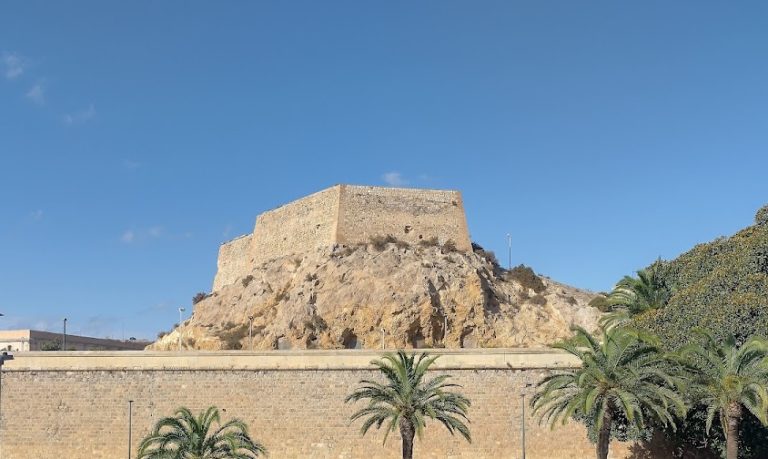
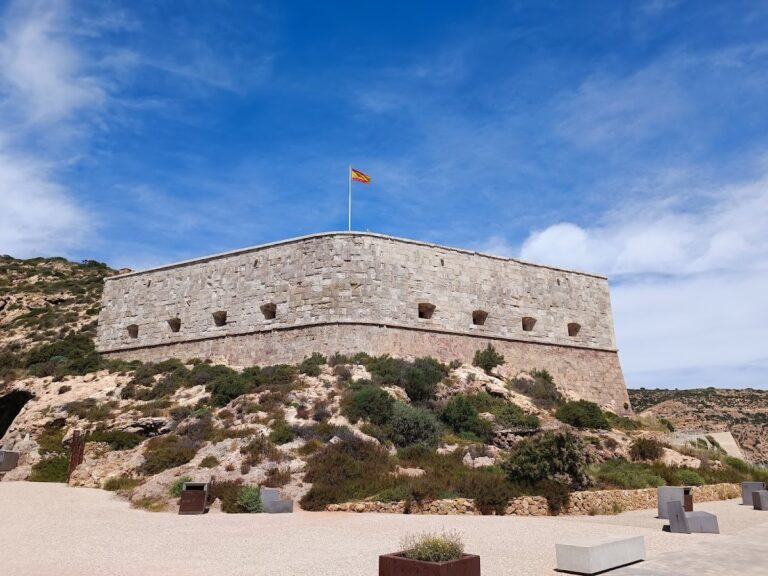
The castle stands on Los Moros Hill, 56 metres above sea level, in Cartagena’s present-day Santa Lucía district. Its surviving form belongs to the Neoclassical military architecture of the French-influenced Spanish school. The work has often been described as a hornwork, an outwork formed by projecting walls and a connecting defensive line, although the accepted classification is a crownwork, a more complex outwork with several projecting elements.
Its position and design were linked to the defense of the bastioned front of the Naval Hospital and the San José Gates. The castle therefore formed part of Cartagena’s wider system of fortified works rather than standing as an isolated residence or civic building. Its principal surviving identity is that of a late-eighteenth-century defensive monument on the hill whose strategic use had begun during the War of the Spanish Succession.