Castle of Rambures: A Fifteenth-Century Fortress in France


Site at a Glance
- Rating
- 4.5
- Popularity
- Medium
- Country
- France
- Primary era
- Medieval
- External website
- Open
- Eras represented
- Medieval, Early Modern, Modern
- Civilizations
- French
- Site type
- Military
- Remains
- Castle
On this page7 sections
History
Castle of Rambures is a fifteenth-century fortress in France, in the village of Rambures in the Somme department of northern France. Built during the late-medieval period, it became closely involved in the Hundred Years’ War, the prolonged conflict between the English and French crowns that shaped the military history of northern France. Its history also reflects the struggle for Picardy and the rivalry between the French and English monarchies and the dukes of Burgundy.
The Rambures lordship and the Hundred Years’ War
The lands around Rambures belonged to the noble Rambures family from the eleventh century. The lordship later passed through inheritance and marriage, keeping the estate within a network of powerful families while the surrounding region became a contested frontier.
David de Rambures, who became grand master of the royal crossbowmen in 1411, began constructing the major brick fortress in 1412. A grand master of the crossbowmen was the senior officer commanding the king’s crossbow troops. The building campaign was interrupted in 1415, when David and three of his sons were killed at the Battle of Agincourt, a major English victory over the French during the Hundred Years’ War. His surviving eldest son, André de Rambures, continued the work.
In 1423, three years after the Treaty of Troyes, Philip the Good, Duke of Burgundy, captured Rambures with English assistance. The treaty was the 1420 agreement that temporarily recognized the English claim to the French succession and strengthened Anglo-Burgundian control in parts of France. André de Rambures was taken prisoner in 1430 after the English siege of Aumale and remained captive in England for ten years.
Reconquest and completion of the fortress
While André was in captivity, Charles Desmarets, a commander serving the French king, recaptured Rambures from the English. French forces strengthened the fortress and used it as a base for attacks against English positions around Dieppe. André was released for ransom in 1440, after which he resumed military operations against England and continued rebuilding his family’s castle.
The fortress took its present overall form under André and his son Jacques de Rambures. In 1461, Louis XI made Jacques a chamberlain and royal councillor. A chamberlain was a high-ranking court official with duties within the royal household. Jacques represented the king in negotiations with Charles the Bold, the Burgundian duke whose expansion made Burgundy a major political and military power in northern France and the Low Countries. Jacques completed the principal building campaign around 1470.
In 1472, Jacques submitted to Charles the Bold, who then remained at Rambures for three months. The castle continued to stand within a region where political allegiance and military control could change rapidly. After the Hundred Years’ War, it was largely spared major warfare. Although it was besieged more than once, it was never captured by assault or siege.
Later ownership and preservation
Charles de Rambures saved the life of King Henry IV at the Battle of Ivry in 1590. In recognition, the king gave him the epithet le brave Rambures, meaning “the brave Rambures.” The castle was subsequently spared by Louis XIII during the dismantling ordered under Cardinal Richelieu. Richelieu, the chief minister of Louis XIII, pursued the reduction or destruction of fortresses considered potential threats to royal authority. The castle was nevertheless dismantled in the seventeenth century and restored in the nineteenth century.
The male line of the Rambures family ended in the seventeenth century. After Louis Alexandre de Rambures died in 1676, his aunt Charlotte de Rambures inherited the estate. Through her 1645 marriage to François de La Roche, Marquis of Fontenilles, the castle passed to the La Roche de Fontenilles family. The estate later came by inheritance to Guy Le Tellier, Count of Blanchard, in 1930, and it is now owned by the Le Tellier de Blanchard family. The property remains private and continues to serve as a residence.
Rambures was classified as a French historic monument by an order dated 23 February 1927. Protection was extended in 2003 to the outbuildings’ façades and roofs, the park and its paths, the entrance ditch and gates, the tree alignments along the Oisemont to Rambures road, and the façades and roofs of the park chapel and woodshed. The castle also retains a protected historic garden designation, known as jardin remarquable. Despite its military history and later changes, the fortress escaped destruction during both the First and Second World Wars, even though active fighting affected the surrounding areas.
Remains
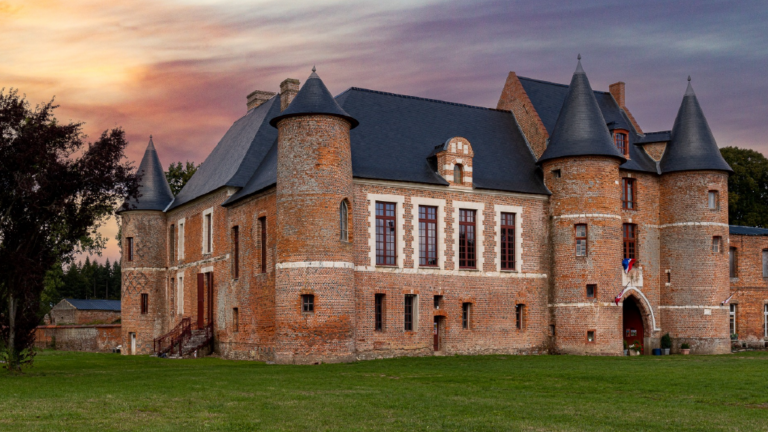
Castle of Rambures is a lowland fortress on predominantly flat ground south of Abbeville and north of the Bresle valley, approximately 20 kilometres from the English Channel coast. Its unusual plan is approximately square, with a massive round tower at each corner and smaller stair towers attached on the courtyard side. Built chiefly of specially fired fifteenth-century brick, the fortress retains its outer circuit of walls in essentially its late-medieval form. The brick’s modular and relatively ductile construction helped it resist fragmentation from artillery projectiles.
The fortified enclosure
The castle’s eight corner and intermediate half-towers rise from the cellars to the second floor. Each level forms a single room, while every corner tower contains a spiral staircase set into its inner angle. This arrangement joins the towers and walls into a compact defensive enclosure whose principal fabric still reflects the major construction campaign begun by David de Rambures and completed under André and Jacques.
The only entrance lies on the south side. A deep, purpose-dug moat stands before the main gate, and the historic approach included a drawbridge. The present bridge is fixed and replaced the former drawbridge. The entrance area also contains a saut-de-loup, a sunken defensive ditch, together with gates. These features form the surviving defensive approach to the fortress, while the large park surrounds the castle beyond the enclosure.
The park and associated buildings
The grounds contain a romantic landscape park, an arboretum, a botanical garden, and a rose garden laid out on the site of the former kitchen garden. An arboretum is a landscaped collection of trees and other woody plants. The gardens were established in the late eighteenth century and rearranged during the twentieth century. A sequoia more than 200 years old grows in the park; it was planted from a tree brought to France in 1787 as a souvenir associated with the American War of Independence.
The U-shaped outbuildings already appeared on plans from the eighteenth century. A Neo-Gothic chapel in the park dates from 1826 and contains the tombs of the La Roche-Fontenilles family. The woodshed has late-nineteenth-century decoration made up of latticework and lambrequins, ornamental motifs with a fabric-like appearance. It is regarded as one of the rare surviving examples of its type in France.