Castle of Grimaldo: A Medieval Fortification in Spain


Site at a Glance
- Rating
- 4.1
- Popularity
- Very Low
- Country
- Spain
- Primary era
- Medieval
- External website
- Open
- Eras represented
- Medieval, Modern
- Civilizations
- Crown of Castile
- Site type
- Military
- Remains
- Castle
On this page8 sections
History
Castle of Grimaldo, also known as the Tower of Grimaldo, is a medieval fortification in Grimaldo, Spain, dating from the second half of the thirteenth century, more specifically from its final third. It formed part of the former Lordship of Grimaldo, a territorial possession governed by a lord with rights of administration and jurisdiction.
Thirteenth-century origins
The earliest reference to the castle dates from the second half of the thirteenth century, when Pedro Sánchez de Grimaldo was recorded in connection with the lordship. Some historians, including Vela Nieto, have proposed an origin during the Muslim period, but this earlier phase has not been established by archaeological or documentary evidence.
Ownership by the Trejo family
During part of the fourteenth century and throughout the fifteenth century, the castle belonged to the Bermúdez de Trejo family. The family’s association with the site is also reflected in the adjoining church, where several of its members were buried.
Later aristocratic ownership and protection
By the end of the sixteenth century, ownership had passed to Rodrigo Calderón de Aranda, a Spanish nobleman and political favorite associated with the Duke of Lerma. Calderón became the first Count of Oliva de Plasencia in 1612 and the first Marquis of Siete Iglesias in 1614.
The property has been protected as a Cultural Heritage Site in the category of Historic Complex since 3 September 1991. It also benefits from the general protection established by the Decree of 22 April 1949 and Spain’s Historical Heritage Law of 1985.
Remains
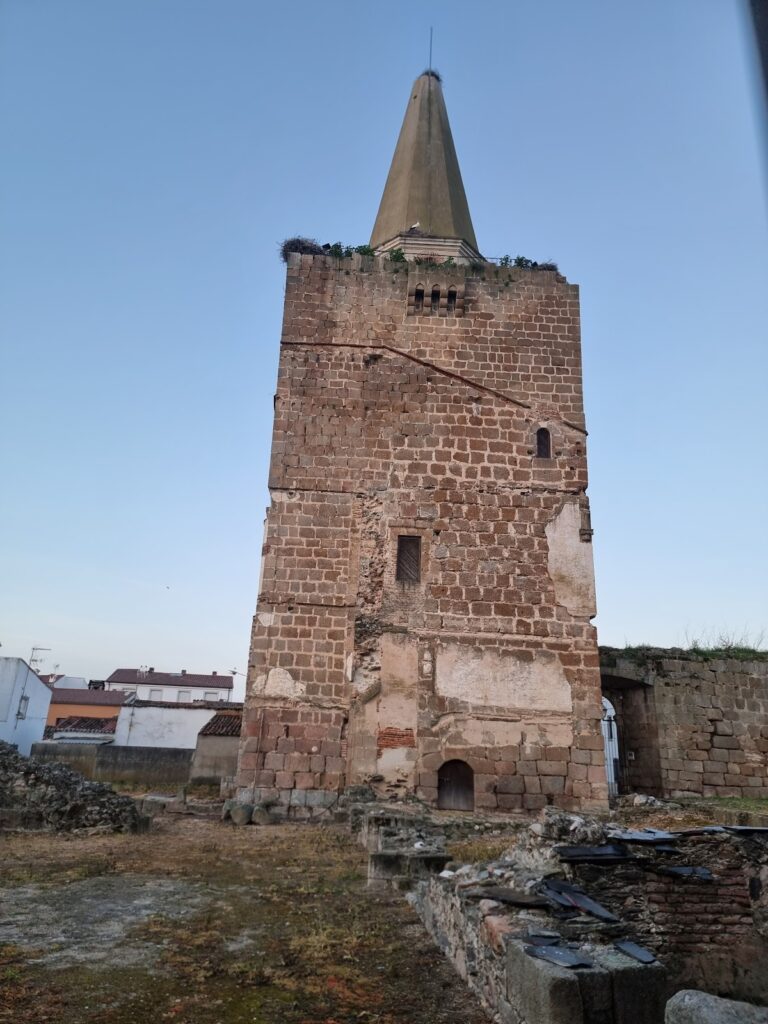
The surviving complex consists of a principal keep and an adjoining small Gothic church. The defensive buildings were constructed with stone and rubble masonry, while the present tower and church date from the end of the fifteenth century. The keep preserves its principal medieval spaces, and the tower remains in very good condition.
Keep and church
The keep
The keep, the castle’s principal fortified tower, contains a subterranean cistern, a constructed reservoir for storing water, and two surviving period floors. Both floors are covered by barrel vaults, continuous curved ceilings shaped like the lengthwise half of a barrel. During the twentieth century, an additional floor and a terrace were added to the tower.
Two examples of the family coat of arms appear on the keep. One occupies the upper part of the tower at the most visible corner facing the castle entrance. The other is positioned beside a side wall at the level of the ground-floor ceiling. This second shield is supported by two heraldic figures resembling wild men, with an inscription or legend placed between their feet.
The Gothic church
The adjoining church is a small Gothic building, belonging to a medieval architectural tradition associated with pointed arches, ribbed vaults, and an emphasis on vertical forms. It contains the burials of several members of the Trejo family, descendants of Bermúdez de Trejo.