Cathedral of Saint Mary of the Assumption of Coria: A Roman Catholic Cathedral in Spain
Site at a Glance
- Rating
- 4.5
- Popularity
- High
- Country
- Spain
- Primary era
- Early Modern
- External website
- Open
- Eras represented
- Medieval, Early Modern
- Civilizations
- Crown of Castile, Kingdom of León, Spanish
- Site type
- Religious
- Remains
- Cathedral
On this page27 sections
History
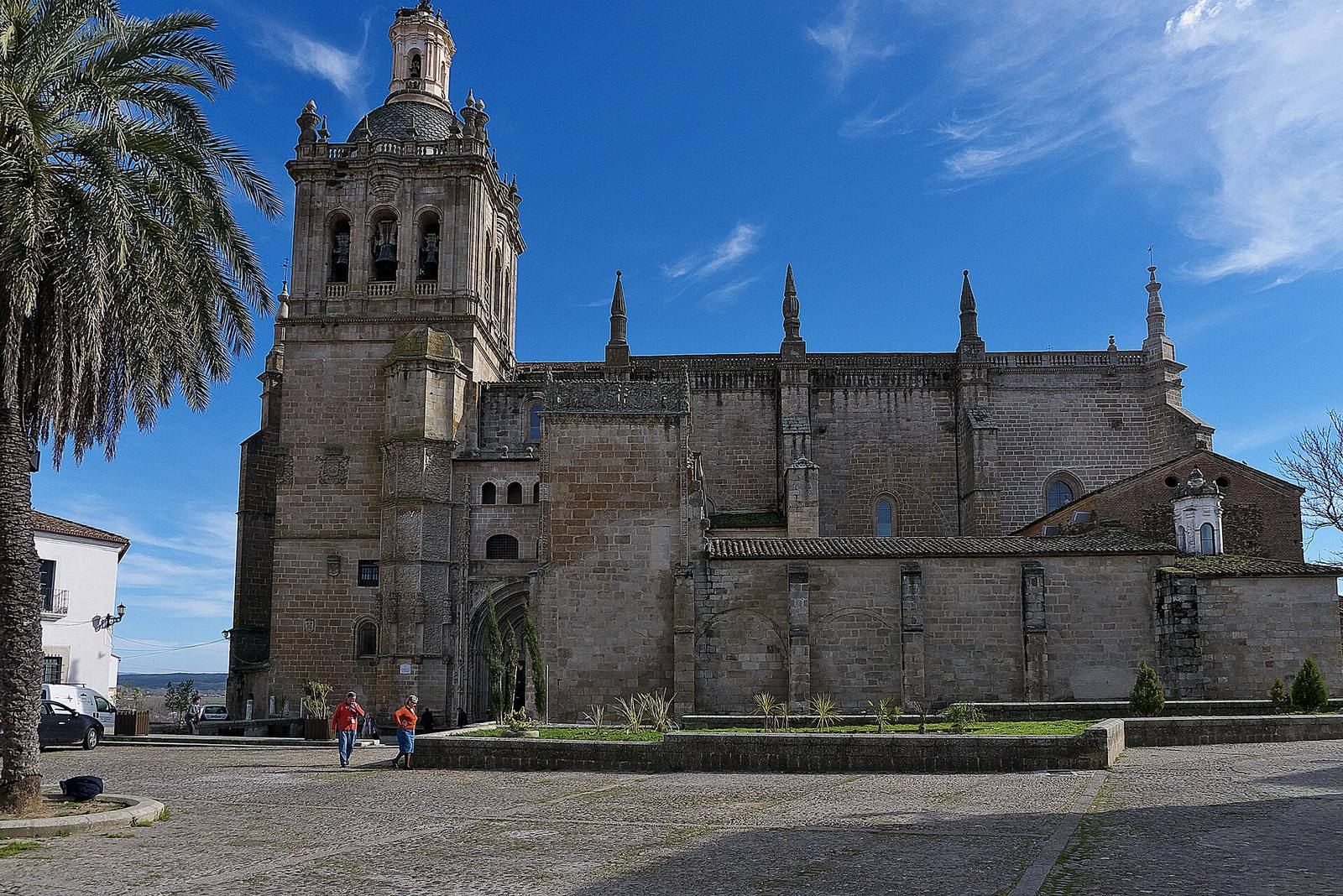
The Cathedral of Saint Mary of the Assumption of Coria is a Roman Catholic cathedral in Spain, dedicated to Mary and serving the Diocese of Coria-Cáceres, a church district under a bishop’s authority. Its present building took shape from 1498, combining transitional Gothic work with later Plateresque, an ornate form of Spanish Renaissance design, and Baroque additions. The cathedral stands on a site associated with successive Christian and Islamic uses, and its earliest known predecessor was a Visigothic church. It is served by secular clergy, priests who do not belong to a religious order.
Early Christian and medieval churches
A mid-first-century origin has been proposed for the site as a titulus, an early Christian place of worship. A Roman mosaic found in the cloister has been cited in support of this possibility, but the earliest known cathedral there was Visigothic. The Visigoths were a Germanic people who ruled much of Iberia before the Muslim conquest.
The Visigothic cathedral was later converted into Coria’s principal mosque. After Alfonso VII of León, a 12th-century king, reconquered the city, the diocese was restored under Bishop Íñigo Navarrón. A Romanesque cathedral, in a medieval European architectural style, then took the mosque’s place. In the 14th century, a brick Mudéjar cloister was added. Mudéjar describes work made by Muslim craftsmen or shaped by Islamic artistic influence in Christian-ruled Iberia. A Gothic cloister replaced it in the middle of the 15th century.
Construction of the present cathedral
By the late 15th century, Bishop Pedro Ximénez de Préxamo had concluded that the Romanesque church was too small. He ordered its replacement, and a plan submitted by Bartolomé de Pelayos received approval in 1497. Work began the following year. Although the design was subsequently changed, it remained the principal basis for the new cathedral. Martín de Solorzano and Pedro de Ybarra contributed to its designs during the following century.
Most of the complex was completed in the 16th century, but work continued as builders addressed flaws in the construction and foundations. The exact date of completion is uncertain. The church’s successive artistic phases include Gothic, Renaissance, and Baroque work, alongside Plateresque decoration. The Baroque bell tower was designed by Manuel de Lara Churriguera.
Later changes and damage
The Lisbon earthquake of 1755 caused serious damage to the cathedral and brought down its bell tower. In the early 20th century, the Gothic tombs of the Maldonado family were removed from the Chapel of the Immaculate Conception to make room for Bishop Ramón Peris Mencheta’s burial; the family tombs were lost. The Chapel of the Blessed Spínola, previously dedicated to the Annunciation, took its present dedication after Marcelo Spínola was beatified in 1992. The cathedral was designated an Asset of Cultural Interest in Spain on 3 June 1931. Its formal dedication took place on 20 April 1898.
Remains
Church plan and exterior
Layout and construction
The church has a single nave, the main lengthwise space, divided into five bays and covered by vaulted ceilings whose intersecting ribs form star patterns. A shallow transept, the crosswise part of the church, has doorways in both arms: the north entrance faces Cathedral Square, while the south entrance opens toward the garden. The principal entrance is at the west end. The nave’s first bay contains the square main chapel, which measures 17 metres on each side.
Exterior and tower
Two windows light each nave bay; the main chapel instead has one round window, or oculus, high on the wall on the right when facing the altar. Exterior buttresses mark the bays, and the small windows contribute to the building’s solid appearance. Pinnacles and a balustrade were added around the church’s perimeter in the 18th century. The balustrade once formed a walkable route, but mid-20th-century roof alterations changed that arrangement. The tower now adjoins the church at its east end, replacing an earlier tower at the west end that was demolished.
Main chapel
Altarpiece
A large altarpiece fills the main chapel’s end wall. Made in 1747, it replaced an earlier work probably dating from the 16th century. Trinitarian friars José de la Santísima Trinidad and Juan de San Félix made the altarpiece; Alejandro Carnicero carved its sculptures, which Eugenio Piti painted in colour. The composition has three vertical sections, two tiers, and a crowning section. Its imagery reflects the devotions of Bishop José Francisco Magdaleno, who paid for the work.
Saint Joseph and Saint Francis of Paola appear in the left section, corresponding to the bishop’s given names. The right section shows Saint Peter of Alcántara, patron saint of Coria, and Saint Teresa of Ávila, the bishop’s baptismal patron. At the centre, a display for the Blessed Sacrament is surrounded by the four Evangelists and crowned with an image representing the triumph of Faith. Above it, an image of the Assumption of Mary is lit through a large opening in the end wall. The uppermost group portrays Mary holding the dead Christ at the foot of the Cross, with the donor’s coat of arms above.
Bishops’ tombs
The chapel contains praying tombs of Bishops Pedro Ximénez de Préxamo and Pedro García de Galarza. Ximénez de Préxamo’s Gothic-style monument has two openings beneath a pointed, double-curved ogee arch. Its original arrangement placed the kneeling bishop in one opening and a tabernacle in the other. Only the bishop’s figure remains, now set in the opposite niche. It depicts him in old age, dressed for Mass and wearing a jewelled mitre. The sculptor was Diego Copín de Holanda, who was associated with the Catholic Monarchs, Isabella I of Castile and Ferdinand II of Aragon. The commission was linked to the bishop’s friendship with Cardinal Cisneros, a prominent church and political reformer.
García de Galarza’s Renaissance tomb was made in 1596 to designs by architect Juan Bravo and sculptor Lucas Mitata. A semicircular arch sits beneath a broken pediment, whose upper outline has a gap, and is framed by fluted pilasters. The praying bishop faces a decorated reading stand holding a book and an episcopal mitre. The tomb’s original metal grille has been lost, apart from a fragment of its wooden upper band.
Grille, paintings, and furnishings
A Renaissance grille closes the main chapel. It originally had three sections and a crest, but during Bishop Juan José García Álvaro’s 18th-century episcopate it was dismantled and reduced to its first section. A new crown bearing the bishop’s arms was added, and the doors, soundboards, and pulpits were altered to bring the ensemble together. The grille now has five sections divided by small pilasters, with green and gold bars shaped like turned posts. Its original design is kept in the cathedral museum.
Two 16th-century lecterns shaped like eagles and a 17th-century dignitaries’ bench stand in the chapel. Two silver lamps, made around the time of the altarpiece, hang from gilded wrought-iron brackets by Cayetano Polo, each topped with a peacock. Four paintings hang on the walls. On the left when facing the altar are the Archangel Gabriel and the Virgin and Child, both in a Mannerist style. On the right are two Baroque paintings, Christ Crucified and Christ Crucified with Saint Francis and Saint Rose.
Side chapels
Chapel of the Immaculate Conception
At the base of the tower, the square Chapel of the Immaculate Conception is among the church’s oldest chapels and was already part of the Romanesque cathedral. Pedro de Ybarra altered it to support the tower and gave it a simple ribbed vault that survives beneath an 18th-century stucco covering and painted decoration. Its central Rococo altarpiece has four tapering supports and a single niche containing a 19th-century image of the Immaculate Conception. Above it, a round panel shows a vase of lilies, an emblem of the cathedral chapter and a symbol associated with Mary.
The Picazo brothers made two side altarpieces in 1880 in a Neo-Plateresque style. The left one holds a sculpture of Saint Francis Borgia, probably acquired after the 1755 earthquake because of his association with protection from earthquakes. The right one contains a Sacred Heart of Jesus, probably made in the late 19th century. Bishop Ramón Peris Mencheta’s tombstone lies at the chapel’s centre.
Chapel of the Blessed Spínola
Situated in the south arm of the transept beneath the smaller organ, this chapel has a simple tunnel-shaped barrel vault crossed by arches, like other rooms in the church’s south wing. Two altarpieces face each other. The Rococo altarpiece on the right contains an 18th-century Annunciation by José de Mera and a 16th-century panel of Christ presented to the people, between the Virgin and Saint John. The panel has Flemish characteristics.
The Baroque altarpiece on the left is framed by small columns with spiralling shafts, known as Solomonic columns. It contains a portrait of Marcelo Spínola by Francisco Gil Japón; Spínola served as bishop of Coria from 1886 to 1887. The altarpiece previously held a sculpture of Saint Catherine of Alexandria, now kept in the cathedral museum.
Chapel of Saint Peter of Alcántara
Founded by canon Hernando de Amusco before the present church was built, this chapel was incorporated into the new structure and stands on its south wall. Its pointed entrance arch and grille of square-section bars are Gothic in character. After deterioration, the chapel was altered in the 17th century: its original vault and choir gallery were removed. It is now rectangular, with a barrel vault supported by crosswise arches.
The Baroque altarpiece is lit by two square windows and a round opening in its upper section. Its lower panel, or predella, carries reliefs of several saints. Between spiralling columns, a niche contains a 1676 image of Saint Peter of Alcántara by Bernardo Pérez de Robles. A small arch in the chapel’s right wall leads to a smaller chapel, where a shell-shaped Baroque altarpiece stands with a group of sculptures of Christ on the Cross, Saint John the Evangelist, Saint Mary Magdalene, and the Sorrowful Virgin. The crucifix is a 16th-century work by Lucas Mitata; the figures of Saint John and Saint Mary Magdalene date from the 17th century, and the dressed statue of the Virgin from the 18th.
Chapel of the Relics
At the west end of the church, the Chapel of the Relics was extensively renovated in 1783. Its dome rests on curved supports that carry it over the square space, and its panels bear symbols of the Passion. An elaborate 18th-century grille fills a large semicircular arch between the chapel and nave. The main of its three altarpieces is a large cabinet for the cathedral’s relic collection, arranged in three vertical sections and topped by an image of Saint Joachim.
The chapel’s two side altarpieces were originally a matching pair. One was dismantled to open the brick arch connecting the chapel to the cloister. The surviving altarpiece contains a 1777 sculpture of Saint Sebastian by José Salvador Carmona, flanked by less finely made figures of Saint Anthony of Padua and Saint Vincent Ferrer. The dismantled work held Saint Peter of Verona, the chapel’s original dedication, between Saint Francis and Saint Dominic; these sculptures are now in the museum.
Choir
Stalls and choir enclosure
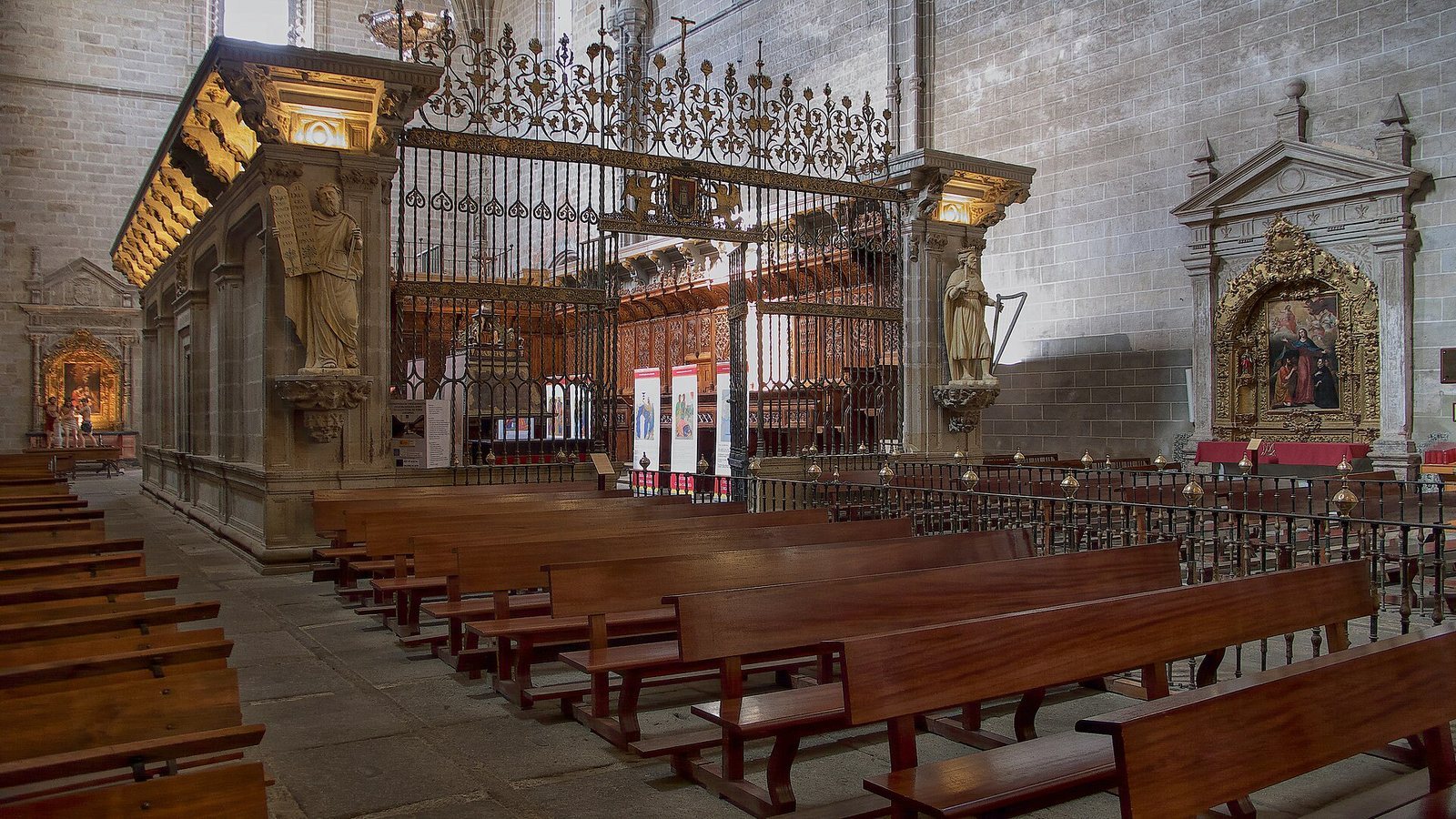
The walnut choir stalls form a Mudéjar ensemble made in two phases. The set has 71 seats, 43 in the upper row and 28 in the lower, together with a bench. Part of the work, made in 1489 shortly before construction of the present cathedral began, came from the Romanesque church, where it stood in the central nave. That earlier portion forms the front and half of the side sections. Martín de Ayala completed the stalls in 1514 after their installation in the new church, and Francisco Pérez added a cresting with small saint figures in 1560.
The bishop’s seat occupies the centre of the front row, between the dean’s seat, which carries the inscription dating the work, and the cantor’s. A standing figure of Christ holding the world and giving a blessing appears beneath a Gothic canopy on the bishop’s seat. The other stalls have varied geometric Mudéjar panels. At the ends are seats for the Dukes of Alba, lords of Coria, set at the bishop’s level. A Baroque lectern stands at the centre of the stalls.
A Renaissance wall encloses the choir. Michel de Villarreal made it in the first half of the 16th century with payment from Dean Gaspar de Bardales. Its grille, made by master Hugo de Ras, carries the arms of Bishop Juan Ortega Bravo de Laguna in the centre. Corbels decorated with small figures and the cathedral chapter’s arms originally served as kneelers for the Dukes of Alba. In the 18th century, sculptures of Moses and David were placed on them instead. The wall also has two side entrances with lintels and the chapter’s arms.
Retrochoir
Behind the choir, a musicians’ gallery stands above a small Baroque altarpiece of the Virgin of the Rosary. Four stone figures, Saint Peter, Saint Paul, Saint Andrew, and Saint James the Greater, stand beside it on supports beneath canopies. Gaspar de Bardales, dean and donor of the choir wall, is represented by his coat of arms above the altarpiece.
Cloister
Galleries and earlier remains
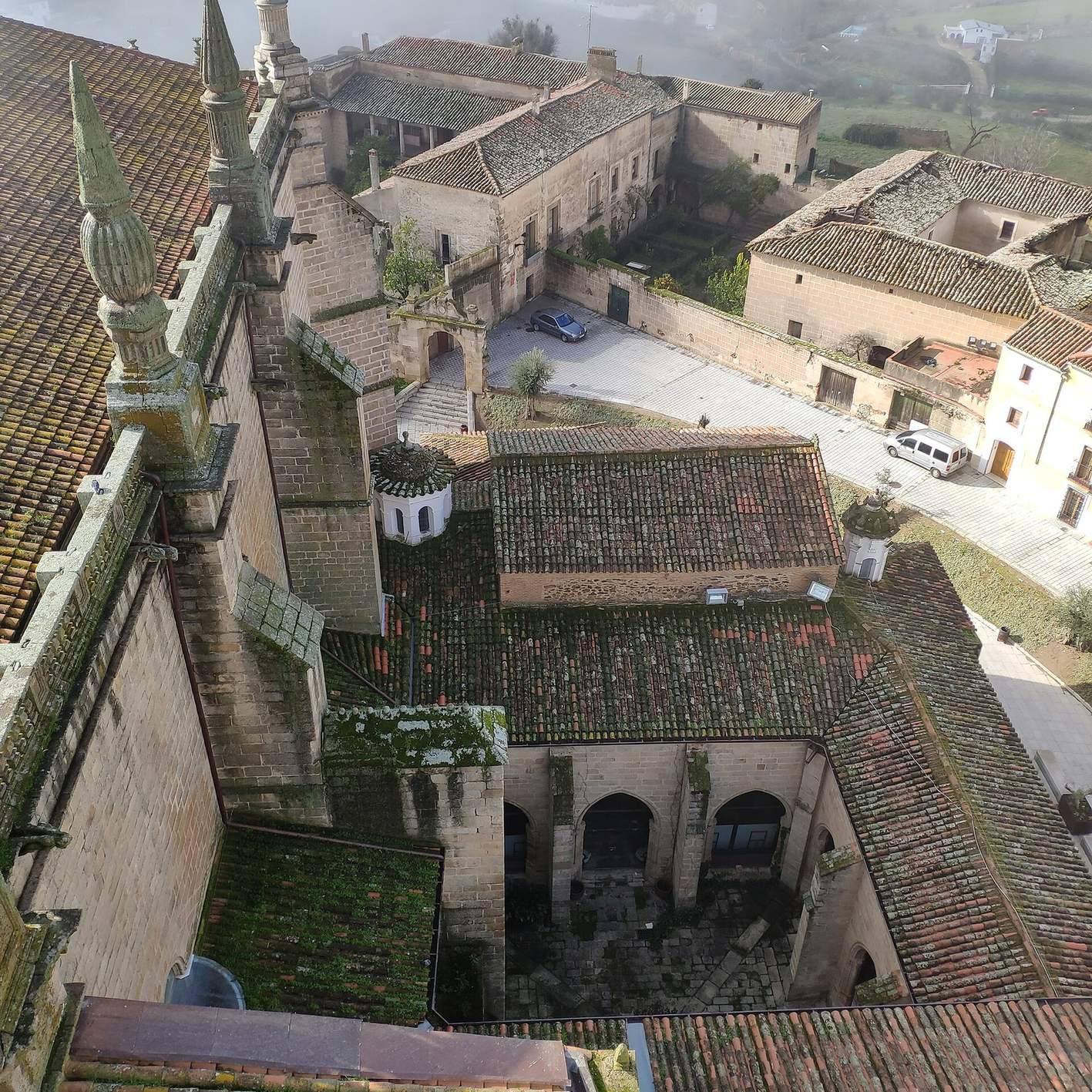
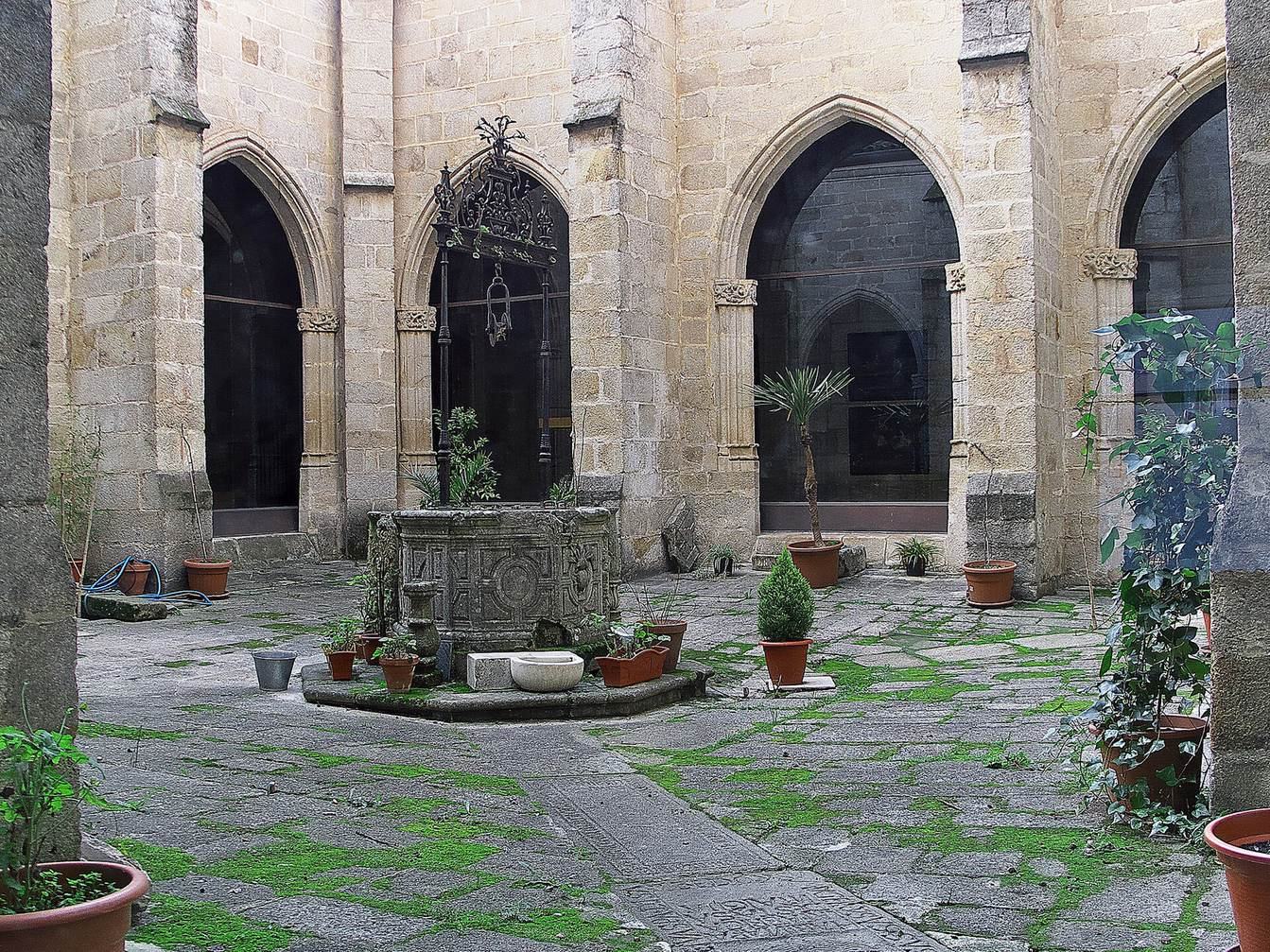
The 15th-century Gothic cloister is square, with four galleries, each divided into three bays covered by simple ribbed vaults. Some arches from the earlier 14th-century brick cloister survive. An 18th-century support interrupts the middle of the south gallery, where a semicircular opening passes through it. Beneath this gallery lies a buried geometric mosaic floor from the Visigothic cathedral.
Corner altarpieces
Four small altarpieces occupy the cloister’s corners. The 17th-century Baroque altarpiece of Saint Anthony Abbot has a Portuguese character and holds a painted wooden image. Another, in the Rococo style, contains Saint Benedict of Nursia. The altarpiece of Saint Louis, bishop, holds a sculpture made by José Salvador Carmona in 1777. The one dedicated to the Virgin of Pilar contains a marble sculpture and a painting of Pentecost in its upper section.
Sacristies and collections
Main sacristy
The two sacristies were built in the 17th century while the cathedral chapter was completing the complex and strengthening parts of the 16th-century construction. The main sacristy lies beside the main chapel and is reached from the right side of the church through an antechamber. A basin in the antechamber is carved from pink Portuguese marble and decorated with two intertwined dolphins. Both rooms have tunnel-shaped barrel vaults crossed by arches. Three paintings in the antechamber show Saint Louis, bishop, Bishop Dionisio Moreno Barrios, and Pope Benedict XV.
The nearly square main room has a floor patterned in granite and slate. A Baroque cabinet occupies one side. Above it, gilded cresting and stepped supports carry an 18th-century Neoclassical crucifix. The room also contains paintings, including the Virgin of the Rosary and Saint Thomas Aquinas.
Beneficiaries’ sacristy
The larger but lower beneficiaries’ sacristy stands at the west end on the right side of the church. It has a wooden ceiling divided into panels and a decorated cabinet. A small altarpiece once in the Chapel of the Relics was moved here. Stuccoed walls have ornamental painted decoration, and the room displays objects from the cathedral’s furnishings.
Organs and museum objects
Two monumental organs stand on separate galleries above the second nave bay, at the transept. The cathedral’s collection includes paintings, sculptures, and metalwork. The museum preserves a relic believed to be the tablecloth used by Jesus at the Last Supper.