Castillo de Galisteo: A Historic Palace-Fortress in Spain


Site at a Glance
- Rating
- 4.2
- Popularity
- Very Low
- Country
- Spain
- Primary era
- Medieval
- Eras represented
- Medieval, Early Modern
- Civilizations
- Crown of Castile, Kingdom of León, Spanish
- Site type
- Military
- Remains
- Wall
On this page14 sections
History
Castillo de Galisteo is a castle in Spain whose origins are uncertain, with an early date placed in the ninth or tenth century and later reconstruction associated with the thirteenth century. That rebuilding is attributed to Alfonso IX, the Leonese king connected with Christian expansion in western Iberia, during the reconquest of lands near the Tagus River. The site developed within a landscape shaped by Roman and Islamic periods, and later became the centre of a territorial lordship and a palace-fortress.
Roman and Islamic connections
Galisteo lies near the Roman settlement of Rusticiana and the Roman road called the Vía de la Plata, a major route through western Hispania and present-day Spain. The road included roadside stations where horses were changed. These earlier connections place the castle within a region that had already been occupied and linked by important communications before its medieval fortification.
Christian reconquest and the Lordship of Galisteo
Galisteo was mentioned in the early thirteenth century, shortly after the conquest of Alcántara, when Alfonso IX established the boundaries of that settlement. From 1229 to 1837, Galisteo served as the capital of the Lordship of Galisteo, a territorial jurisdiction granted by the Crown to a noble family or individual. Its territory included Pozuelo de Zarzón, Guijo de Galisteo, Montehermoso, and Carcaboso.
The Manrique de Lara palace-fortress
In 1429, John II, the fifteenth-century king of Castile and León, granted the lordship to García Fernández Manrique, Count of Osorno. The castle subsequently became part of a palace-fortress associated with the Manrique de Lara family. García Fernández Manrique de Lara y Toledo, Count of Osorno and the first Duke of Galisteo, was the family’s leading member during much of the first half of the sixteenth century. His works in the lordship included a bridge over the Jerte River, commemorated by a plaque dated 1546, and the fortification of the church in 1506.
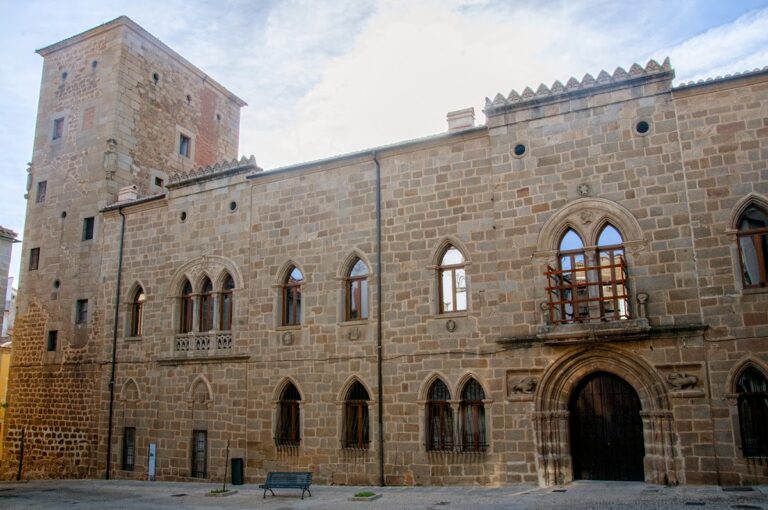
The character of the palace changed in the early sixteenth century. García Fernández Manrique de Lara married María de Luna in 1510, and her heraldic arms on the entrance arch are interpreted as evidence that the marriage led to alterations to the residence. The original palace-fortress now survives in its fifteenth-century tower and sixteenth-century palace portal, while the castle itself is in a semi-ruinous condition.
Historic protection
Castillo de Galisteo was designated a Cultural Interest Asset as a Historic Ensemble on 3 September 1991. This status reflects the value of the surviving fortification and the historic settlement associated with it.
Remains
The fortification stands on a plateau above the Jerte River in Extremadura. Its walls adapt to the irregular topography and enclose a circuit of approximately 1,200 metres. Rounded river stones from the nearby Jerte River form the walls. Rather than using attached towers, the defensive system relied on battlements capped with pyramidal tops, several of which remain visible.
Gates and access points
Santa María Gate
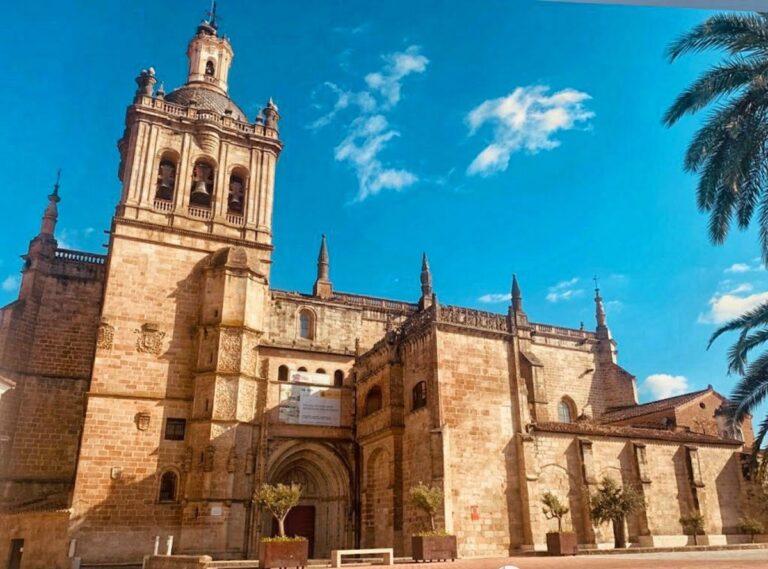
The Santa María Gate stands opposite the church. Its entrance combines a granite arch with a pointed brick arch and includes a buhedera, a defensive opening comparable to a projecting machicolation, through which defenders could attack people below. On the inner side, a double staircase is set at an angle. Another staircase begins at the vertex of that angle and leads to the church belfry, linking the gate’s circulation with the adjacent religious building.
Villa Gate
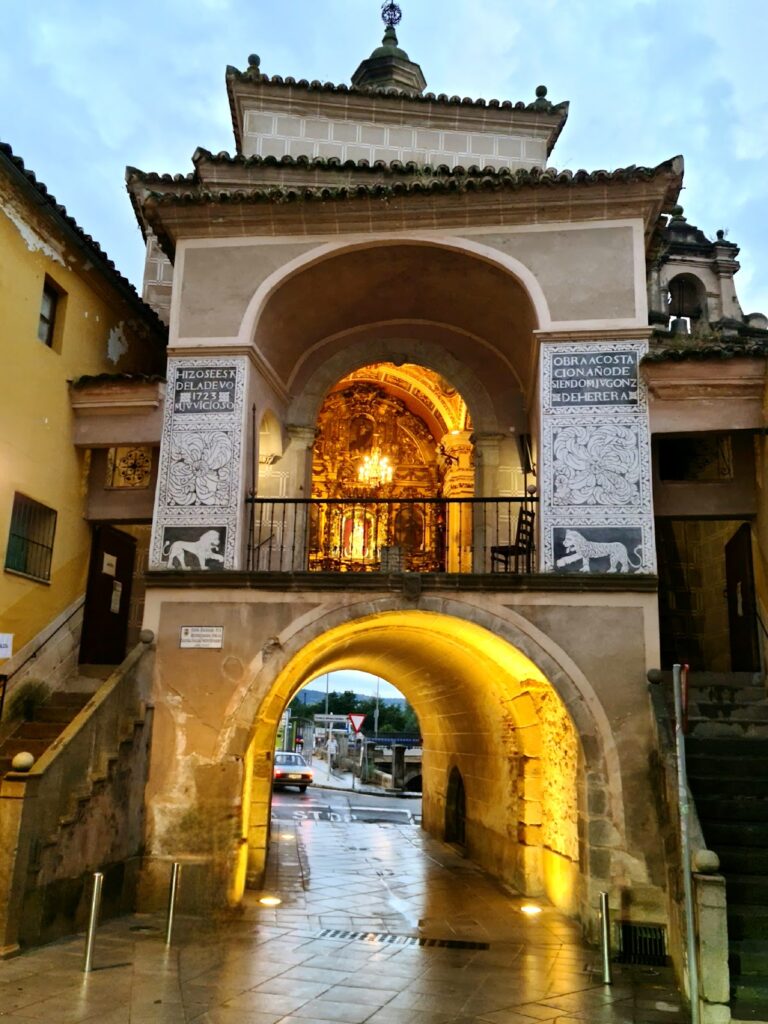
The Villa Gate, also called the River Gate and the Angustias Gate, is placed perpendicular to the wall in a bent defensive arrangement. Before the passage, a small eighteenth-century chapel dedicated to Our Lady of Sorrows stands to the left. The chapel includes a small tower and bell built over the fortification.
King’s Gate
The King’s Gate opens through a broad and well-preserved stretch of wall. Its upper outer section carries a badly worn coat of arms belonging to the Manrique de Lara family, although the individual heraldic devices can no longer be identified. This was the principal entrance and exit, and it was connected with the first road built toward Plasencia.
Palace Gate
The Palace Gate was reserved for the inhabitants of the palace. It predates the residence erected by the second Duke of Galisteo and forms part of the surviving remains associated with the noble household.
Palace and defensive tower
Fifteenth-century tower
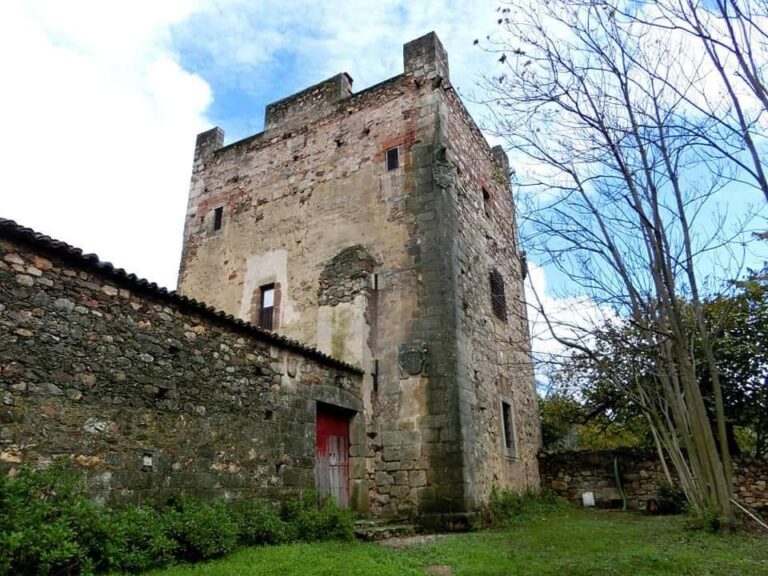
The palace-fortress’s fifteenth-century tower retains defensive features from its period, including machicolations, which are projecting structures with openings used to attack those directly below a wall or tower. Its upper section is made of brick and is crowned by a tall finial. The tower is one of the principal surviving elements of the earlier residence.
Sixteenth-century palace portal
The palace portal dates from the sixteenth century and preserves the entrance arch bearing the arms of María de Luna. Together with the tower, it represents the surviving architectural core of the palace-fortress linked to the Manrique de Lara family.
Nearby sites