Castle of Donoratico: A Medieval Fortress in Italy


Site at a Glance
- Rating
- 3.9
- Popularity
- Very Low
- Country
- Italy
- Primary era
- Medieval
- Eras represented
- Medieval
- Civilizations
- Holy Roman Empire
- Site type
- Military
- Remains
- Castle
On this page9 sections
History
Castle of Donoratico is a ruined medieval fortress in Italy, built in stone during the twelfth century by the Della Gherardesca family on a modest hill near Donoratico, in the municipality of Castagneto Carducci. The castle became a preferred residence of this powerful Tuscan aristocratic family and developed around an earlier religious foundation dedicated to Saint Columban.
Monastic and Etruscan predecessors
Before the tenth century, the hill was occupied by a wooden monastery dedicated to Saint Columban, an Irish missionary and monastic founder active in the sixth and early seventh centuries. The foundation probably belonged to the Lombard period, when the Lombards, a Germanic people, ruled much of Italy. From the eleventh century, the monastery was among the possessions of the Monastery of Saint Peter at Monteverdi.
Archaeological discoveries also point to an earlier Etruscan fortification on the hill. The Etruscans were an ancient people of central Italy whose communities flourished before the expansion of Roman power, and their presence connects the medieval castle with a much older defended landscape.
The Della Gherardesca castle
The Della Gherardesca family established the castle as a residence during the twelfth century. Another historical tradition describes it as an Aldobrandeschi fief granted to Della Gherardesca vassals at the end of that century. In this version, the castle belonged to Guglielmo degli Aldobrandeschi until his death and then passed to the Della Gherardesca during the territorial struggles that accompanied the breakup of the Aldobrandeschi county.
Those conflicts involved pressure from several directions. Florence attacked from the north, while Siena and Orvieto advanced from the east and Pisa from the west. During the castle’s development, its earlier construction was rebuilt in stone. A church dedicated to Saint Columban already stood within the complex, initially with a single nave, and it was enlarged as the fortified settlement grew.
Destruction and later memory
The castle and church were destroyed in 1447 during the advance of Alfonso V of Aragon, the fifteenth-century king of Aragon whose Italian campaigns reached Donoratico. A wooden crucifix from the fifteenth century, held in especially high veneration, was later found beneath the church ruins. It was transferred to Castagneto Carducci, where the Church of the Most Holy Crucifix was founded in 1587.
The ruins were restored in 1929. Some stones were removed during the work and taken to Castagneto Carducci for the construction of the bell tower of the Provost Church of Saint Lawrence. Local tradition holds that Count Ugolino della Gherardesca lived at the castle. Ugolino, a Pisan nobleman remembered by Dante Alighieri in Inferno, also gave the ruins a place in literary memory. Giosue Carducci, whose writing often engaged with Tuscan landscapes and history, referred to the Tower of Donoratico in his poem Avanti! Avanti!
Remains
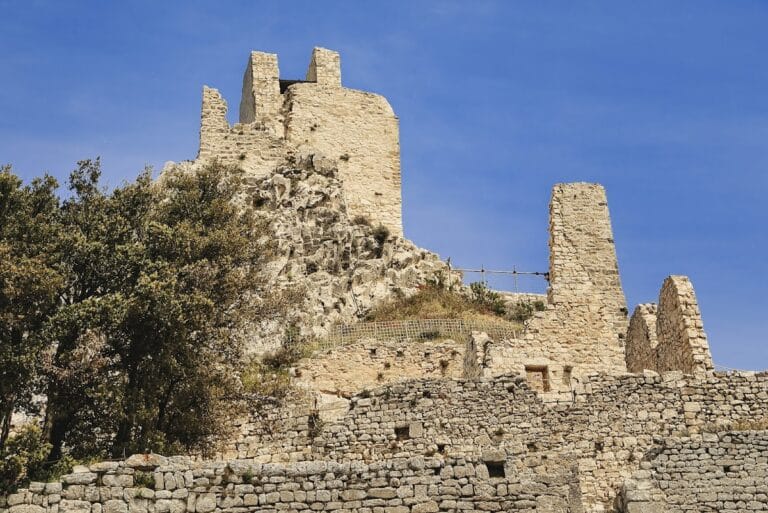
The castle now survives as a ruin, with parts of its outer curtain wall and the tower remaining on the hilltop. The complex was rebuilt in stone, and its twelfth-century defensive arrangement included a tower, a new circuit of walls, and a second curtain enclosing the summit. The church was enlarged within this developing enclosure.
Castle and church
Principal tower
The principal surviving structure is the tower, which retains its full original height. It served as the lordly residence and preserves its west side, part of its north front, and its south side, where it is joined to a lower tower built later. This second tower is more recent and lower than the first, creating a visible distinction between the main residential structure and its later addition.
Walls and church remains
The summit was enclosed by a second defensive curtain, while the outer defenses were strengthened between the fourteenth and fifteenth centuries with sloping scarps, which are reinforcing faces added at the base of a wall to make assault more difficult. Excavations have revealed traces of stone and terracotta flooring together with the remains of the church dedicated to Saint Columban.
Etruscan burial remains
A short distance from the tower lie the remains of a necropolis, or cemetery, and several Etruscan tombs. These burial features belong to the earlier occupation of the hill and place the medieval fortress within a landscape that had already been used and defended in antiquity.