Castle Libštejn: A Medieval Fortress and Noble Residence in Czechia


Site at a Glance
- Rating
- 4.6
- Popularity
- Low
- Country
- Czechia
- Primary era
- Medieval
- External website
- Open
- Eras represented
- Medieval
- Civilizations
- Holy Roman Empire, Kingdom of Bohemia
- Site type
- Military
- Remains
- Castle
On this page8 sections
History
Castle Libštejn is a fourteenth-century castle in Czechia, south of Liblín, built as the private residence of Ulrich Tista von Liebstein, a royal construction supervisor. The castle was first documented in 1361 and later became associated with the political and military history of medieval Bohemia.
Foundation and the Kolowrat family
At the end of the fourteenth century, Libštejn passed to the Kolowrat family, an important Bohemian noble house. During the Hussite Wars, the religious and political conflicts in Bohemia associated with the followers of Jan Hus, the castle belonged to Bedřich of Kolowrat. He opposed the Hussites together with his brother Hanuš.
The Hussite siege
In the 1420s, Hussite forces besieged Libštejn. The siege lasted seven weeks, after which Bedřich and Hanuš reached an agreement with the Hussites and changed sides. The castle was also partly captured during the conflict, adding military damage and political change to its history.
Decline and destruction
In 1540, Jan Libštehnský von Kolowrat sold Libštejn to the Valdštejn family. The new owners restored and strengthened the castle, but later in the sixteenth century it passed to the Gryspek family of Kaceřov. Members of that family did not live at Libštejn, and the castle declined. By 1590 it was described as abandoned, while the municipality of Liblín assumed its former role as the administrative center of the estate.
Parts of the castle walls were later demolished, and masonry was reused in nearby houses. During the Thirty Years’ War, the major European conflict fought from 1618 to 1648 amid military and political-religious upheaval, Libštejn was looted and burned in 1639. It subsequently fell into ruin. The ruins and their constituent buildings are protected as a Czech national cultural monument.
Remains
Hilltop layout
The ruins stand on a rocky hill south of Liblín, above the right bank of the Berounka, at an elevation of about 301 metres. The hill occupies a basin between three higher summits, a militarily disadvantageous setting associated with the comparatively peaceful and stable period of Charles IV, King of Bohemia and Holy Roman Emperor in the fourteenth century. The castle was arranged around two adjoining principal residential buildings, which formed a small, elongated courtyard.
Towers and residential buildings
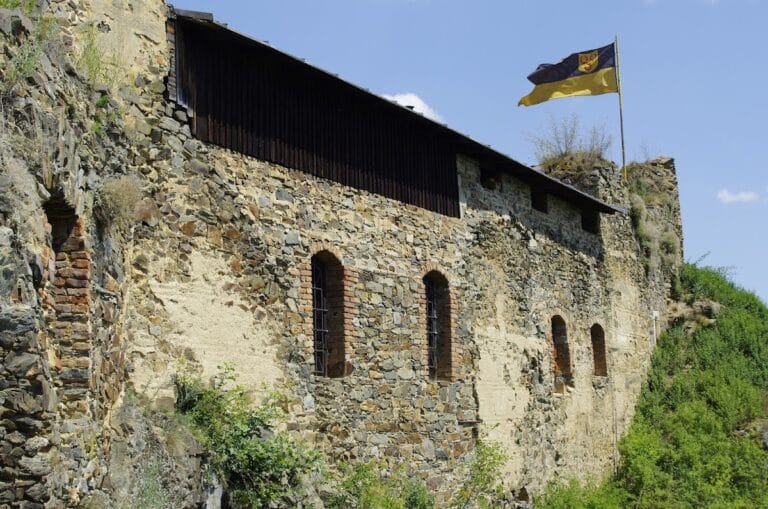
Square residential towers stood at the short ends of the courtyard. The principal surviving structure is a tall quadrangular tower, regarded as particularly strongly fortified before the widespread use of artillery. Only a tall fragment of masonry survives from the second tower, while other parts of the complex are represented by collapsed walls.
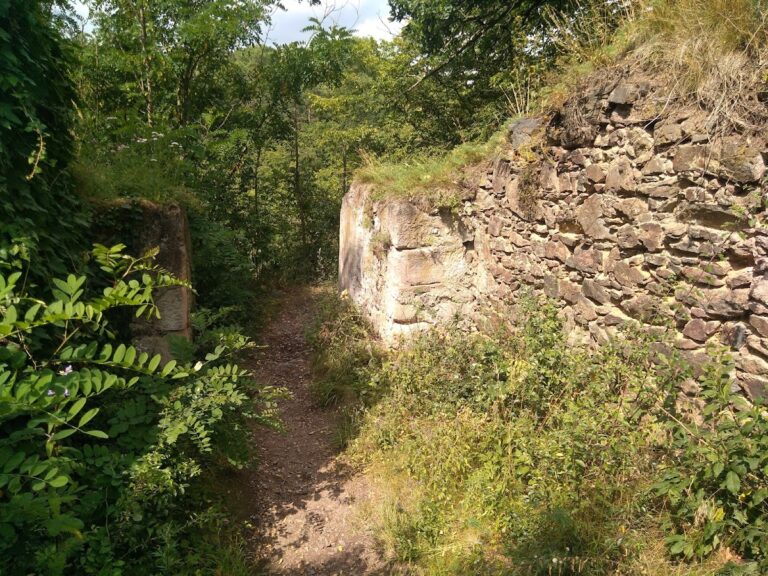
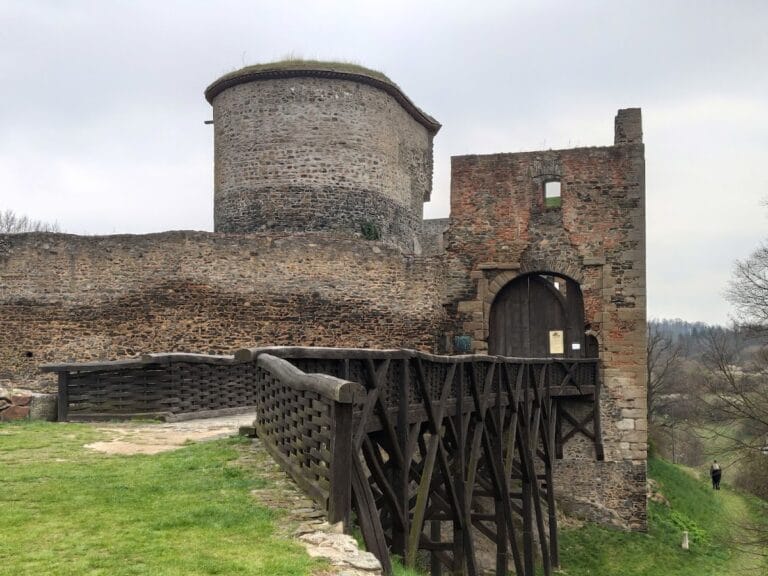
The surviving residential remains cover a substantial area and enclose several small courtyards. On the southern side, an entrance with a semicircular arch remains visible. On the southwest side are the remains of the lordly chapel, while the surviving walls and fallen masonry convey the former scale of the castle complex.
Moat and surviving masonry
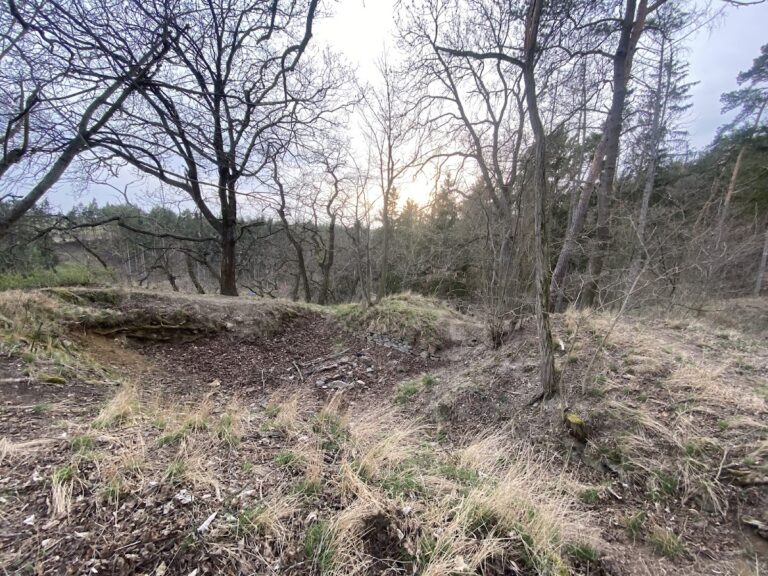
Traces of the moat remain visible along the eastern and western sides of the hilltop. Together with the towers, courtyard walls, entrance, and chapel remains, these features show how the castle’s residential and defensive elements were organized. Some sections of the masonry were removed and reused in nearby buildings, leaving the present complex as a combination of standing fragments, collapsed walls, and surviving structural outlines.