Angerbach (Kožlany): An Abandoned Medieval Castle in Czechia


Site at a Glance
- Rating
- 4
- Popularity
- Very Low
- Country
- Czechia
- Primary era
- Medieval
- External website
- Open
- Eras represented
- Medieval
- Civilizations
- Holy Roman Empire, Kingdom of Bohemia
- Site type
- Military
- Remains
- Castle
On this page10 sections
History
Angerbach (Kožlany) is an abandoned medieval castle in Czechia, founded around the middle of the thirteenth century in the period of Přemyslid expansion. It survived approximately from the second half of the thirteenth century until the first half of the fourteenth century and is classified as a castle of transitional type because its predominantly wooden and earthen defenses were combined with more developed stone construction.
Foundation and connection with Týřov
Archaeological evidence places the foundation around the middle of the thirteenth century, probably after 1238. In that year, King Wenceslaus I, a thirteenth-century Bohemian ruler of the Přemyslid dynasty, acquired Kožlany while establishing a power base in the Přemyslid hunting forest. If Angerbach was functionally connected with Týřov, it was founded after that castle.
Angerbach probably served as an auxiliary administrative site in the remote part of the Týřov estate. Týřov was a medieval castle and the center of an associated estate, although the precise relationship between the two sites remains uncertain. The modern name Angerbach was applied to the Kožlany site only in eighteenth-century sources. Medieval references traditionally associated with that name point to Týřov Castle, which also used the German name Angerbach. The two castles may once have shared the name and later been distinguished by qualifiers such as “small” and “large” or “old” and “new,” which have not survived.
The name Týřov Pond may preserve a connection with Týřov, although it may instead derive from the Týřovský family of Ensidle, a noble family that owned the surrounding landscape around the transition from the Middle Ages to the early modern period. The hill on which the castle stood is called Royal Mountain, a name that may also point to a royal foundation.
Decline and interpretation
Angerbach was a fully developed castle when built, but its construction was of lower quality than that of other royal castles. Its structurally problematic ramparts required continuous maintenance, and the fortification rapidly became obsolete. These difficulties, together with wider historical developments, probably contributed to its abandonment, most likely at the beginning of the fourteenth century.
The castle’s status is debated. In 2005, Vladislav Razím proposed that Angerbach might have been the seat of a minor nobleman or a dependent retainer associated with Týřov rather than a royal castle. Tomáš Durdík rejected this interpretation, arguing that the scale of its fortifications exceeded what sites of minor noble origin normally achieved at the time.
Archaeology and protection
In April 2004, ground disturbance on the northeastern side of the castle core produced 25 ceramic fragments dating from the turn of the thirteenth and fourteenth centuries. The disturbance also exposed a faced wall comparable to the wall of the dug-in building in the front part of the castle. Between 1975 and 2009, masonry at that building was damaged, reducing its wall height by as much as half. Angerbach has been protected as a cultural monument since 1964.
Remains
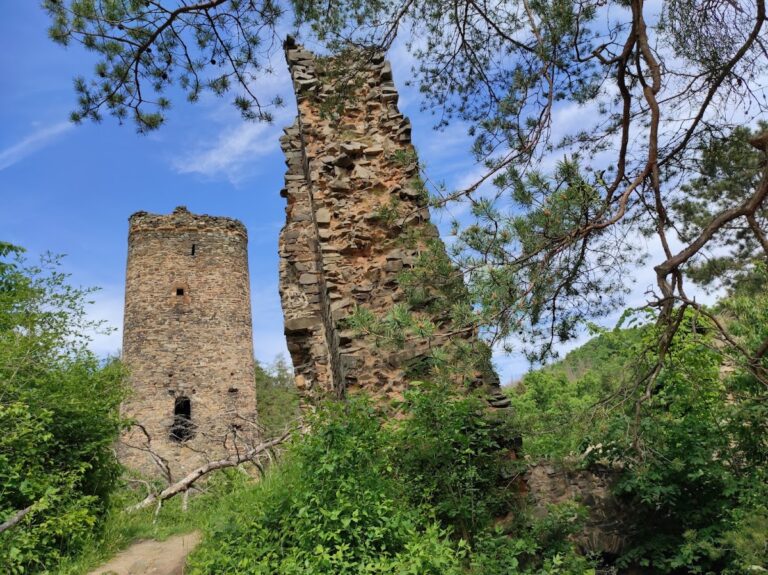
Angerbach occupied a spur about one kilometre northeast of Kožlany, above the confluence of the Javornice and Hradecký Brook, at an elevation of approximately 400 metres. Its two-part plan used the natural shape of the spur together with ditches, ramparts, timber defenses, and stone-faced construction.
Castle sections and buildings
First section
The approximately rectangular first section was enclosed by an earthwork rampart, a ditch, and a timber log wall. A large dug-in building was excavated into the rock inside this area. Its walls had a stone lining, and the surviving masonry is associated with the damaged structure identified as the dug-in building in the front part of the castle.
Second section
A second section lay beyond another ditch and was reached by a wooden bridge. Its front and sides were protected by loose-fill ramparts, raised defensive banks without internal reinforcement. The front rampart had a stone facing. A half-timbered palace, built with timber framing and infill, was inserted between the side ramparts, while its rear wall formed part of the outer fortification.
Rear defenses
The rear part of the castle spur was cut off by two ditches, adding another defensive barrier to the fortifications around the two main sections.
Archaeological finds
The site has yielded an extensive assemblage of ceramic fragments. Regional ceramic development is not understood well enough to date these pieces more precisely than from the second half of the thirteenth century to the first half of the fourteenth century.
Metal finds survive in very poor condition, and almost half are nails or small nails. Fragments of a padlock came from the second ditch. Military objects make up about 20 percent of the metal finds and consist only of arrowheads and crossbow bolts. A single coin from a destruction layer formed after the castle had ceased to exist is probably a heller, a small coin denomination, minted at Hall during the fourteenth or fifteenth century.
Only a small quantity of animal bone survived because of unfavorable preservation conditions. Less than four percent belonged to game animals, a pattern that does not support interpreting Angerbach as a hunting castle.