Castle in Bronka: A Medieval Stone Fortification in Ukraine
Site at a Glance
- Popularity
- Medium
- Country
- Ukraine
- Primary era
- Medieval
- Eras represented
- Medieval
- Civilizations
- Hungarian
- Site type
- Military
- Remains
- Castle
On this page9 sections
History
The Castle in Bronka was a medieval stone fortification on Tsarska Mountain east of Bronka in Ukraine. Built in the second half of the thirteenth century, after Mongol campaigns into Eastern Europe, it was among the region’s earliest medieval stone strongholds. The hill had been occupied during the Copper and Bronze Ages, about 4,000 to 5,000 years earlier. Its limited summit space, difficult approach, and commanding view suggest that the castle may have served mainly as a lookout and control post, rather than as a noble residence.
Royal conflict and abandonment
The castle became involved in conflict between the Hungarian king Béla IV and his son Stephen V. A charter issued by King Ladislaus IV in 1273 records that Master Peter of the Csák family was received at court for helping retake the castle from Stephen V’s enemies. The fighting at the fortress had taken place about a decade earlier.
A charter from late in the thirteenth century instructed the castle’s defender to hold it until Andrew III arrived. After a year of conflict, Andrew III and Albert of Austria made peace in 1291. The agreement may have required Andrew to demolish this and other small frontier fortifications. Alternatively, the castle may have been included under a clause aimed at strongholds used for raiding.
By 1321, documents referred to the castle only as ruins. A boundary description from 1336 called it destroyed, and it had been abandoned by the middle of the fourteenth century.
Later reuse and local traditions
The village of Bronka first appears in written records in 1454. A small number of fifteenth-century finds suggests that people may later have used the castle ruins as a refuge. Hungarian historian Sándor Kovács argued that robbers occupied the site until their defeat in 1471, a claim echoed in local traditions.
Local stories offer differing explanations for the fortress’s destruction. Some describe its lord as a cruel ruler called Brinda or the Black Knight. In these tales, villagers used livestock carrying lights to deceive the castle’s defenders; versions credit either an old woman or a prince of Mukachevo with devising the plan. The Black Knight’s horse, Tatosh, was said to have fallen with its rider into a ravine.
Another legend links the castle with Andrew III and his granddaughter Gabriella. The king supposedly promised her to anyone able to throw a stone from the Borzhavka River to the mountaintop. When a robber nicknamed Moustache succeeded, Andrew refused to keep the promise. Moustache then attacked the fortress and ordered it burned, in a fire said to have lasted three days and nights.
A separate tradition places Brinda at the ruins after the castle’s destruction. It portrays him as a robber who helped poor villagers while plundering wealthy lords, and who escaped royal troops through a hidden refuge with secret exits. His lover Leila eventually revealed an entrance, allowing soldiers to ambush and kill him. Other stories place the Black Knight’s treasure in underground chambers and tell of a seeker who fell ill after taking jewels, then recovered after returning them.
Excavations have taken place at the site over many years. In 2008, an expedition organized through the Institute of Carpathian Studies at Uzhhorod National University surveyed the hilltop and found extensive disturbance from illicit digging. Legal and illegal excavations had removed much of the soil containing traces of human activity, leaving the site unsuitable for further archaeological investigation.
Remains
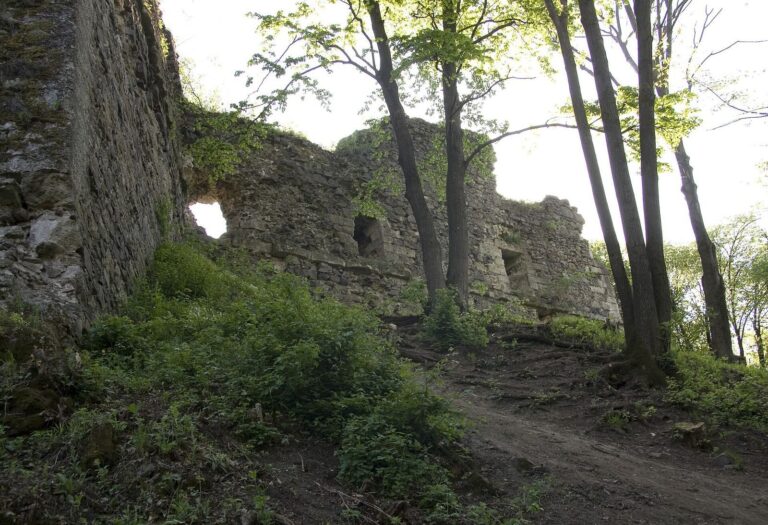
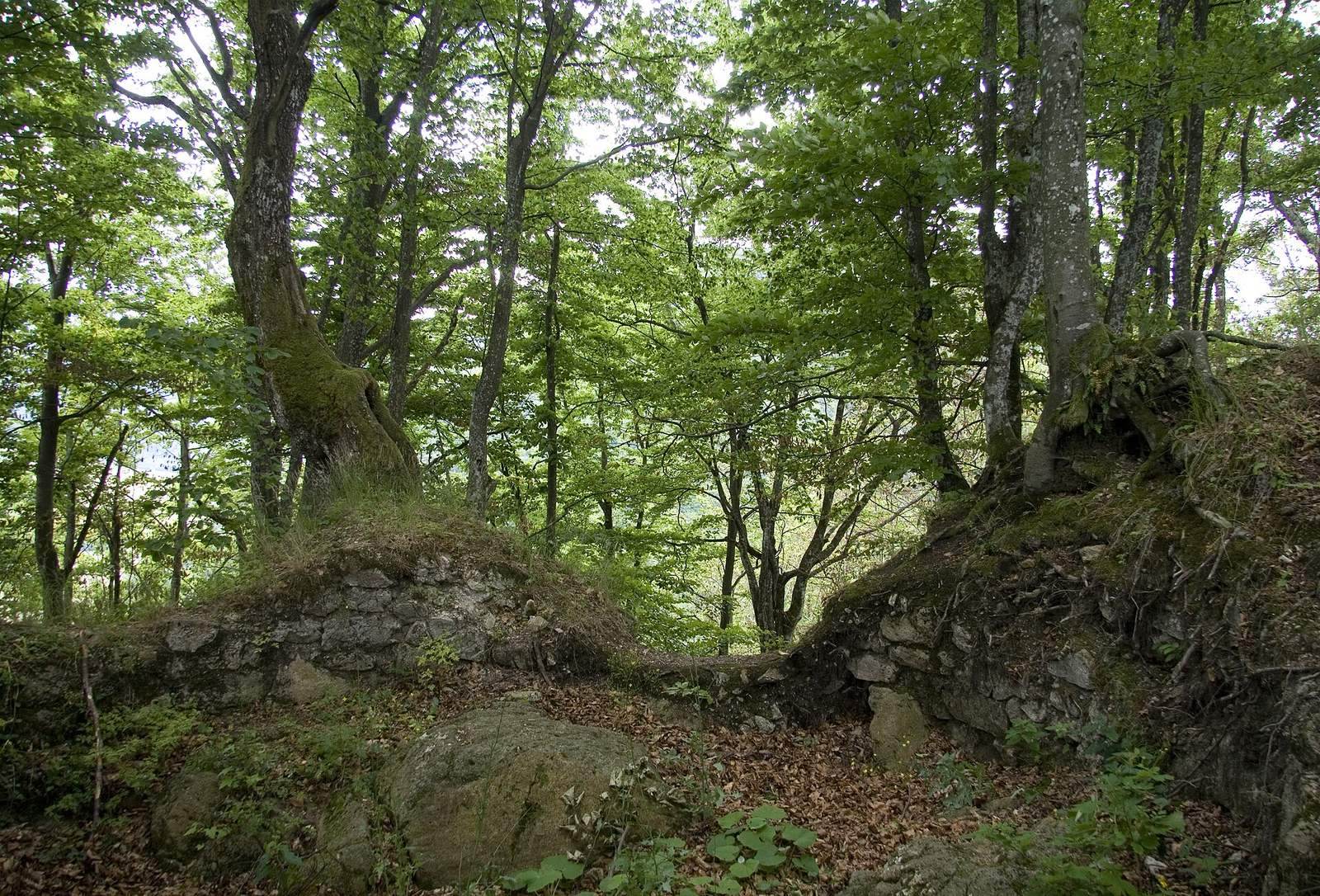
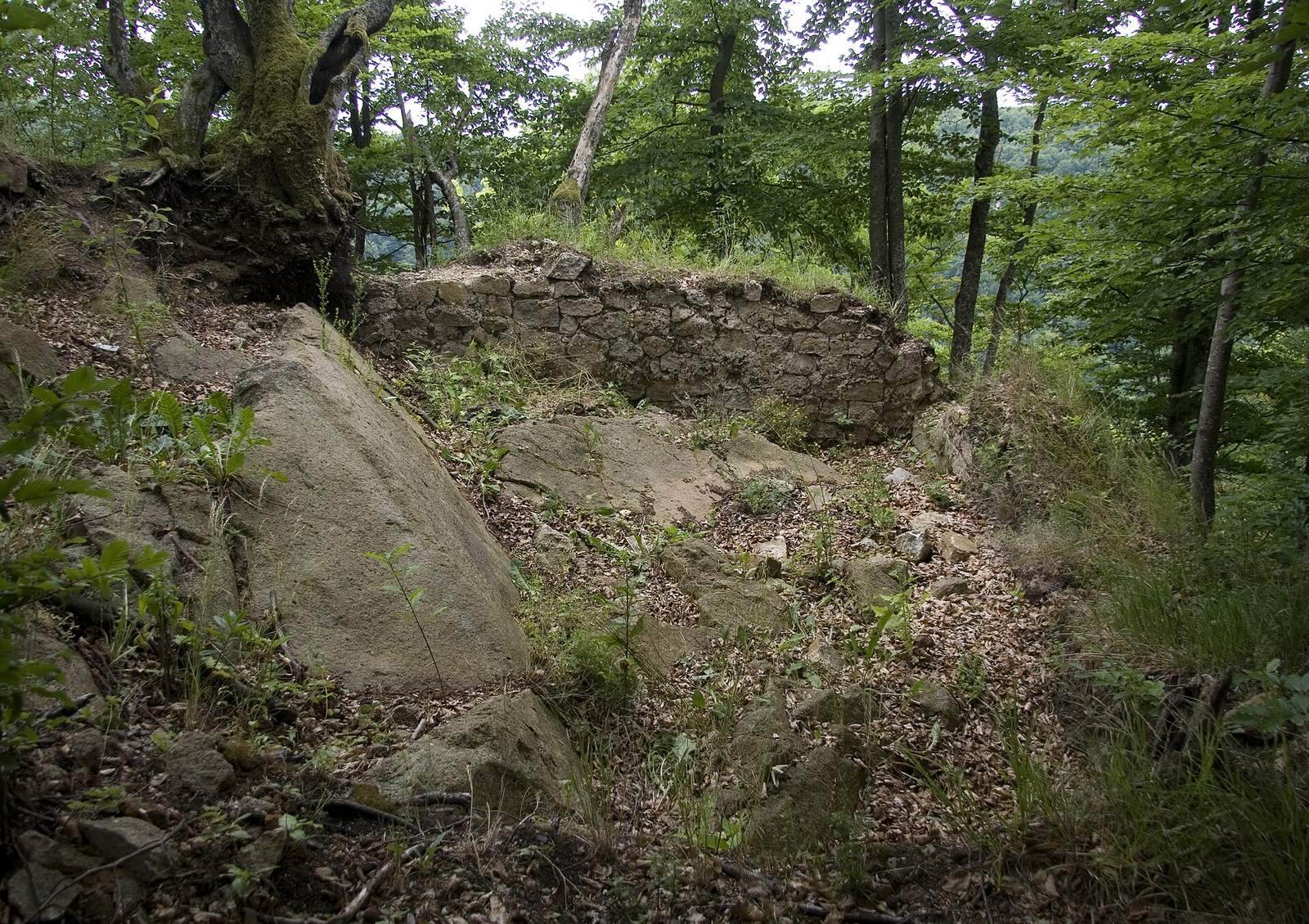
The castle occupied the rocky summit of steep Tsarska Mountain. The Bronka River bends around the mountain on its southern, western, and northwestern sides, enclosing the hill within a loop. The castle platform formed an elongated oval about 35 metres long and 14 metres wide, aligned roughly west to east. It was not levelled: the western end stands higher than the eastern end. The poorly prepared building surface may indicate that construction proceeded in haste.
Stone buildings and storage
Eastern tower and provisions cave
Traces of a circular stone tower were identified at the eastern end of the platform. It measured 7.8 metres across externally, with walls about 1 metre thick. The tower may have served as a lookout and helped defend the slope that was easiest to climb. A rock outcrop about 3 metres high adjoins it on the south; an artificial cave at the foot of the outcrop was used to store provisions.
Western building
The western part of the platform held a rectangular stone building measuring about 13.6 by 7.6 metres, with walls around 1 metre thick. It probably served as a residence. Its northern side bordered a slope of roughly 45 degrees, while sheer rock outcrops met its western side. The south and east sides faced the castle yard. The entrance may have been on the south, where a relatively level strip about 3 metres wide lay between the building and the steep slope.
Proposed reconstruction
A conjectural drawing by Hungarian military historian Elemér Soós shows three terraces enclosed by battlemented stone walls. Two cross-walls or banks divide the terraces into courtyards linked by gates, with the outer gate set in a tower. In this reconstruction, reaching the upper courtyard required crossing three defensive lines. The drawing also includes a freestanding circular main tower at the centre, with five levels and an entrance on the second, as well as several other buildings. This proposal does not fully match the archaeological evidence.
Finds and evidence of food
Finds from the hill include handmade pottery fragments from the Copper and Bronze Ages, an Austrian pfennig, a historical European coin dated 1270, and an ancient mace reportedly found by local schoolchildren on an excursion. Animal bones indicate hunting of wild boar, roe deer, deer, and wolves, along with fishing. Pork and beef were also eaten.