Castle Dyck: A Moated Noble Residence and Garden Heritage Centre in Germany


Site at a Glance
- Rating
- 4.6
- Popularity
- Medium
- Country
- Germany
- Primary era
- Early Modern
- External website
- Open
- Eras represented
- Medieval, Early Modern, Modern
- Civilizations
- German, Holy Roman Empire
- Site type
- Domestic
- Remains
- Castle
On this page13 sections
History
Castle Dyck is a moated castle in Germany, in Jüchen, whose recorded history begins in 1094 and whose principal residence was transformed into an early Baroque residence during the seventeenth century. From the eleventh century, it served as the administrative and official seat of the Imperial Lordship of Dyck, a territory of the Holy Roman Empire whose ruler held authority directly from the emperor. The castle was also the ancestral seat of the Dyck noble dynasty.
Medieval lordship and destruction
In 1094, Hermannus de Dicco was recorded as the lord of a simple fortification at the site. The location may have contained an extensive farmstead during the Roman period. Castle Dyck later became the centre of the surrounding lordship and remained associated with the Dyck family until the end of its male line.
In 1383, forces from Cologne and Aachen besieged the castle. They were led by Archbishop Friedrich III of Saarwerden and Duke William of Jülich and Guelders, after Gerhard von Dyck had been accused of robbery and knightly banditry. The attackers captured the castle and compelled Gerhard to destroy the high castle. It was rebuilt ten years later.
Gerhard’s death in 1394 ended the male line of the Dyck family. Johann V von Reifferscheidt inherited the castle and lordship, and his family thereafter used the name Reifferscheidt-Dyck. Under Johann VI, the family also inherited the counties of Upper and Lower Salm, establishing the Salm-Reifferscheidt-Dyck line.
Seventeenth- and eighteenth-century residence
Ernst Salentin von Salm-Reifferscheidt, a Cologne electoral colonel from 1645, commissioned the palace-like expansion of Castle Dyck. Plans for the work date to 1658, while the principal residence was built between 1636 and 1663. Much of the complex reflects rebuilding after destruction during the Thirty Years’ War, the major European conflict fought from 1618 to 1648.
During the seventeenth century, the castle became an early Baroque residence. Further Baroque and Rococo changes followed in the eighteenth century, when rooms received wall and ceiling paintings and stucco decoration. The Salm-Reifferscheid family continued to occupy the castle as its principal residence until 1930.
Princely family and wartime damage
The Salm-Reifferscheid family received the title of Imperial prince in 1804. After 1816, Castle Dyck formed part of the Prussian Rhine Province. In 1794, Prince Joseph zu Salm-Reifferscheidt-Dyck began replacing the formal Baroque garden with an English landscape garden, a style based on irregular planting, lawns, paths, water, and composed views rather than geometric symmetry.
After 1930, the princely family lived at Schloss Alfter near Bonn until 1961, although members of the Spanish royal family occupied Castle Dyck for an extended period. The Wehrmacht, the unified armed forces of Nazi Germany from 1935 to 1945, requisitioned the castle in 1939. A bomb severely damaged the south wing in 1945. Restoration followed the Second World War, particularly in 1961, and included the installation of an eighteenth-century Chinese silk wallpaper in one room.
Family residence and changing ownership
In 1950, the estate was divided among Prince Franz’s six daughters because the law limited each landowner to 100 hectares. Castle Dyck again became a residence of the Salm-Reifferscheid family in 1961. Cecilie, Altgravine and Princess of Salm-Reifferscheid-Krautheim and Dyck, Wild- and Rhine Countess, lived there until her death in 1991. The family still retains an apartment in the castle.
The castle library, which contained more than 10,000 works, and the hunting-weapons collection were sold at auction in 1992. From 1995 to 2000, the castle served as an exterior filming location for the television soap opera Verbotene Liebe, where it appeared under the fictional name “Schloss Friedenau.”
Foundation and cultural centre
In 1999, heiress Marie Christine Wolff Metternich transferred Castle Dyck and its gardens to the Stiftung Schloss Dyck. The foundation established the site as a centre for garden art and landscape culture. After it encountered financial difficulties, the state of North Rhine-Westphalia and the energy company RWE provided endowments intended to secure the castle’s long-term preservation.
Castle Dyck became the central venue of the decentralized 2002 North Rhine-Westphalia State Horticultural Show and the EUROGA 2002plus European Garden Region exhibition. These events led to new thematic gardens on the historic grounds and on Dycker Feld, a former agricultural area. Exhibition areas were completed in 2003, an international institute for garden art and landscape culture was founded in 2005, and the European Garden Heritage Network was expanded in 2006.
From 2004, the reorganized gardens were consolidated and presented permanently. Castle Dyck also became a founding member and the seat of the association responsible for the Garden Art Road between the Rhine and Meuse. Contemporary-art exhibitions have been held at the site since autumn 2003, while the Dyck Castle Concerts were established in 2004. From 2006 to 2021, the grounds hosted the Classic Days vintage-car event in support of the Stiftung Schloss Dyck; after negotiations failed, the event moved to Düsseldorf in 2022.
Remains
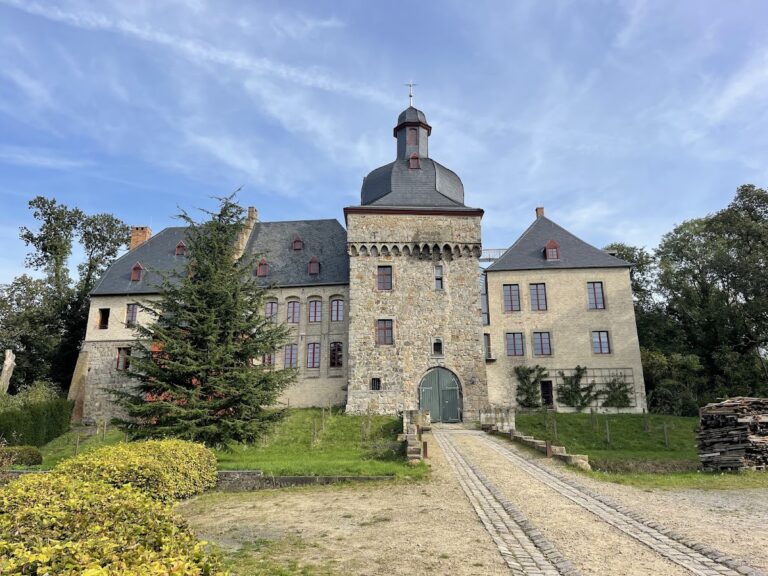
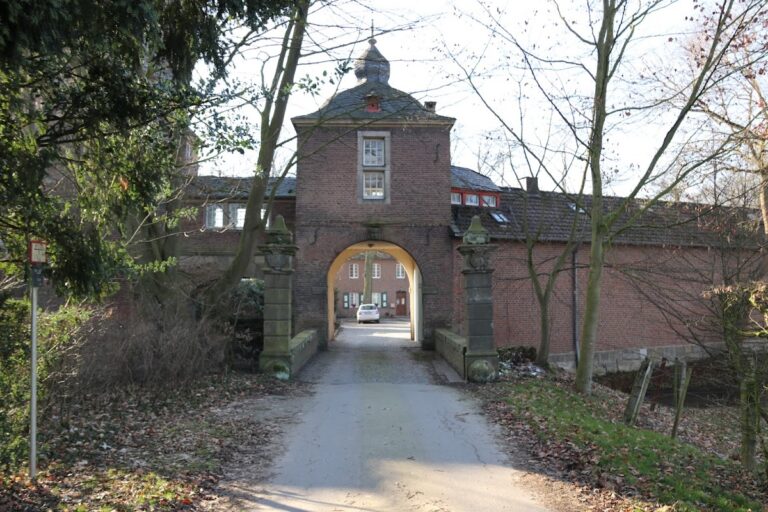
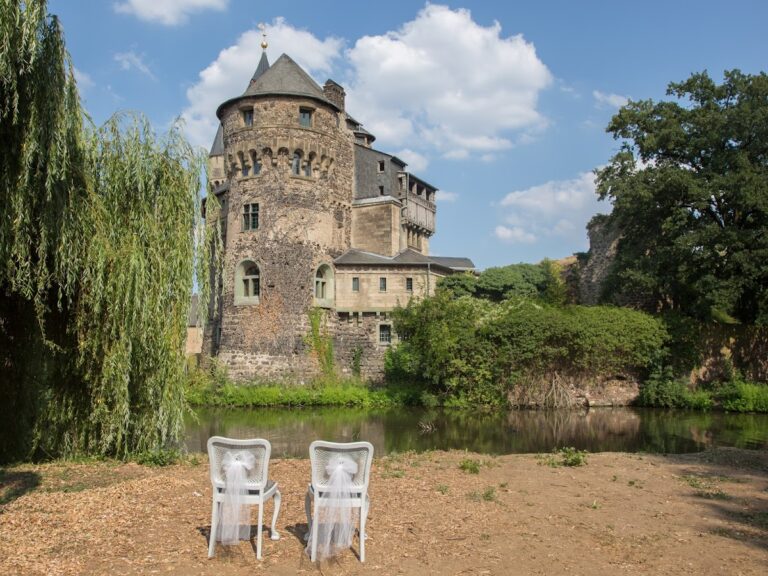
Castle Dyck occupies four islands within a triple moat, a system of water-filled defensive ditches. The complex includes the high castle, two outer baileys, and additional outbuildings and stables. Access to the main residence passes through the outer and inner baileys, linking the fortified areas with the palace-like core.
Castle complex
Principal residence
The principal residence is a four-wing complex built between 1636 and 1663. Corner towers enclose an almost square courtyard, and the seventeenth-century expansion renewed the watch rooms, stables, and brewery. The south wing was remodeled in 1897, when a representative staircase was added on the courtyard side. The residence retains eighteenth-century wall and ceiling paintings, stucco decoration, and an eighteenth-century Chinese silk wallpaper depicting everyday scenes of Chinese artisans and farmers.
Festival and performance spaces
The complex includes a historic festival hall and a courtyard used for performances. Present facilities also include a small hotel, food-service areas, a registry office, playgrounds, plant and fruit sales, a manufactory, and a farm shop.
Historic and expanded gardens
English landscape garden
The park was redesigned from 1794 as an English landscape garden under Prince Joseph zu Salm-Reifferscheidt-Dyck, replacing the eighteenth-century Baroque garden. Thomas Blaikie was the principal garden architect, with contributions from Maximilian Friedrich Weyhe and Peter Joseph Lenné. More than 150 rare trees were planted, including a Japanese ginkgo and a North American bald cypress. The park is also known for its valuable woody plants and botanical rarities.
Joseph zu Salm-Reifferscheidt-Dyck recorded the plants cultivated in the park and gardens in the Hortus Dyckensis. He also founded the Castle Dyck library, whose principal subject was botany.
Dycker Feld gardens
The 2002 horticultural exhibition created an integrated park across a 24-hectare former agricultural area. Its design contains rectangular beds of reeds and Miscanthus, broad intervening lawns, anthracite-colored radial paths, and central sightlines and connections. A historic avenue of sweet chestnuts provides the reference point for the layout.
A Lower Rhine landscape garden dedicated to Hanns Dieter Hüsch forms part of the expanded grounds. A modern bamboo garden was added during the 2005 Year of Bamboo. The exhibition-related work also included a sculpture by Ulrich Rückriem, while two stainless-steel sculptures by Beate Schroedl were displayed in the historic park in connection with the bamboo theme and an exhibition of her work.