Castillo Mayor: A Muslim Fortress in Calatayud, Spain


Site at a Glance
- Rating
- 3.9
- Popularity
- Low
- Country
- Spain
- Primary era
- Medieval
- External website
- Open
- Eras represented
- Medieval, Early Modern, Modern
- Civilizations
- French, Spanish, Umayyad
- Site type
- Military
- Remains
- Castle
On this page8 sections
History
Castillo Mayor is a ninth-century Muslim fortress in Calatayud, Spain, originally known as Qalat Ayyub. It gave its name to the city and formed the origin of the present urban settlement. Calatayud is traditionally said to have been founded in 716, when Ayyub ben Habib al-Lajmi established it at the site now occupied by Doña Martina Castle.
Foundation and the Emirate of Córdoba
In 862, Muhammad I, the emir of Córdoba, commissioned Abd al-Rahman ben Abdelaziz al-Tuyibi to enlarge Calatayud’s fortifications. The work strengthened the city against the Banu Qasi, a Muslim ruling family whose authority was centered in the Ebro valley. At this time, Calatayud belonged to the Upper March, the northeastern frontier region of Muslim al-Andalus, whose administrative center was Zaragoza. The fortress also served a district that included Daroca.
Calatayud joined the Tuyibis of Zaragoza in rebellion against the Córdoba caliphate, the Muslim state that succeeded the emirate. Abd al-Rahman III captured the city in 937. This episode placed Castillo Mayor within the political and military struggles that shaped the northeastern frontier of al-Andalus.
The Zaragoza taifa and Christian conquest
By 1031, Calatayud had become one of the principal cities of the Zaragoza taifa. A taifa was an independently ruled Muslim kingdom that emerged in Iberia after the weakening of the Córdoba caliphate. The city experienced considerable economic and cultural prosperity until approximately 1110. Around 1050, during a short period of semi-independence, it declared itself an independent taifa under Muhammad ben Hud and minted its own coinage.
The Almoravids, a North African Muslim dynasty that controlled much of Iberia in the late eleventh and early twelfth centuries, took control of the peninsula in 1110 while attempting to contain Christian expansion. In 1120, Alfonso I of Aragon besieged Calatayud. The city surrendered after the Almoravid defeat at the Battle of Cutanda.
Military changes from the eighteenth century onward
Castillo Mayor was substantially altered after the War of the Spanish Succession. In 1705, following the promulgation of the Nueva Planta Decrees, Philip V ordered the castle to be dismantled because Aragon had supported Archduke Charles, the Habsburg claimant to the Spanish throne. The decrees reduced the traditional institutions and privileges of territories that had opposed Philip V.
French troops later used the castle during the Peninsular War, the Iberian conflict against Napoleonic France, and modified its structure. Further changes were made during the Carlist Wars, nineteenth-century Spanish civil conflicts connected to rival claims to the throne, when the fortress was adapted for artillery. Castillo Mayor is now classified as an Asset of Cultural Interest under Aragón’s heritage system. The designation was made by resolution dated 17 April 2006 and published on 22 May 2006.
Remains
Enclosures and towers
Fortified setting and enclosures
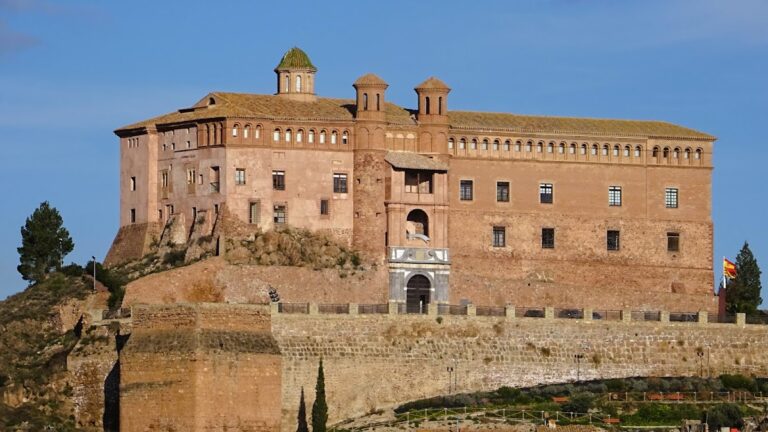
Castillo Mayor forms part of the fortified enclosure around Calatayud’s old city. The wider defensive system links five hilltop castles through almost four kilometers of walls. Castillo Mayor occupies an oval gypsum plateau at the city’s highest and most visible point, north of the Clock Castle and east of Torre Mocha and its perimeter enclosure. The fortress has two enclosures: a higher, older enclosure facing the city and a lower enclosure to the north that expanded the original castle.
Towers and La Longía
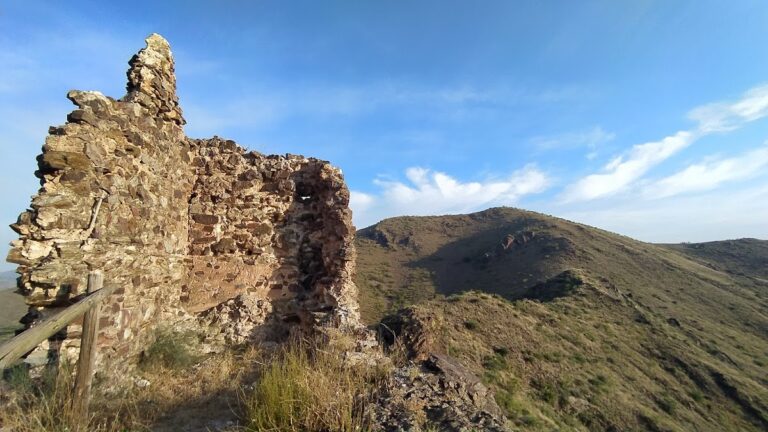
Four towers are identified by their positions within the enclosure. The east and west towers have externally octagonal plans, two vaulted levels, and roofs formed by false domes. The south tower is square in plan and is the least well preserved. The central tower has a semi-octagonal plan and retains considerable height. Both the south and central towers are covered by slightly pointed barrel vaults.
The south and central towers enclose a broad area probably used as an albacara, an open fortified enclosure for refuge or for containing people and livestock. This space is known as La Longía. Together with the two enclosures and the surviving towers, it forms the principal physical remains of Castillo Mayor, which is described as the most important and best-preserved castle in Calatayud’s fortified complex.
Nearby sites