Castillo de Tíscar: A Medieval Frontier Fortress in Spain


Site at a Glance
- Rating
- 4.2
- Popularity
- Very Low
- Country
- Spain
- Primary era
- Medieval
- External website
- Open
- Eras represented
- Medieval
- Civilizations
- Crown of Castile, Nasrid
- Site type
- Military
- Remains
- Castle
On this page9 sections
History
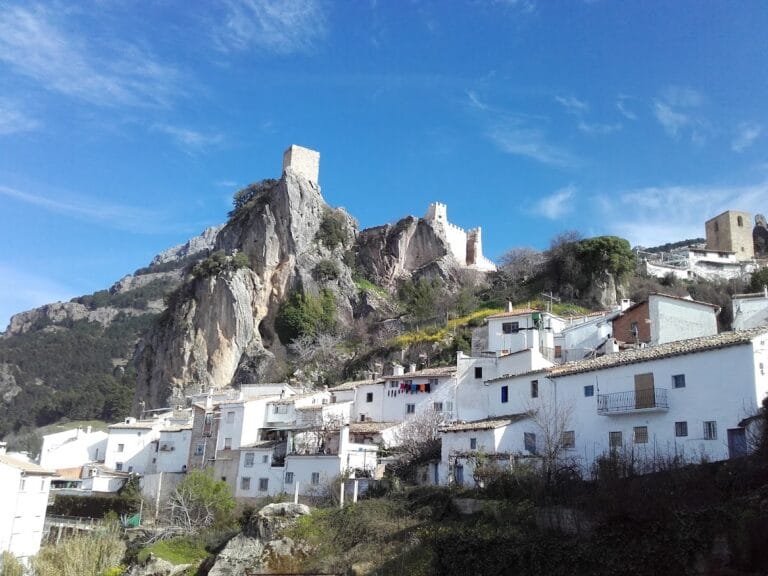
Castillo de Tíscar is a medieval Muslim fortress in Spain, beside the Sanctuary of the Virgin of Tíscar in Jaén, about 13 kilometres south of Quesada. Built during the Andalusi period, the centuries when Muslim-ruled states controlled much of the Iberian Peninsula, it served for nearly a century as an advance position of the Nasrid Kingdom of Granada in the frontier district of Cazorla. The Nasrids ruled the last Muslim kingdom in Iberia, which remained in existence until its conquest by Castile in 1492. From Tíscar, raids were launched against Quesada, and the fortress was praised for its seemingly impregnable defenses by the writers Al-Razi and Al-Idrisi.
The Nasrid frontier
In May 1319, the Castilian infante Pedro conquered Tíscar. An infante was a son of a reigning or former Iberian monarch who was not heir to the throne. Pedro, a son of Sancho IV and Queen María de Molina, was then one of the tutors of the minor King Alfonso XI, serving with Queen María and Infante Juan, son of Alfonso X.
The Chronicle and the Great Chronicle of Alfonso XI describe the events leading to the siege. Pedro was at Úbeda with the masters of the military orders of Santiago, Calatrava, and Alcántara, Catholic religious and military institutions that held land and fought on the medieval Iberian frontier. The archbishops of Toledo and Seville were also present. Pedro asked Mahomad Handon, lord of Tíscar, to become a vassal of Alfonso XI. The scouts Pero Joan de Berrio and Ramos de Xérez carried the proposal and were instructed to study how the fortress could be taken, but Mahomad Handon refused.
Pedro then prepared an expedition in secret. He ordered provisions for twelve days while spreading the false impression that his army was heading elsewhere. The troops first followed a road leading away from Tíscar, then turned back toward the fortress. The strength of the defenses alarmed Pedro, who ordered siege engines to be brought forward. The siege lasted thirteen days, and the defenders prevented a rapid capture. Pedro’s troops were forced to fight on foot, wearing footwear made from esparto fiber.
The capture of 1319
A turning point came when Pero Fidalgo, a very short soldier under the master of Calatrava, climbed Peña Negra at night with several companions. At dawn they attacked the ten Muslim defenders there, killed them, and seized the position. Pedro followed this success with a general assault that captured the village of Tíscar.
After losing Peña Negra and the village, Mahomad Handon agreed to surrender the castle. He requested safe departure for himself and the remaining Muslim defenders, together with their belongings. Pedro, unwilling to prolong the siege, accepted. He guaranteed safe passage for the 4,500 people living at Tíscar until they reached Baza.
On 25 June 1319, one month after the conquest, Infantes Pedro and Juan died at the Disaster of the Vega of Granada at Pinos Puente. Control of the fortress continued to require organized settlement and maintenance. On 13 June 1321, Alfonso XI’s tutors ordered the inhabitants of Tíscar, Quesada, Bélmez, Cambil, and Alhamar to pay for the upkeep of their castles and watchtowers. Property could be confiscated by the Crown if payment was not made within thirty days.
Castilian administration and defense
On 1 June 1329, Alfonso XI confirmed an earlier grant affecting Tíscar, Quesada, Cambil, Alhamar, and other fortresses on the Granada frontier. The measure freed their inhabitants from debts and “malfrentas,” a medieval term for wrongs or grievances, in order to encourage settlement.
On 28 November 1335, Alfonso XI granted Castillo de Tíscar to the council of Úbeda, a medieval municipal council, so that it would populate and defend the fortress. The grant included privileges and exemptions. On 6 February 1336, Úbeda received 15,000 maravedís each year and 30 cahices of wheat for fifteen years to maintain the castle. A maravedí was a medieval Iberian monetary unit, while a cahiz was a large measure of grain whose capacity varied by region. The supplies came from the royal thirds of the Bishop of Jaén’s grain revenues, meaning portions of ecclesiastical income claimed by the Crown. On 15 September 1338, Alfonso XI ordered a further 3,000 maravedís for work on the castles of Tíscar, Quesada, and Albanchez.
Castillo de Tíscar is protected as a Spanish Asset of Cultural Interest in the category of Monument. Its protection derives from the decree of 22 April 1949 concerning Spanish castles and Law 16/1985 on Spanish Historical Heritage. The designation is recorded from 29 June 1985 under reference RI-51-0007963.
Remains
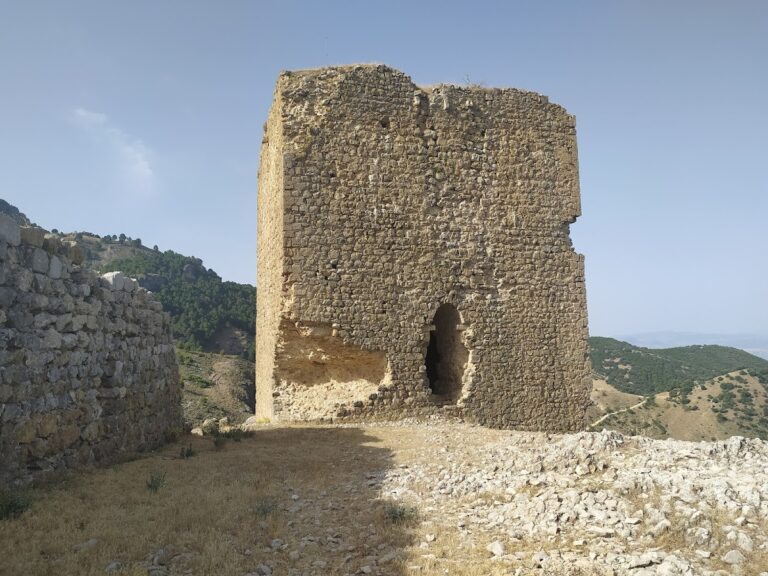
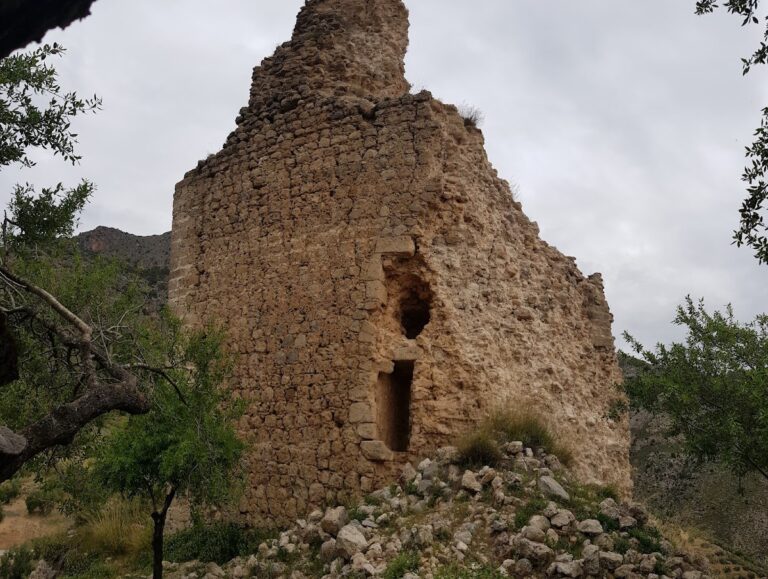
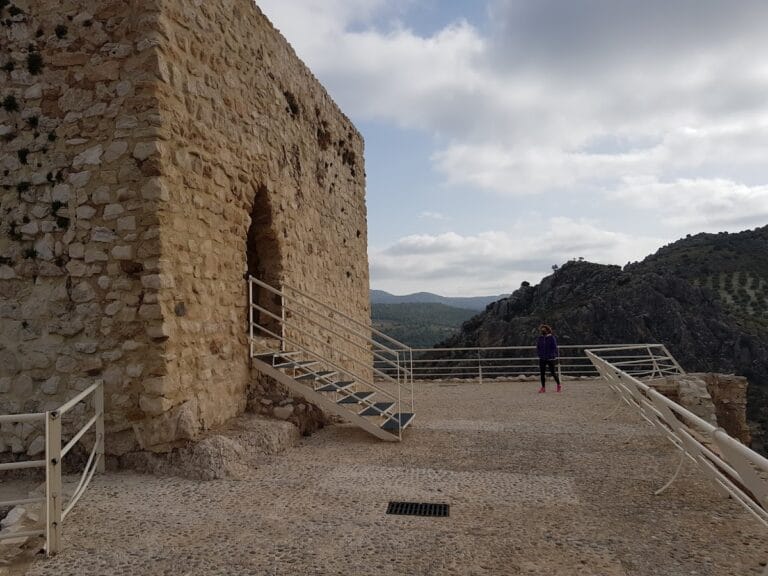
Castillo de Tíscar occupies a rocky ridge beside the sanctuary. It forms a small fortified enclosure whose walls use the natural rock formations to close the spaces between them. Rough compacted-earth construction predominates, with sections of irregular stone masonry, while a small keep stands at the eastern end. A large rock called Peña Negra rises within the enclosure and may have served as an inner fortified position, or alcazarejo, inside the larger castle.
Fortified enclosure
Walls
The enclosure walls are built mainly from rough rammed earth, a technique in which compacted earth is formed in successive layers. Other stretches use irregular stone masonry. Rather than standing independently across open ground, the wall lines attach directly to the rocky ridge and seal the gaps between its outcrops. This structure is attributed to the Andalusi period and expresses the fortress’s adaptation to its elevated, uneven setting.
Peña Negra
Peña Negra is the large central rock within the enclosure. Its position and fortification made it a defensible inner point, and it may have functioned as the castle’s alcazarejo, a smaller stronghold within a larger fortified enclosure. In the 1319 siege, Pero Fidalgo and his companions climbed the rock at night and captured it at dawn from its ten defenders. The seizure helped bring about the fall of the village and the subsequent surrender of the castle.
Eastern keep
A small keep occupies the eastern end of the enclosure. Unlike the wall system, which belongs to the Andalusi period, the keep is considered to date from the first half of the fourteenth century, shortly after the Castilian conquest. Its position forms the principal later addition to the surviving fortified layout.
Nearby sites