Castillo de Sobradillo: A Frontier Fortress in Spain

Site at a Glance
- Rating
- 4.5
- Popularity
- Very Low
- Country
- Spain
- Primary era
- Medieval
- Eras represented
- Medieval
- Civilizations
- Crown of Castile, Kingdom of León
- Site type
- Military
- Remains
- Castle
On this page7 sections
History
Castillo de Sobradillo is a frontier fortress in Spain, near the Águeda River in the municipality of Sobradillo, built during the first third of the fifteenth century for defense against Portugal. It occupies part of the historic Raya, the border region between Spain and Portugal where fortifications monitored movement and resisted incursions. The castle also served as a seigneurial residence for lords, soldiers, and servants.
Medieval origins and noble ownership
The fortress probably replaced an earlier twelfth-century watchtower. Alfonso de Ocampo, a medieval nobleman, ordered the fifteenth-century construction for defensive purposes. The earliest known record dates from the reign of Enrique II, the fourteenth-century king of Castile. At that time, the fortress belonged to his brother, Count Sancho, and to Sancho’s wife, Beatriz of Portugal.
The castle remained in the family’s possession until 1508. In that year, Pedro Ocampo, then lord of Sobradillo, took control of it by force.
Frontier defense and decline
Castillo de Sobradillo formed part of the defensive network along the Spanish-Portuguese frontier. Its military role was strengthened by the natural protection provided by the Águeda River. By 1643, however, the fortress was described as an old stronghold without defenses, even though a garrison of 120 men remained there.
During the eighteenth century, the castle passed to the Marquisate of Cardeñosa, a territorial lordship held by a marquis. Portuguese sieges contributed to its deterioration. The castle, or what remained of it, passed to the Spanish state in 1851 and then endured a long period without maintenance.
Modern restoration and use
In 1985, responsibility for its use was transferred to the Junta of Castile and León, the regional government of the autonomous community that includes Sobradillo. This change began a restoration process. The complex was tidied in 1995 and restored in 2000. It now houses the Casa del Parque of Arribes del Duero, a foundation that promotes public use of the region’s natural heritage through visits to the monument and its surroundings.
Castillo de Sobradillo is protected by the generic declaration of 22 April 1948 concerning Spanish castles and by Law 16/1985 on Spanish Historical Heritage.
Remains
Fortified enclosure
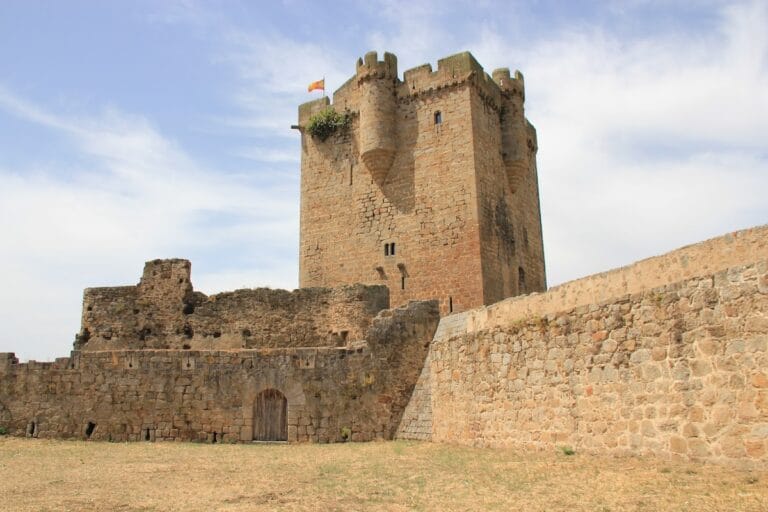
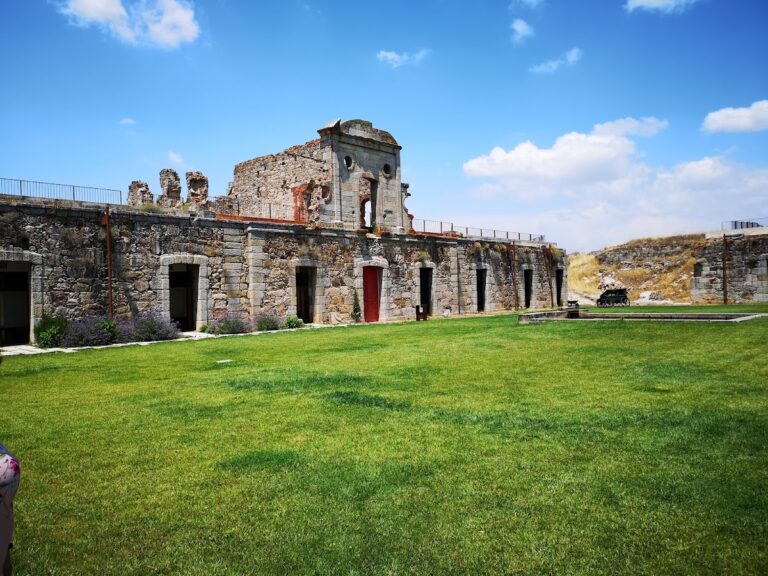
The surviving castle takes the form of a tower-shaped enclosure built with rubble masonry and reinforced by ashlar blocks at the corners. Sentry boxes, small guarded shelters built into or projecting from a fortification, reinforce its military character. The former parade ground has become a modern square, while the enclosure preserves the material evidence of its defensive and residential functions.
Surviving tower and palace
The tower is divided into three levels by wooden structures. A large former fireplace remains visible on the second level, recalling the building’s use as a place of residence as well as defense. The fortress now survives principally through this watchtower and the remains of a feudal palace, the residential and administrative center of a lord’s estate.