Albrechtsberg Castle on the Große Krems: A Renaissance Castle Complex
Site at a Glance
- Rating
- 4.5
- Popularity
- Very Low
- Country
- Austria
- Primary era
- Early Modern
- Eras represented
- Early Modern
- Civilizations
- Habsburg, Holy Roman Empire
- Site type
- Military
- Remains
- Castle
On this page8 sections
History
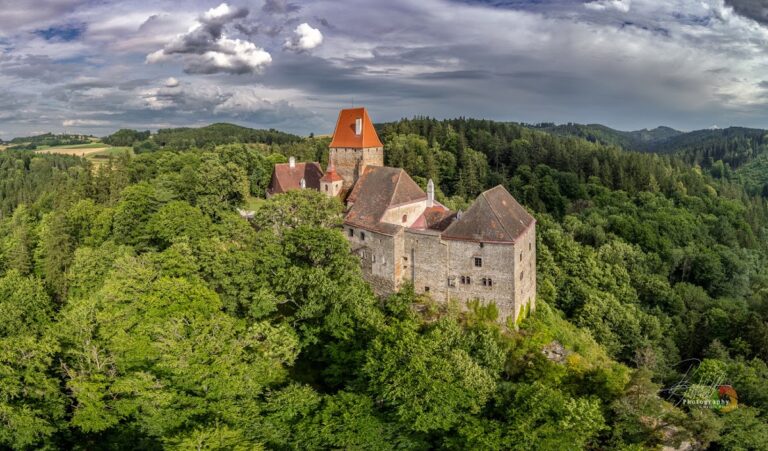
Albrechtsberg Castle on the Große Krems is a preserved hilltop castle complex in Austria, developed from a medieval lordly seat into a Renaissance castle during the second half of the sixteenth century. Its history is connected with the settlement of the Waldviertel within the Eastern March, the frontier territory that developed into the Austrian march, and with several noble families who held and transformed the estate.
Settlement and the Medieval Lordship
Albrechtsberg belonged to the early colonization of the Waldviertel. After the Hungarian incursions, the Babenberg margraves, the medieval ruling dynasty of Austria, encouraged the formation of new lordships through forest clearance. In the valley of the Große Krems, a lordly seat belonging to a ministerial named Adelhart is suspected from around 1100. A ministerial was a member of the service nobility who held authority on behalf of a ruler or lord.
The settlement was first mentioned in 1137 under the name Elharteschirchen. The castle itself appears in the historical record in 1230, in connection with Konrad of Albrechtsperge. Gundakar of Starhemberg held the lordship in 1263. In 1377, Rüdiger the Younger of Starhemberg sold it to Ulrich of Neidegg, whose Protestant family retained the castle until 1527.
War and Renaissance Expansion
The castle suffered severe damage during the Hussite Wars, fifteenth-century religious and political conflicts centered in Bohemia. In 1527, the knight Erasmus von Peuckham acquired the lordship from the Neidegg family. He expanded the damaged medieval complex into a Renaissance castle, creating the form that still defines much of the site.
Further destruction came during the Thirty Years’ War, the major European conflict of 1618 to 1648 involving religious, dynastic, and political struggles. Imperial troops under Charles Bonaventure de Longueval inflicted severe devastation on the castle in 1619. Hans Bernhard von Peuckham, a Protestant relative of the later holder Christoph Wilhelm Veldendorf, died from the consequences of the fighting in 1620.
Later Noble Ownership
Christoph Wilhelm Veldendorf received the lordship in 1630. After his death, Hans Bernhard Zägkhler acquired the complex in 1652, but sold it ten years later to the court official Matthias Ernst Spindler von und zu Hofegg. Spindler enlarged the castle further, placed it within an entailed estate, and bequeathed it in 1695 to his grandson Hans Karl Ignaz von Lempruch. An entailed estate was a legally restricted hereditary property intended to keep land within a family and prevent its ordinary division or sale.
The Lempruch family and their descendants retained the castle until Karl Lempruch sold it in the 1950s. The paleontologist Edith Kristan-Tollmann and the geologist Alexander Tollmann purchased it in 1990 and lived there. Their son Raoul Tollmann owned the property from 2007 to 2021, and Erich Erber acquired it in 2022.
Albrechtsberg Castle is a listed monument in Austria and is included in the country’s cultural-heritage information system. Its historical associations also continue through the castle chapel, which contains the burial place of the Neidegg family.
Remains
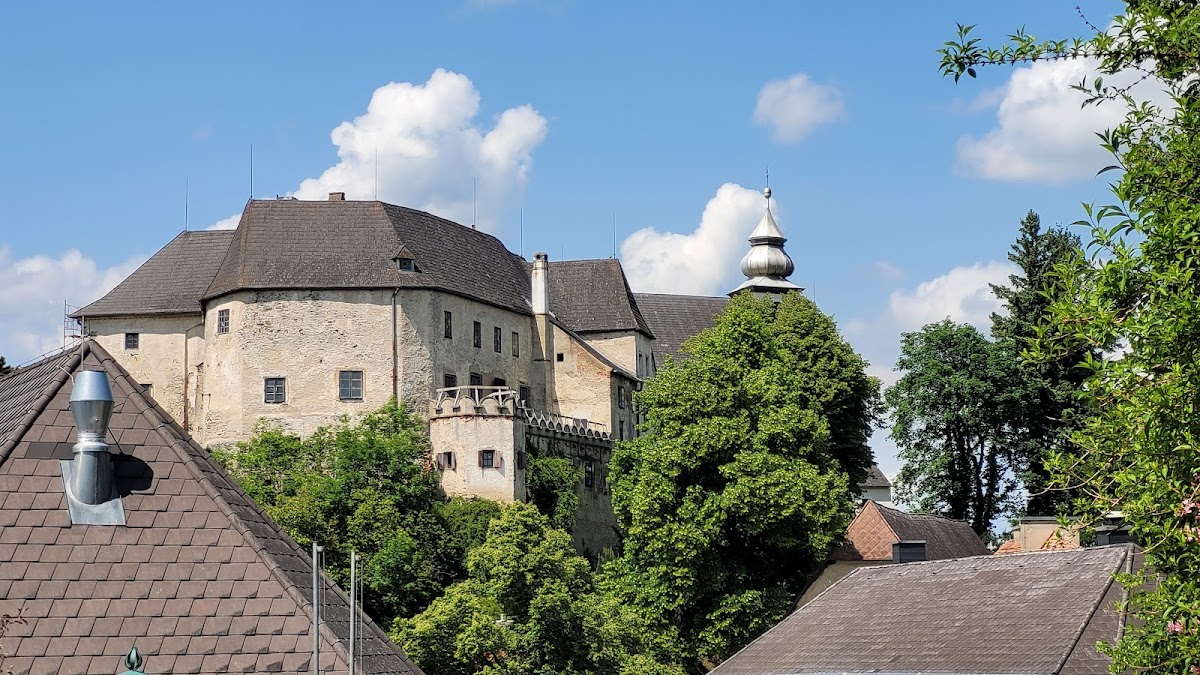
The surviving complex rises irregularly on a hill in Albrechtsberg an der Großen Krems, with the Albrechtsberg parish church attached to it. Its vertically arranged buildings form three storeys and several wings around three courtyards. Much of the visible structure belongs to the Renaissance expansion of the earlier castle, while later additions include an eighteenth-century storage building.
Walls, Towers, and Entrances
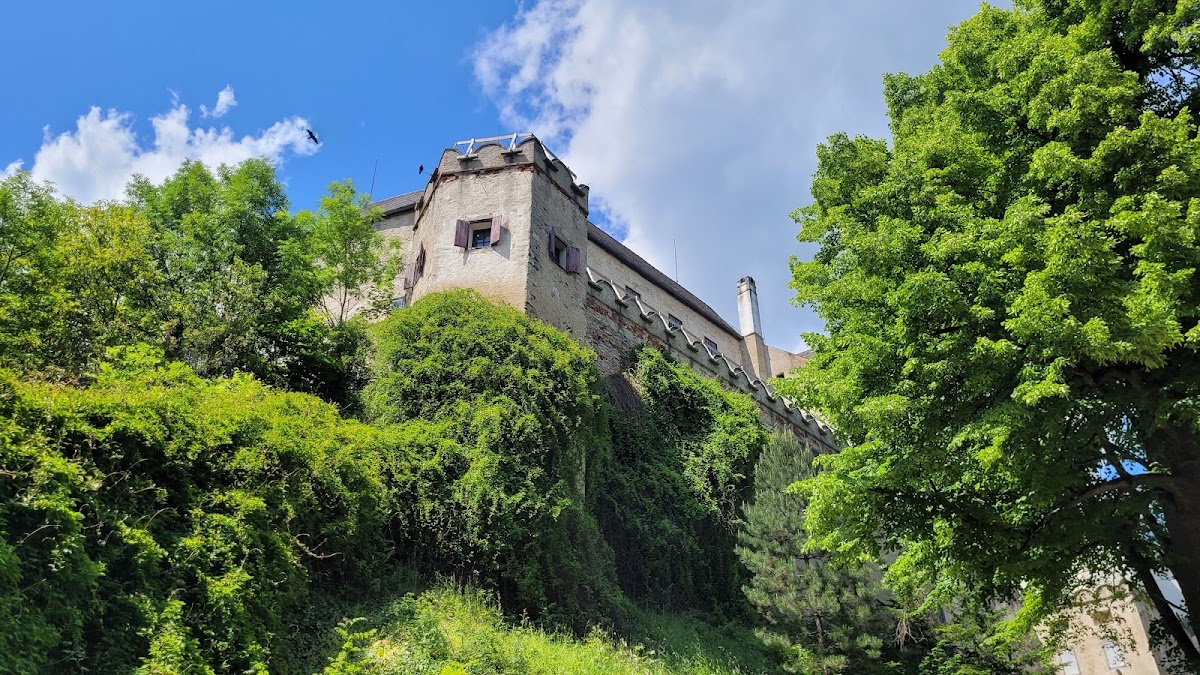
High, battlemented enclosing walls surround the complex, with defensive and watchtowers projecting from them. The towers contain numerous keyhole-shaped loopholes, narrow openings designed for firearms. The southern entrance passes through a round-arched portal whose gable carries the date 1675. The principal gate is positioned to the northeast and includes a machicolation, a projecting opening through which defenders could observe or attack targets below the gate.
Courtyards and Interior Rooms
One courtyard contains an arcade supported by squat columns and covered with groin vaulting, vaulted ceilings formed where two barrel vaults intersect. Inside the castle are rooms with groin vaults and a smoke kitchen, where smoke historically escaped through the room or a large chimney rather than through a modern flue. The kitchen has a pyramidal chimney, while a wooden ceiling bears the date 1604.
Granary and Chapel
The complex includes an eighteenth-century granary with a clipped-hip roof. A granary was used to store grain and other agricultural supplies. The castle chapel contains the burial place of the Neidegg family, preserving a direct physical connection with one of the noble houses that held Albrechtsberg before its Renaissance transformation.
Nearby sites