Castell del Brull: A Romanesque Fortification and Jurisdictional Centre in Spain
Site at a Glance
- Rating
- 4.4
- Popularity
- Low
- Country
- Spain
- Primary era
- Medieval
- External website
- Open
- Eras represented
- Medieval
- Civilizations
- Crown of Aragon
- Site type
- Military
- Remains
- Castle
On this page8 sections
History
Castell del Brull is a Romanesque fortification in Spain, associated with the tenth century and represented today by construction phases from the twelfth and thirteenth centuries. Originally belonging to the territory of Seva, it later became the jurisdictional centre of Brull and was held by the counts of Barcelona and the viscounts of Osona-Cardona. Romanesque architecture was a medieval style marked by heavy masonry, rounded arches, sturdy proportions, and relatively small openings.
Medieval lordship and conflict
During the second half of the twelfth century, the castle became the focus of a dispute between the viscount Guillem Ramon and the seneschal Guillem Ramon I de Montcada. A seneschal was a senior official with important administrative and military responsibilities. The viscount had pledged the castle to Montcada for 2,000 maravedis, a medieval monetary unit, and Montcada retained it until the debt was repaid.
Guillem Ramon then organized an armed expedition to recover the castle. The action brought royal intervention because he was attempting to administer justice independently. Montcada ultimately recovered the castle, and the king apparently took no further action.
In the thirteenth century, the lords of the fortified house of Esparraguera and the fortress of Puig de Terrades, both located within the castle’s territory, entered into feudal agreements with the viscounts of Cardona. In exchange for protection, they promised never to attack the viscounts.
The barony of Brull
In 1265, the viscount Ramon de Cardona sold the barony of Brull to the bishop of Vic. A barony was a territorial lordship whose holder exercised jurisdiction over dependent lands and inhabitants. Brull remained part of the barony of the bishopric of Vic until jurisdictional lordships disappeared.
Santa Maria del Brull
The associated church of Santa Maria del Brull is documented from 1018. A new church was built between 1048 and 1060 and continued to serve as the parish church of the settlement. Guillem de Balsareny, bishop of Vic, consecrated it. From the fourteenth century, one of its altars was dedicated to Santa Maria, while extensive reforms took place between the sixteenth and eighteenth centuries.
Castell del Brull is protected as a Cultural Asset of National Interest under Catalan heritage law and as a Spanish Asset of Cultural Interest since 1988.
Remains
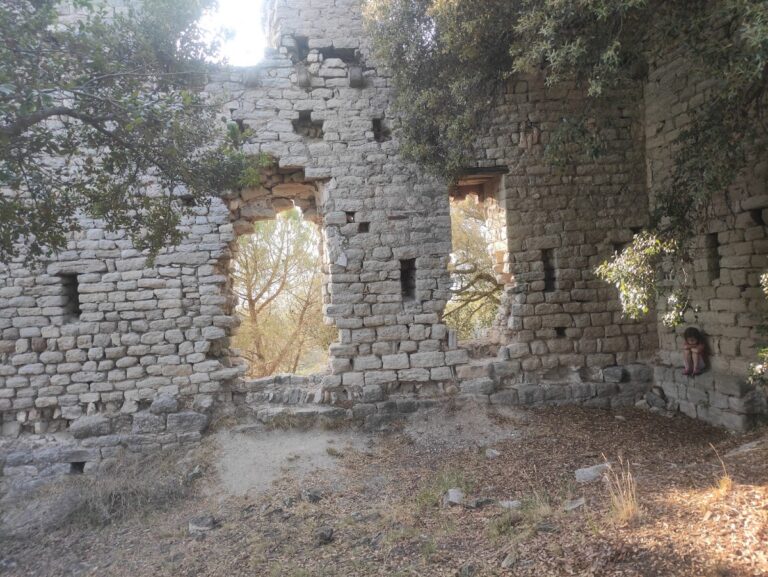
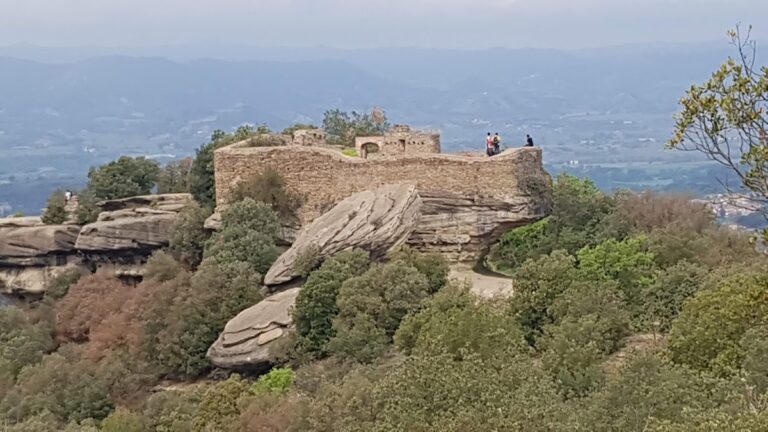
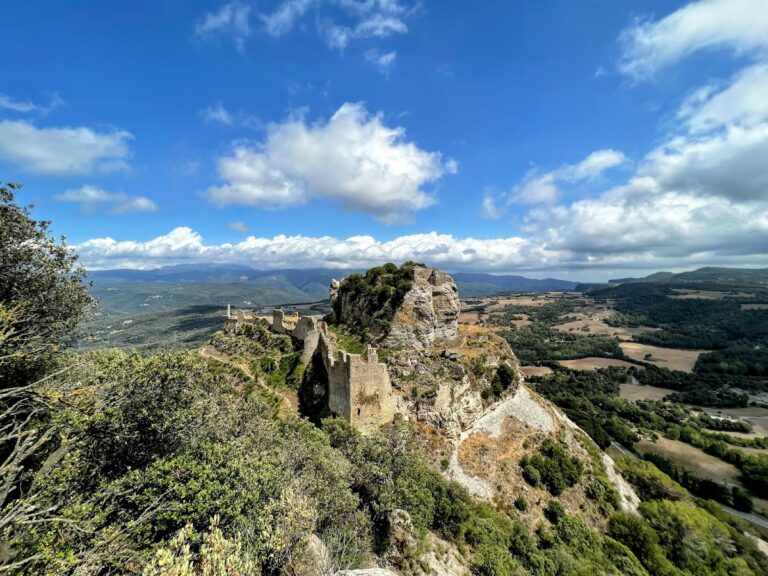
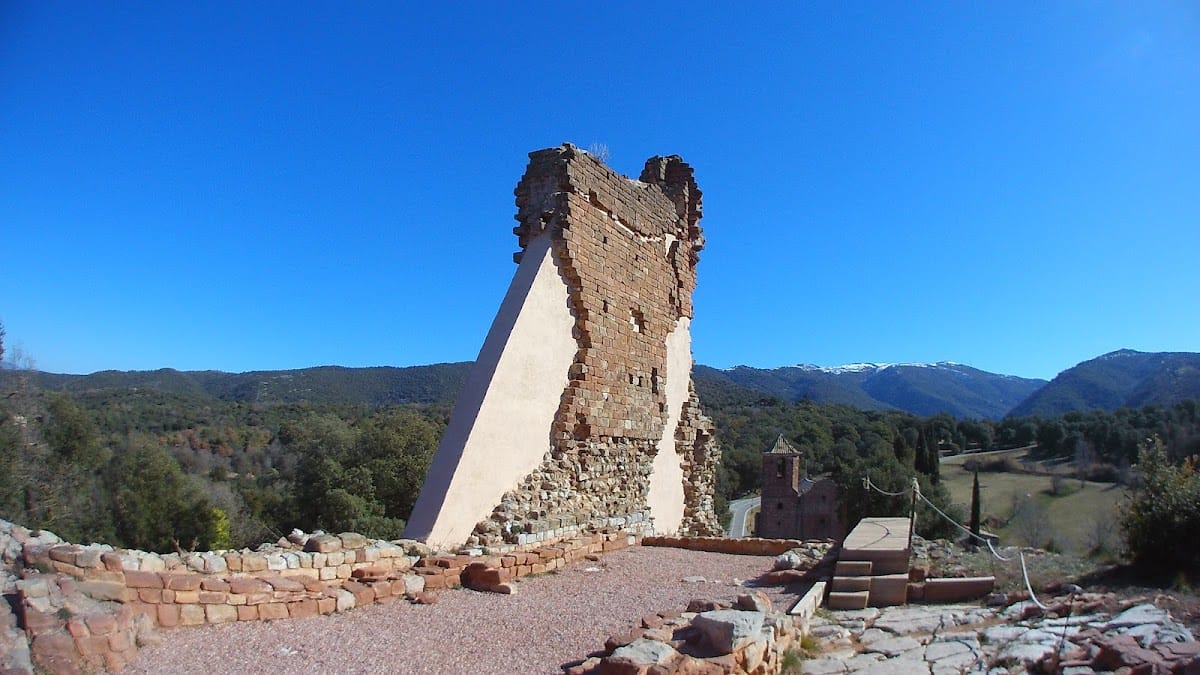
The surviving site is a small portion of a Romanesque fortification positioned at 859 metres above sea level. Its original plan appears to have been pentagonal, with the point directed south. Circular towers reinforced the corners, and another tower stood at the centre of the north wall. The principal remains belong to the fortification’s northeast angle, together with a fragment of the north wall and part of the associated church.
Surviving buildings
Castle remains
The visible castle remains centre on a tower about one metre wide. When the fortification was reinforced, this earlier tower was enclosed by a second tower. The older masonry uses well-cut limestone ashlar blocks, while the later outer masonry consists of larger red sandstone blocks. The contrast between the materials makes the two construction phases distinguishable. A section of the north wall also survives, including a severely damaged window.
Santa Maria del Brull
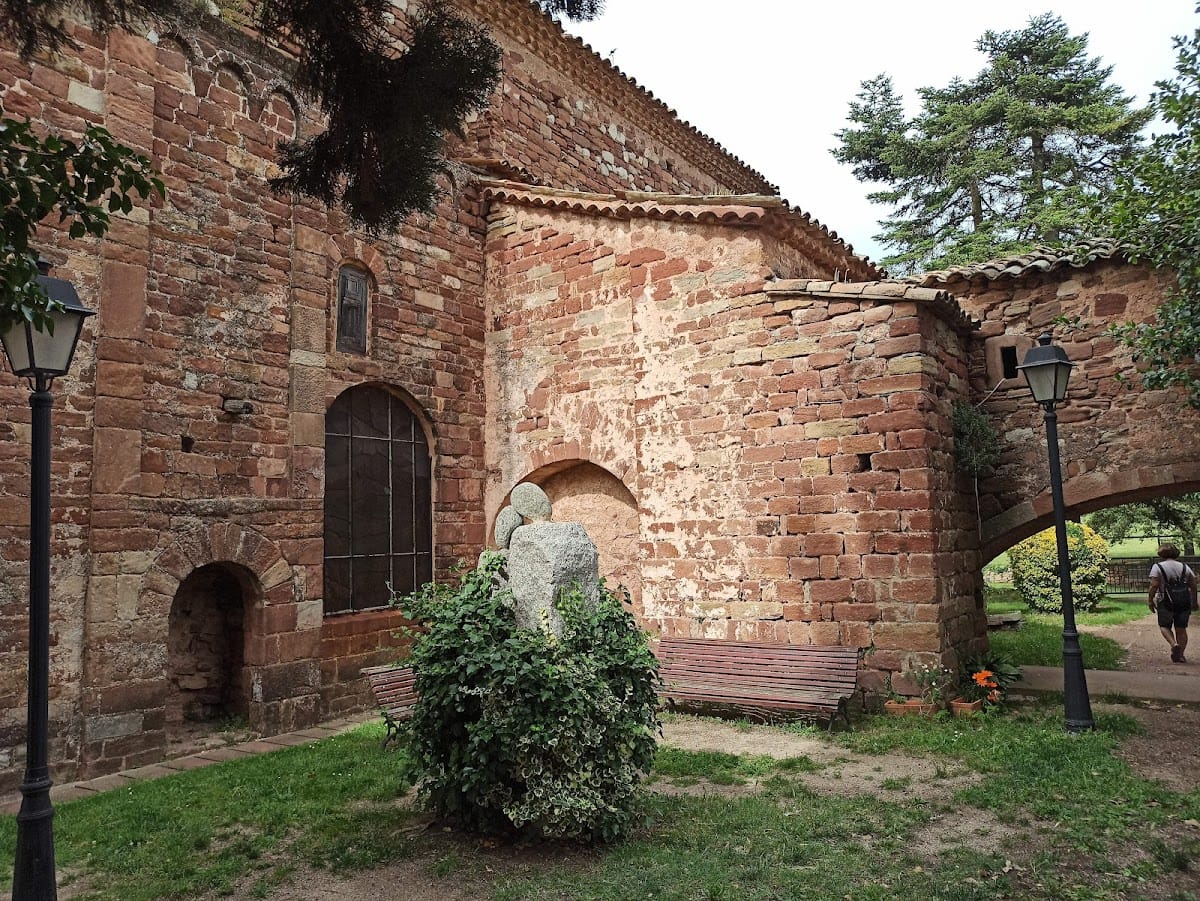
Santa Maria del Brull originally had small subsidiary apses, or apsidioles, on both sides of the main apse. These spaces contained altars dedicated to Saint Martin, Saint Michael, and Saint John. The apsidioles have since disappeared. Later changes opened the west portal and added the bell tower, while further work altered the church interior.
Nearby sites