Fuentetéjar Castle: A Medieval Rural Fortress in Spain


Site at a Glance
- Rating
- 3
- Popularity
- Very Low
- Country
- Spain
- Primary era
- Medieval
- Eras represented
- Medieval
- Civilizations
- Almohad, Crown of Castile
- Site type
- Military
- Remains
- Castle
On this page11 sections
History
Fuentetéjar Castle, also known as Fuentetétar Castle, is a medieval rural fortress in Jaén, Spain, built during the twelfth and thirteenth centuries. It occupies the summit of a high hill, where its position allowed control over much of the surrounding countryside and provided visual connections with Jaén Castle and the Castillejo de Zumel.
Roman and Islamic origins
The settlement associated with the castle began as a large agricultural village during the Flavian period, the Roman imperial dynasty that ruled from AD 69 to 96. It remained inhabited into the Late Roman Empire and may have continued in use until Muslim forces entered the region.
Pottery from the Emirate period was found at the eastern end of the hill, where a defensive structure may have stood. Archaeologists Juan Carlos Castillo Armenteros and Vicente Salvatierra Cuenca identified the site with Qāmarat Ŷayŝ, a fortress mentioned by the historian Ibn Hayyan in his account of a campaign ordered by Abd Allah in 895–896. The Emirate of Córdoba, the Islamic state centered on Córdoba before the caliphate, retained the fortress as a strategic position loyal to its government during the struggle against rebels.
The surviving castle structures date mainly from the twelfth and thirteenth centuries, although they were later transformed during the Christian period. A large concentration of pottery from the Almohad period was also found. The Almohads were a North African Islamic dynasty that ruled much of the Iberian Peninsula during the twelfth and early thirteenth centuries.
Christian lordship and frontier conflict
The earliest surviving reference to the name Fuentetétar dates from 1311. At that time, the settlement was an annex of the parish of Mengíbar within the Archpriesthood of Jaén, an ecclesiastical district supervising several parishes. Its population was not yet sufficiently stable to form a parish of its own. During the fourteenth century, the place also appeared under the name Teetar as an estate of the bishopric.
On 7 November 1378, Men Rodríguez de Biedma y Benavides and his wife, Teresa Manrique, the lords of Santisteban, donated the castle to Jaén Cathedral. During the fifteenth century, it was leased to prominent Jaén political figures, including Pedro de Alfaro, a municipal councillor or magistrate. In 1466, the fortress was affected by an incursion linked to the struggle for the Castilian throne between Pedro Girón and Constable Iranzo.
Repeated skirmishes between rival Castilian lineages in the Guadalbullón area prevented the formation of a settled village outside the fortress. After the political pacification associated with the accession of the Catholic Monarchs, Isabella I of Castile and Ferdinand II of Aragon, references began to mention houses and farm dwellings at Fuentetétar. The fortress then lost its military function and was being called a cortijo, or rural agricultural farmstead, by the beginning of the sixteenth century.
Later agricultural use and protection
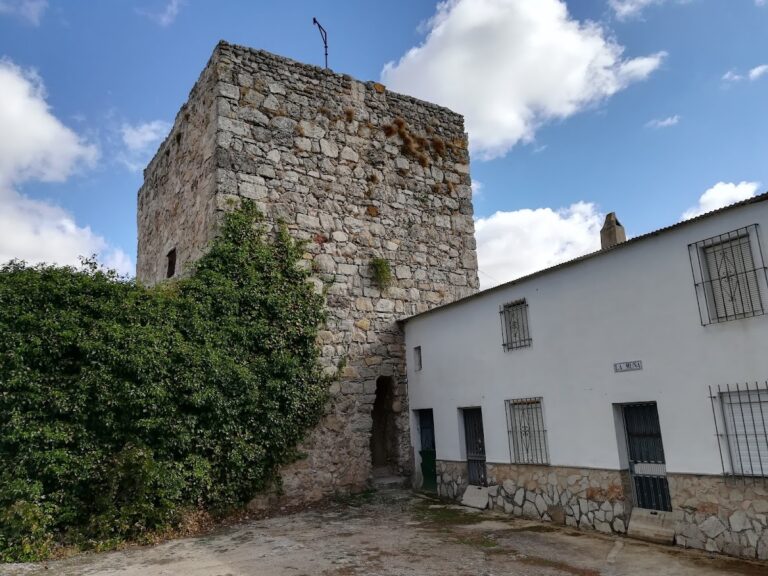
The site remains occupied as a rural farmstead and has undergone extensive alteration. Continued agricultural use helped protect parts of the structure from systematic quarrying for building materials, although sections of the walls and towers have been destroyed or have deteriorated. The castle’s original organization and chronology remain partly uncertain.
On 25 June 1985, Fuentetéjar Castle was declared a Historic Monument and therefore a Property of Cultural Interest. Its protection also falls under the general provisions established by the Decree of 22 April 1949 and Spain’s Law 16/1985 on Historical Heritage. Its physical conservation remains poor because of neglect and the destruction of sections of the walls and towers.
Remains
The surviving fortress has a rectangular plan and stands on an elevated hilltop overlooking the surrounding land. Its defenses were built with rubble masonry, using irregular stones set in mortar or another binding material. The outer enclosure had circular towers at three corners and a square tower at the fourth. Later farm buildings, new openings, and overlapping roofs have altered the site so extensively that the original castle is difficult to recognize in places.
Enclosure and defensive towers
Outer enclosure
The curtain walls formed a rectangular perimeter around a large interior parade ground, an enclosed area used for circulation and military or communal purposes. The western entrance has been heavily modified to permit agricultural machinery and livestock to pass into the courtyard. Additional doorways were opened through the curtain walls, and later buildings were attached directly to them.
Corner towers and keep
The three circular corner towers survive as vestiges. Their outlines, portions of their walls, and internal entrance doors remain visible. Because these towers were not incorporated into the later farmstead, they were dismantled or abandoned and subsequently deteriorated. The masonry keep has almost entirely disappeared, leaving the surviving enclosure and tower fragments as the clearest indications of the castle’s defensive arrangement.
Farmstead alterations and archaeological remains
Courtyard and agricultural buildings
The former parade ground has been substantially transformed by rooms belonging to the rural dwelling. Roofs added over the site overlap the fortress walls and obscure parts of its earlier form. Some of the resulting rooms are used as stables for goats, while the altered western entrance continues to serve agricultural purposes.
Ceramic evidence
Visible archaeological remains across the site include ceramic material from all periods of occupation. Emirate-period pottery is concentrated at the eastern end of the hill, where it relates to the possible earlier defensive structure. The large concentration of Almohad-period pottery provides further evidence for activity during the Islamic phase before and alongside the later Christian transformation of the fortress.
Nearby sites