Castillo del Berrueco: A Medieval Muslim Fortress in Spain


Site at a Glance
- Rating
- 4.2
- Popularity
- Low
- Country
- Spain
- Primary era
- Medieval
- Eras represented
- Medieval
- Civilizations
- Crown of Castile
- Site type
- Military
- Remains
- Castle
On this page8 sections
History
Castillo del Berrueco is a Muslim fortification in Spain, near Torredelcampo in Jaén, constructed around the twelfth century and remodelled after the Castilian conquest. Its position beside an ancient crossroads gave it strategic importance, drawing it into Christian-Muslim frontier conflicts and later disputes between nobles and King Enrique IV of Castile, who ruled from 1454 to 1474.
Earlier occupation and frontier use
The hilltop had a long history before the medieval fortress. Iberian, Roman, and Visigothic material has been found there, and an extensive Roman settlement occupied San Antón Hill and the lower part of its slope. The medieval castle inherited the importance of an older minor road and stood beside routes connecting Jaén with Arjona and Andújar, and Cazalilla, Mengíbar, and Atalayuelas with Martos and Porcuna.
In 1311 and 1380, Castillo del Berrueco was listed among the fortifications associated with Jaén. Its position remained important during the political and military struggles of the fifteenth century. In 1465, Pedro Girón, grand master of the Order of Calatrava, a Catholic military order that defended territory on the medieval Iberian frontier, captured the castle while leading a rebel faction. It later passed into royal hands and became an advance position for Jaén against Arjona.
The tradition of Pedro Girón
A local tradition connects the castle with Pedro Girón’s journey to Segovia to marry Isabella, the sister of Enrique IV. Isabella later became Isabella I of Castile and, with Ferdinand of Aragon, was known as Isabella the Catholic. After leaving Porcuna, Girón is said to have spent a night at the castle. A large flock of storks then circled above it, filling the sky with noise before continuing on its way.
Girón died a few days later at Villarrubia de los Ojos under unexplained circumstances. The storks were interpreted as a bad omen. Some of his companions suspected a royal conspiracy, while another explanation blamed a possibly poisoned meal.
Decline and modern protection
The site declined during the sixteenth century. The settlement beside the castle, once associated with the Council of Jaén, the municipal governing body linked to Jaén, became a rural hamlet but remained inhabited until the middle of the twentieth century. Its small church was restored and a school was built several decades before the present day; both buildings are now ruined. Some farmsteads continue to be occupied permanently or intermittently, while scattered agricultural sheds are mainly used for olive-farming machinery and equipment.
Castillo del Berrueco is protected as a Historic Monument and property of cultural interest under Spain’s general protection decree of April 22, 1949, and Historical Heritage Law 16/1985. It was formally declared on June 22, 1993, under register code RI-51-0007983. The municipality has owned the castle since 2009.
Remains
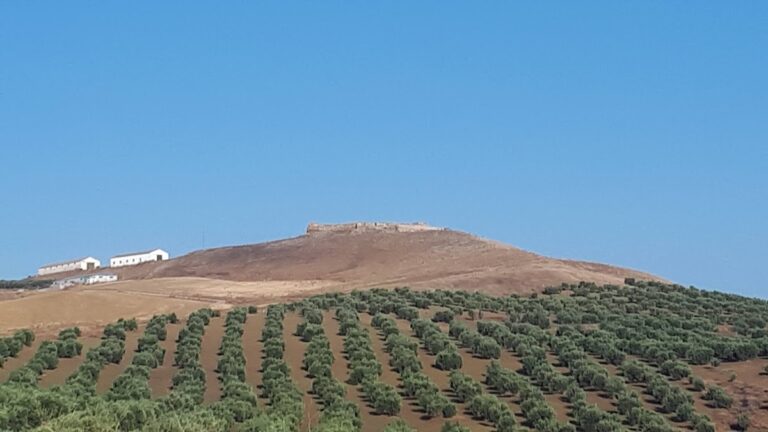
The fortress occupies a rocky spur and is arranged in two clearly differentiated enclosures. Its walls follow the difficult ground, extending the natural defensive value of the outcrop. The castle is built throughout from regular rubble masonry, meaning irregular stones set in mortar, with extensive repairs or packing made with gypsum and mortar. Its general condition is considered good, although restoration and urgent consolidation are needed where sections of rock are detaching.
Upper enclosure
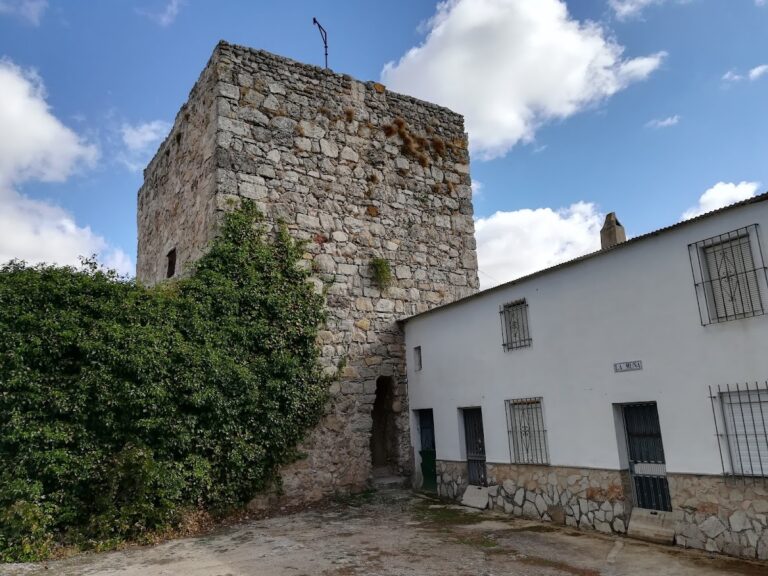
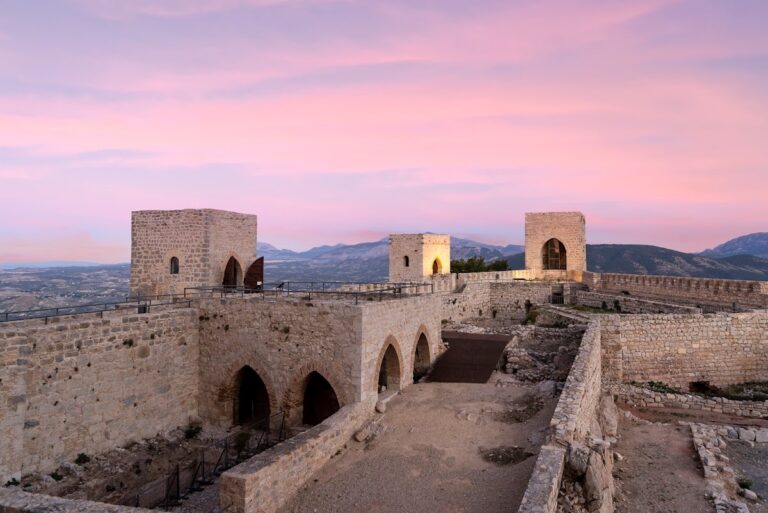
The upper enclosure is defined by a closing wall and three towers placed at its corners. Two towers are circular in plan, while the third is square. Together, these structures establish the enclosure’s boundaries and provide its principal defensive points.
Lower enclosure and outer defences
The lower enclosure occupies especially rugged ground. Its walls bend with the terrain in a sinuous plan that strengthened the defensive arrangement. Walkways survive along the tops of some curtain-wall sections, meaning the connecting walls between towers. These passages are protected by loopholes, narrow openings through which weapons could be used, and pointed crenellations, the raised sections along the top of a parapet.
The northern wall retains remains of machicolations, projecting defensive structures with openings through which objects or missiles could be dropped onto attackers. They are supported on corbels, which are projecting structural supports. The outer wall is generally well preserved and continues the defensive line of the rocky spur, although parts of the supporting rock are detaching.
Settlement and surrounding features
The nearby settlement preserves the ruins of its small church and school, both associated with the hamlet’s later occupation. The castle stands between two small streams in dry-farming land, while higher ground around it limits its visual control of the wider landscape.
A substantial medieval watering trough lies a short distance north of the castle beside the Jaén to Arjona road. It supplied water to transhumant livestock, animals moved seasonally between different grazing areas, travelling along the route.