Castillo de Campogrande: A Reconstructed Castle in Asturias

Site at a Glance
- Rating
- 5
- Popularity
- Very Low
- Country
- Spain
- Primary era
- Modern
- Eras represented
- Medieval, Modern
- Civilizations
- Crown of Castile, Spanish
- Site type
- Domestic
- Remains
- Castle
On this page6 sections
History
Roman and Medieval Origins
Castillo de Campogrande is a ruined castle near Blimea in Asturias, Spain, at La Cabezada. It probably originated as one of the defensive towers built by the Romans along the Nalón Valley, while a medieval castle was apparently established on the same defensive site around the fourteenth century. The building is also popularly known as the Castle of Blimea and the Fortress of La Cabezada.
A legend links the castle to its owner and his daughter Florinda, who reportedly took her own life for love. After the earlier defensive site was abandoned, the place was occupied by a manor house rather than by a formal castle.
The Fernández Miranda and García Argüelles Families
The ancestors of the Fernández Miranda family came from Quirós and reached Blimea between the eleventh and twelfth centuries. They first settled at the Casona del Bravial. In 1496, descendants of the family moved their residence to La Cabezada, the site later occupied by Castillo de Campogrande. That year is also the last in which written references to the Fernández Miranda family appear.
Garci González and Teresa Fernández de Ciaño subsequently lived at La Cabezada and founded the mayorazgo of the García Argüelles of La Cabezada. A mayorazgo was a hereditary entail that kept an estate and its associated rights within a designated family line. The García Argüelles family left no descendants, and their property passed to the Fernández-Miranda and Llano-Ponte family of Grado.
Nineteenth-Century Reconstruction
By the nineteenth century, the building had fallen into ruins. Álvaro Fernández de Miranda, Viscount of Campogrande, rescued and reconstructed it as his residence. The work, dated to 1897, transformed the manor house into a castle by adding crenellations, the notched parapets traditionally associated with fortified buildings, and a tower designed to imitate an earlier defensive tower. The mining engineer and scholar Aurelio Delbrouck was born there.
War, Abandonment, and Remembrance
The castle was assaulted during the Revolution of 1934, a major uprising in Spain particularly associated with industrial Asturias, and again during the Spanish Civil War of 1936 to 1939. Belarmino Tomás, a socialist, reportedly ordered the looting of its valuable furniture and works of art. Insurgent forces later assaulted the library.
After the Civil War, the castle remained inhabited until the 1970s, when it was definitively abandoned. Its collapse may have been partly caused by damage from operations at the San Mamés shaft in Sotrondio and possibly by construction of the road leading to the cemetery.
In February 2014, the municipal government of San Martín del Rey Aurelio organized The Castle of Blimea: History, Legends, Abandonment. Historian Belén González Collado prepared the exhibition from old documents donated anonymously to the San Martín del Rey Aurelio Memory Museum, housed in the Casona del Bravial. It presented the castle’s history, its resident families, and its coat of arms through bibliographic material, photographs, and memories contributed by Blimea residents.
Remains
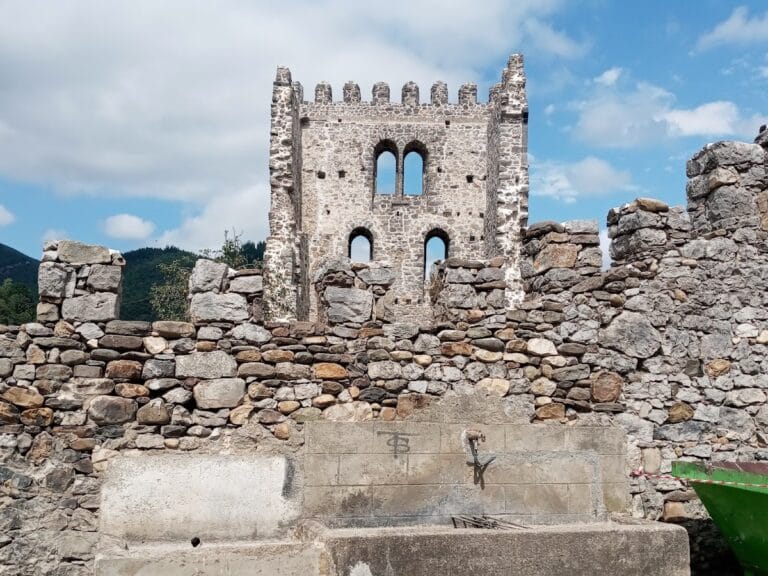
Only a few remains of Castillo de Campogrande survive at La Cabezada, and the site is now ruinous. Its physical development reflects the succession of defensive and residential forms associated with the location. The medieval castle occupied an earlier defensive installation, probably one of the Roman towers along the Nalón Valley. Before the nineteenth-century rebuilding, the site consisted of a manor house rather than a formal castle.
The 1897 reconstruction gave the residence its castle-like appearance. Álvaro Fernández de Miranda added crenellations along the building and erected a tower intended to imitate a primitive defensive tower. A coat of arms stood along the line of the crenellations and predated the reconstruction. It later fell with the rest of the building and disappeared, after which the municipal government produced a reproduction.