Castelo de Monforte: A Medieval Frontier Castle in Portugal


Site at a Glance
- Rating
- 3.8
- Popularity
- Low
- Country
- Portugal
- Primary era
- Medieval
- Eras represented
- Medieval, Early Modern
- Civilizations
- Portuguese
- Site type
- Military
- Remains
- Castle
On this page8 sections
History
Castelo de Monforte is a ruined medieval castle in Portugal, above the town of Monforte in the Alto Alentejo. Its Christian reconstruction formed part of the frontier defenses that protected Portuguese territory from Muslim forces and Castile, and the fortress remained involved in regional conflicts until its destruction in 1801.
Early settlement and Christian conquest
The beginnings of Monforte are uncertain. The settlement may have developed from a pre-Roman hillfort, later becoming a small Roman oppidum, a fortified settlement or town. Visigoths and Muslims subsequently occupied the site. Its position placed it within a defensive line that also included Arronches, Portalegre, Marvão, Alegrete, Castelo de Vide, Vila Viçosa, Borba, Veiros, and Alandroal.
Afonso Henriques, the first king of Portugal, conquered Monforte from Muslim forces in 1139. In 1168 he granted the settlement a charter of privileges, known as a foral, to encourage population and defense. Muslim forces based at the Castro of Ayamonte, on the hilltop of Vaiamonte, later retook it, although the date when Portuguese control was restored remains uncertain.
After the definitive Christian conquest of the region, Afonso III granted Monforte a new charter in 1257. Earlier warfare had devastated and depopulated the area, so the grant encouraged resettlement and the recovery of its defenses.
Reconstruction and royal lordship
In 1281, King Dinis granted the lordship of Monforte to his wife, Isabel, as part of her marriage dowry, together with Óbidos, Porto de Mós, Sintra, and other territories. Dinis later ordered the castle and the town’s fortifications to be rebuilt over the earlier stronghold. Work began around 1310 and formed part of a north-south defensive system along the frontier.
Pedro I entrusted the castle’s governorship to Aires Afonso in 1357 and confirmed extensive privileges for the county and inhabitants of Monforte in 1358. During the succession crisis of 1383–1385, which followed the disputed claim to the Portuguese throne, Monforte and its castle supported Beatriz’s faction. Martim Anes Barbuda took refuge there for several days after the Battle of Atoleiros and resisted a siege led by Nuno Álvares Pereira, the leading commander and constable of John I. The town remained under Martim Anes Barbuda’s control for a period.
Between 1391 and 1395, John I granted Monforte to Nuno Álvares Pereira in recognition of his service during the crisis. The lordship passed to the Count of Arraiolos in 1455, was confirmed to his son Fernando, Count of Guimarães, in 1463, and in 1476 was granted, with the town, castle, revenues, and jurisdictions, to the Duke of Guimarães. John II revoked that grant in 1483 and returned Monforte to the Crown while confirming extensive privileges to its inhabitants.
The Braganza period and artillery defenses
The House of Braganza, a major Portuguese aristocratic and later royal dynasty, regained control under Manuel I. In 1501, the king granted Monforte and its rights and revenues to Jaime, Duke of Braganza. By 1542, the town was identified as a Braganza possession under Isabel, wife of Teodósio I, Duke of Braganza. Manuel I also granted Monforte a new charter in 1512.
Around 1509, Duarte de Armas, a Portuguese military surveyor and cartographer, depicted Monforte and its defenses in the Book of Fortresses. Gonçalo de Aguiar was identified as the probable person responsible for the castle’s construction. During the Restoration War, the conflict that re-established Portugal’s independence from Spain, the Council of War of John IV modernized Monforte for artillery warfare. Four bastions, projecting fortifications designed to support defensive fire along adjoining walls, were added, and a second defensive line was built around the contemporary settlement.
Capture, destruction, and later care
Spanish forces commanded by Don John of Austria captured Monforte on 28 June 1662. After the main Spanish force withdrew toward Badajoz, Portuguese troops recaptured the town on 11 July. The fortress was attacked repeatedly during the War of the Spanish Succession and again during the Peninsular War.
A violent Spanish incursion in 1801 destroyed the medieval castle. The keep, the principal fortified tower and command stronghold, and sections of the walls survived, while most of the complex was left in ruins. A first modern restoration initiative began in 2005 under a general plan that divided the surviving walls into project areas. The remains are owned by the Portuguese Republic but are not classified as protected heritage.
Remains
Fortification layout
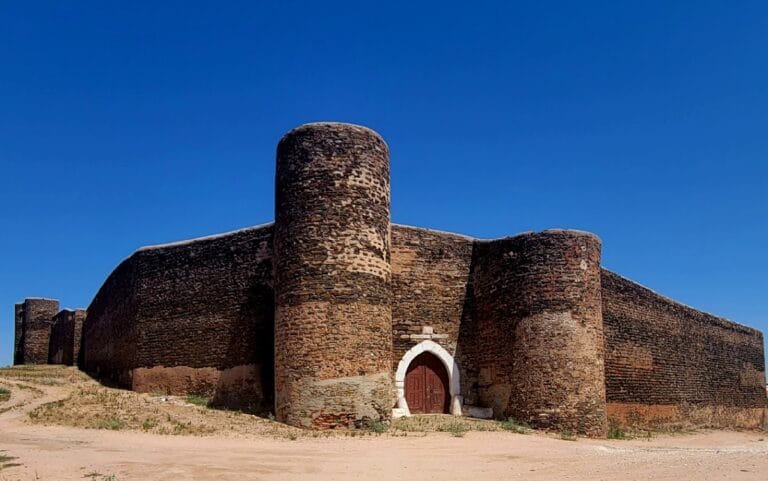
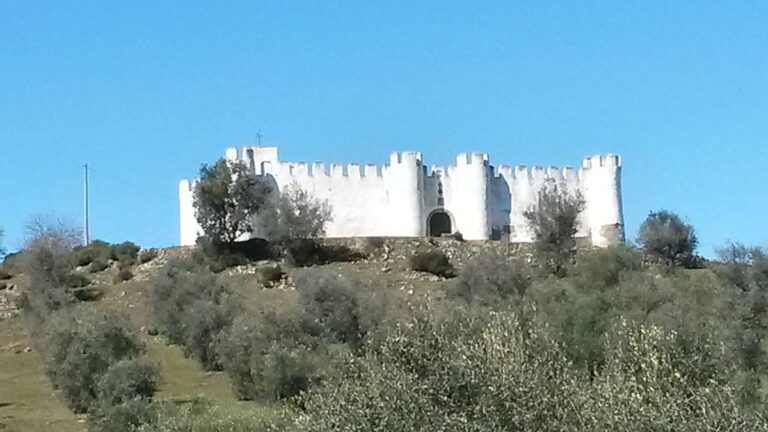
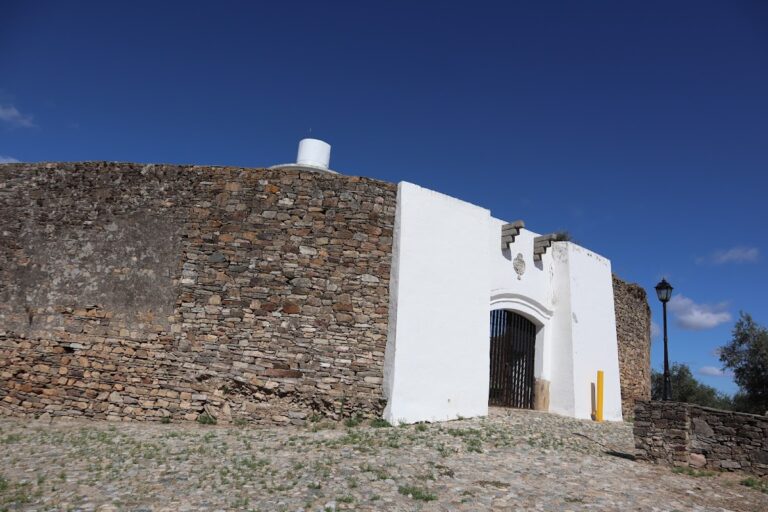
The medieval castle occupied a dominant position above Monforte and was enclosed by defensive walls reinforced with four towers, including the keep. Four gates provided access through the enclosure. The complex also contained a cistern and surrounding ditches. Its recorded and surviving construction materials include granite, wood, cement, and tile. The seventeenth-century modernization added four artillery bastions to the earlier medieval defenses, while the second defensive line built around the settlement during the same period has left no surviving traces.
Surviving towers and walls
The Torre do Relógio, or Clock Tower, forms part of the remaining fortifications. The keep and several wall sections also survived the destruction of 1801, but most of the castle remains in ruins. These surviving elements preserve portions of the medieval enclosure alongside the later artillery-era alterations.
Nearby sites