Castello di Tizzano Val Parma: A Medieval Castle Controlling the Parma Valley


Site at a Glance
- Rating
- 3.9
- Popularity
- Very Low
- Country
- Italy
- Primary era
- Medieval
- External website
- Open
- Eras represented
- Medieval, Modern
- Civilizations
- Holy Roman Empire, Italian
- Site type
- Military
- Remains
- Castle
On this page9 sections
History
Castello di Tizzano Val Parma is a medieval castle in Italy, probably built during the tenth or eleventh century to control the Parma Valley and the Via del Sale, or Salt Road, a historic route connecting inland areas with regions that produced salt. The settlement of Tizzano is first documented in 991, while surviving references to the castle begin in the eleventh century.
Medieval Lords and Feudal Claims
A tradition of uncertain reliability places the castle among the possessions of Giberto III da Correggio until the first quarter of the thirteenth century. In 1247, Emperor Frederick II made feudal grants to the forebears of the Terzi family. These grants later became part of the family’s claims to Tizzano and Belvedere.
In 1364, Niccolò Terzi the Elder and his brother Giberto swore allegiance for the castles of Tizzano and Belvedere to Bernabò Visconti, lord of Milan. In August 1386, Gian Galeazzo Visconti confirmed the feudal concessions to Niccolò and his direct heirs, while also granting Tizzano broader immunities. On 19 August 1387, King Wenceslaus of Luxembourg confirmed the Terzi family’s investitures in a diploma sealed at Nuremberg. An investiture was the formal granting of a fief by a superior lord in return for allegiance and service.
After Ottobuono Terzi, lord of Parma and Reggio, was assassinated at Rubiera in May 1409, the Fieschi occupied the castle. A few years later, Ottobuono’s son Niccolò de’ Terzi, known as “the Warrior,” regained Tizzano and received the title of count of Tizzano. He achieved this through his service as a condottiero and diplomat to Filippo Maria Visconti. A condottiero was a professional military commander who led troops under contract. Niccolò retained the title until 1449, when he fled with his family to the Gonzaga court at Mantua after the last Visconti died and Francesco Sforza took control of the Duchy of Milan.
Pallavicino and Farnese Control
Francesco Sforza then enfeoffed Count Pietro Ghirasio da Contrano, also called Fiasco da Girasio, with Tizzano. His son Agolante, or Avolante, transferred the castle to Marquis Gianfrancesco I Pallavicino without the knowledge of his elder brother Anfitrione, who unsuccessfully tried to recover it. In 1495, Ludovico il Moro formally invested Gianfrancesco with Tizzano, Ballone, and other feudal holdings in the Parma region.
After Rolando Pallavicino died in 1529, his sons-in-law disputed the fief for an extended period. Parmese troops, followed by forces sent by the first Duke Pier Luigi Farnese, occupied the castle. Duke Ottavio Farnese later acquired it despite the continuing claims of the Terzi family.
During the War of Parma in 1551, a conflict over control of the Duchy of Parma, a French garrison occupied the castle. On 7 September, the army of Ferrante I Gonzaga, governor of the Duchy of Milan, attacked with 456 cannon shots. The French secretly abandoned the fortification during the night, and the castle was severely damaged.
Decline, Restoration, and Municipal Ownership
In 1650, Duke Ranuccio II Farnese granted the fief to Marquis Domenico Doria. The Doria family of Genoa retained the ruined stronghold, which then consisted of a tower and the principal building inhabited by the castellan. The family held it until the death of its last descendant, Maria Maddalena, at the end of the eighteenth century. Marquis Troilo Venturi later owned the property but was forced to leave Tizzano in 1806 after Napoleonic decrees abolished feudal rights.
The Castiglione family subsequently acquired the already ruined castle and began restoration work. An earthquake on 13 January 1834 caused the northern wing to collapse. A violent windstorm on 10 October 1835 brought down part of the remaining ruins.
In 1913, the sculptor Ettore Ximenes purchased the structure to convert it into a summer residence and commissioned the architect Lamberto Cusani to design the renovation. Work had barely begun when the First World War interrupted the project, which was never completed. The last inhabitants left the ruined castle in 1930.
The Municipality of Tizzano Val Parma purchased the castle in 1961. Municipal excavations begun in 2002 brought a ground-floor hall to light. In 2003, the hall, perimeter walls, and tower were restored. Further work in 2014 consolidated the structure and installed walkways, allowing the restored ruins to serve as a venue for performances and cultural events. The castle remains municipally owned and survives as restored ruins.
The Castle Chapel
An Oratory of Saints George and Bartholomew, a small place of Christian worship, was built inside the castle in 1476. It was destroyed at the beginning of the eighteenth century and rebuilt several years later.
Remains
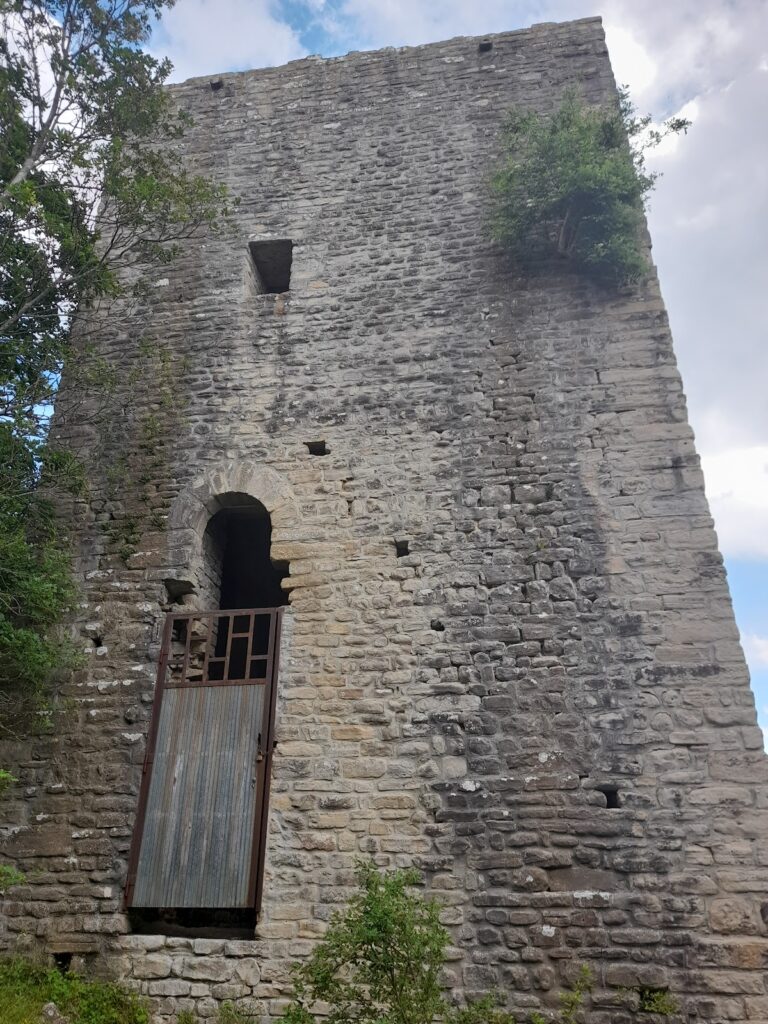
Built entirely of stone on a steep slope above the Parma Valley, the surviving castle is organized around perimeter and retaining walls, a broad rectangular tower, and a vaulted ground-floor room. Restoration and excavation have preserved these elements as connected parts of the ruined stronghold, while walkways provide access to the roofless upper level.
Fortifications and Interior Spaces
Tower and Vaulted Hall
The broad tower has a rectangular plan and forms the principal surviving mass of the castle. Its lower level contains a room covered by a barrel vault, a continuous semicircular or near-semicircular vault used to cover an elongated space. The room opens toward the excavated area through two broad semicircular arches. Together with the perimeter and retaining walls, the tower preserves the stone construction of the medieval stronghold.
Upper Level and Performance Space
Walkways lead to the roofless upper level of the tower. Three rectangular windows face toward the valley, and a broad opening occupies the western wall. The upper space is used as a stage for musical performances, incorporating a surviving part of the castle into its present cultural function.