Castello di Melazzo: A Medieval Stronghold in Italy
Site at a Glance
- Popularity
- Very Low
- Country
- Italy
- Primary era
- Early Modern
- Eras represented
- Medieval, Early Modern, Modern
- Civilizations
- Holy Roman Empire, Italian
- Site type
- Military
- Remains
- Castle
On this page10 sections
History
Medieval origins and changing rule
Castello di Melazzo is a stone castle in Italy with origins in the eleventh century, when Melazzo was an imperial fief, or territory held under an emperor, belonging to the counts of Acquesana. Tradition says Guido d’Acqui, later bishop of the city, was born there in 1004. In 1201, Melazzo’s lords, Guglielmo and Manfredo, transferred the castle to the municipality of Acqui. Alessandrians occupied it in 1218; in 1235, Acqui’s podestà, its chief municipal magistrate, took control without the consent of Bishop Ottone.
During the thirteenth century, Melazzo passed to the marquises of Bosco and later became part of the Marquisate of Monferrato, a historical territory in northwestern Italy. The castle’s position made it an important stronghold for controlling the Erro valley and the route toward Savona. A tradition places Edward II of England, who was deposed in 1327, at the castle between 1330 and 1333. This account conflicts with the conventional chronology, which places his death in 1327, so the reported stay is not secure.
Renaissance and early modern changes
Francesco Sforza’s troops sacked the castle in 1431. Sforza was an Italian military commander who later became Duke of Milan. During the Renaissance, the castle belonged to the Falletti family. Eleonora Ravoira della Croce, wife of Count Giovan Giorgio Falletti, hosted scholars and artists there, including Giuseppe Betussi, who dedicated his dialogue La Leonora to her.
Spanish troops sacked the castle in 1610. The original fortified complex may have been entirely destroyed during their passage. The Gandolfo counts of Porto Maurizio, the last feudal lords, rebuilt it; the new complex had substantial eighteenth-century characteristics.
Nineteenth century to the postwar period
During the nineteenth century, the castle passed among the Tarini, Arnaldi, and Chiabrera families. In 1890, the Arnaldi established an infant school there, run by the Sisters of St Anne, as well as a preparatory college for the Royal Italian Navy. Changes made during the nineteenth and twentieth centuries gave the complex its Neo-Gothic appearance. From 1913 to 1922, Count Cesare Chiabrera sponsored a conservation-focused restoration, carried out under an engineer from Cremona.
During the Second World War, German troops requisitioned the castle and used it as the area’s military headquarters. After the war, it housed the Alessandria institute, promoted by the Foundation for National Solidarity for Partisans and Victims of the Liberation Struggle in the Province of Alessandria.
Remains
Plan and fabric
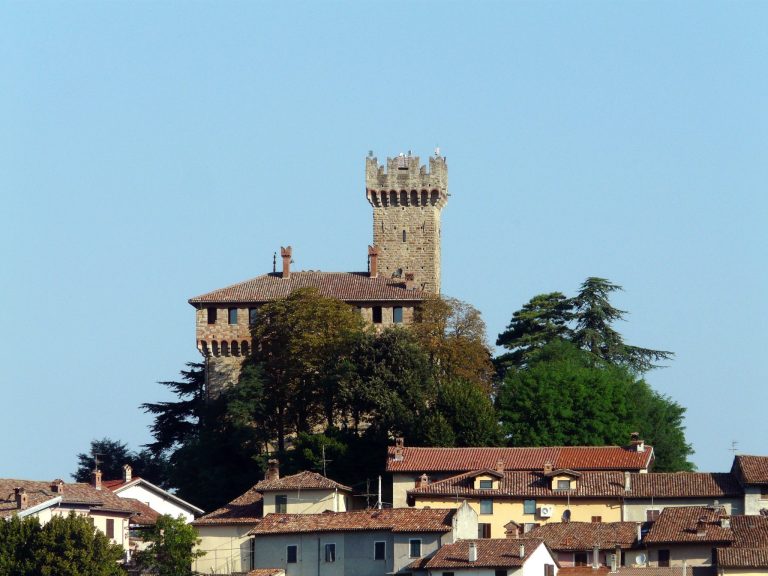
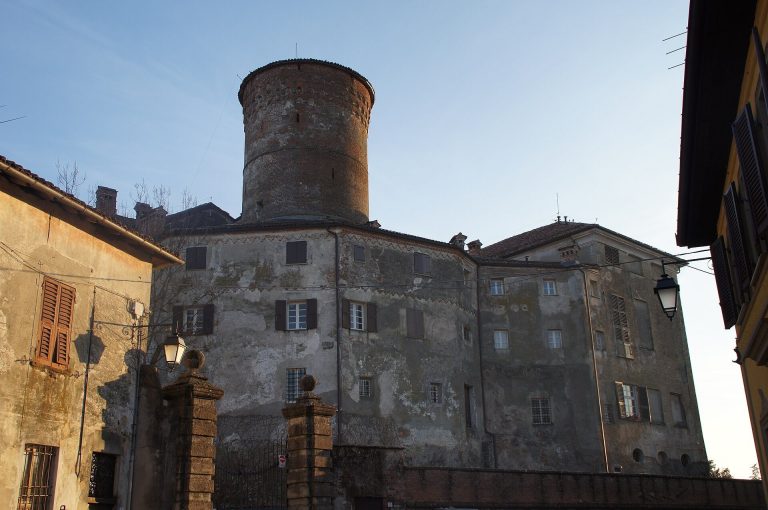
The stone complex follows a pre-existing medieval layout. A continuous central building runs north to south, dividing the property into two open spaces. Late-medieval fabric survives within the castle, altered and incorporated into later restoration work.
Defensive perimeter
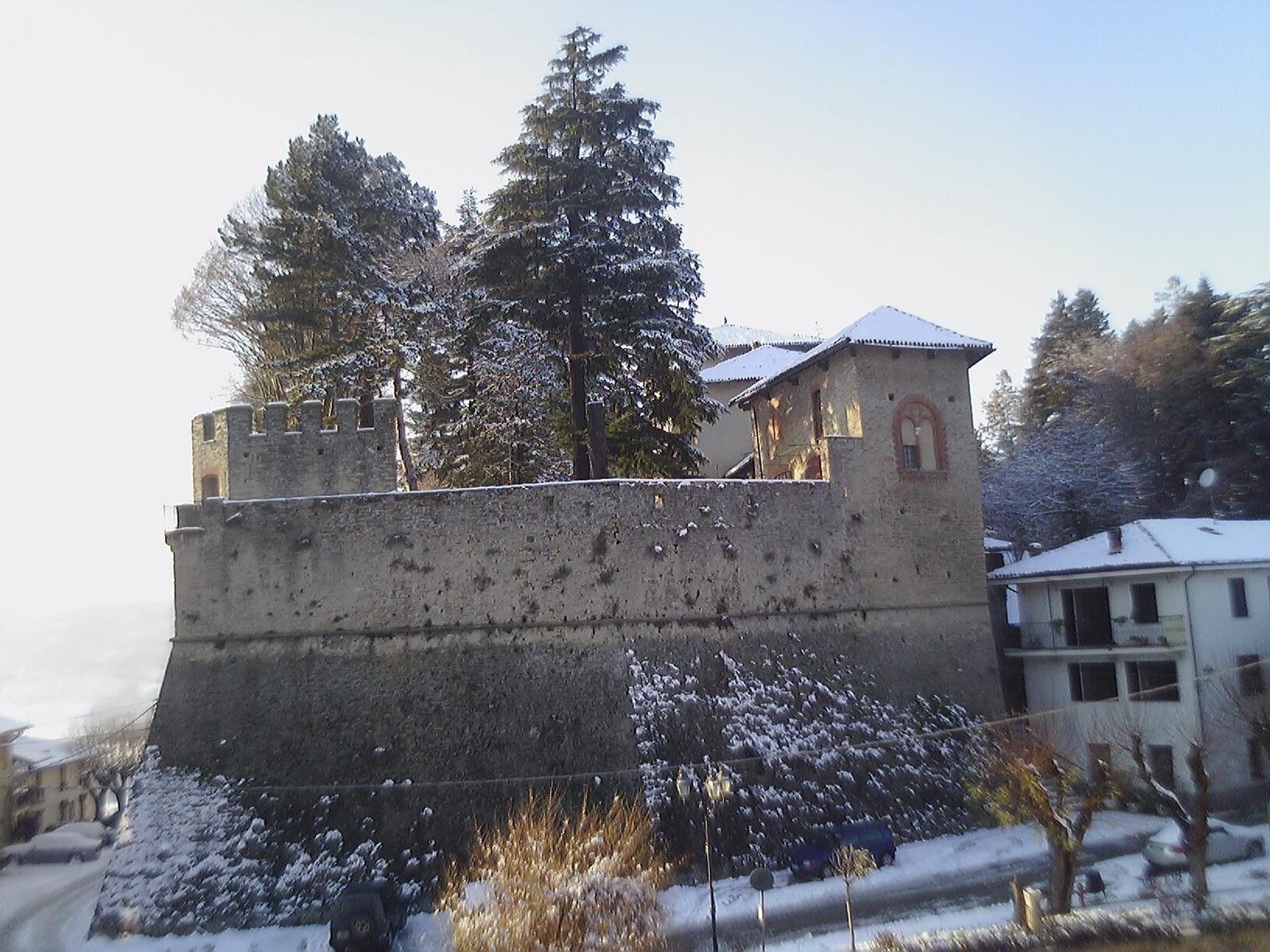
Substantial bastions, defensive structures projecting outward from the walls, remain around the perimeter. A guard passage follows the fortifications behind crenellated walls, which alternate raised sections and gaps. Openings and narrow loopholes for observation or weapons face the Erro valley.
Entrance tower and rooms
The central tower serves as the main entrance. Its features include arched windows, paired windows divided by a central support, and a top row of small brick arches formed by projecting masonry. The castle contains about 35 rooms. Cross vaults, made by intersecting barrel-shaped ceilings, cover the principal floor. The ground and second floors have coverings built with three-hinged arches, which have joints at both ends and at the top to accommodate movement in their supports.
Floors and gallery
Rectangular eleventh-century floor tiles, known as the Saint Guido tiles, came from a kiln at Caliogna owned by the counts of Acquesana, Guido d’Acqui’s family. A gallery ends at a seventeenth-century stone balcony overlooking the Erro valley. A plaque in the gallery commemorates the traditional claim of Edward II’s stay.
Park
The castle park covers more than 6,000 square metres and contains numerous tall trees.