Castano Castle: A Medieval Fortification in Italy

Site at a Glance
- Rating
- 4.8
- Popularity
- Very Low
- Country
- Italy
- Primary era
- Medieval
- Eras represented
- Medieval, Early Modern
- Civilizations
- Unclassified
- Site type
- Military
- Remains
- Castle
On this page7 sections
History
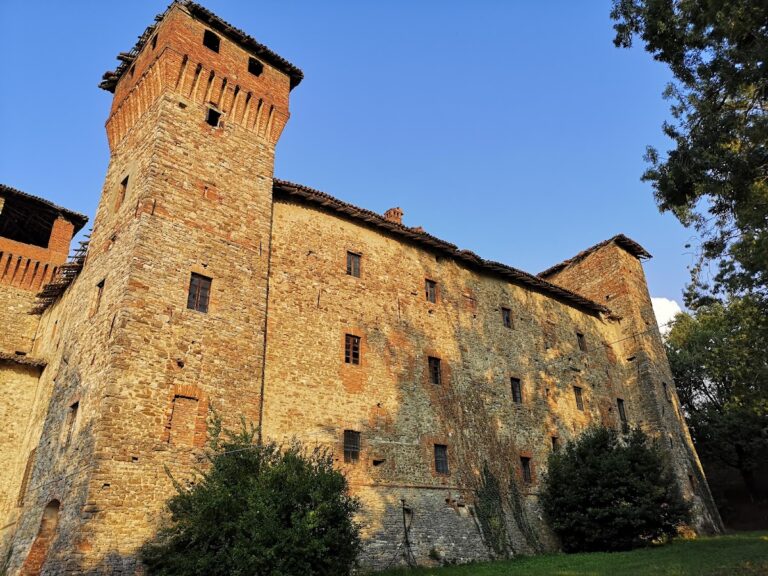
Castano Castle is a medieval lowland fortification in Italy, located at Castano, a hamlet of Agazzano in Piacenza Province. It was probably built during the thirteenth century in the Val Luretta, on the outer hills of the Ligurian Apennines where they meet the Po Plain. Its position provided a strategic defensive point with broad views across the plain.
Medieval origins and Visconti ownership
The castle originally belonged to the noble Scotti family. Its first certain documentary mention dates to 1412, when it was named Cassetano. In that year, Filippo Maria Visconti, Duke of Milan and a member of the Visconti dynasty that ruled Milan during the late Middle Ages and early Renaissance, granted the castle and other local properties to Filippo and Bartolomeo Arcelli. The brothers had been made counts of the Tidone Valley.
After the Arcelli brothers declined in influence, the duke transferred the castle to other soldiers in his service. By the middle of the fifteenth century, the fortress belonged to Michele Guazzardi. In 1467, the Duke of Milan granted Castano and nearby Verdeto to Daniele Rossi.
Inheritance and later ownership
The property passed by inheritance to Giulia Rossi and, in 1595, to her daughter Flavia. Through Flavia, Castano entered the Barattieri family as part of her marriage dowry. After the death of Flavia’s son, Marco Antonio Barattieri, and the extinction of the Barattieri line, the Farnese ducal treasury took possession of the castle. The treasury was the financial and administrative office of the Farnese state, whose ruling dynasty controlled the Duchy of Parma and Piacenza.
The Farnese assigned the castle to Alberico Portapuglia, whose family retained it until the middle of the nineteenth century. It was then sold to the Bianchi family. The Bianchis transferred it to the Collegio Morigi of Piacenza in 1861, and the college passed it to the Marchesi family in 1881.
Modern use and fortified surroundings
The castle was renovated in the early 2000s and converted for conferences and events. It remains privately owned. Castano forms part of a wider fortified landscape that includes Castello della Boffalora to the west, Castello di Agazzano to the east, Torre di Montebolzone to the north, and Castello di Montecanino to the south.
Remains
Plan and defensive fabric
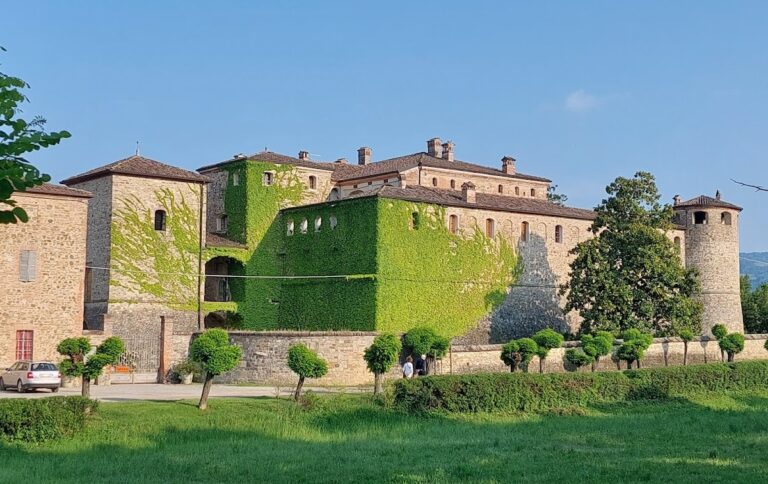
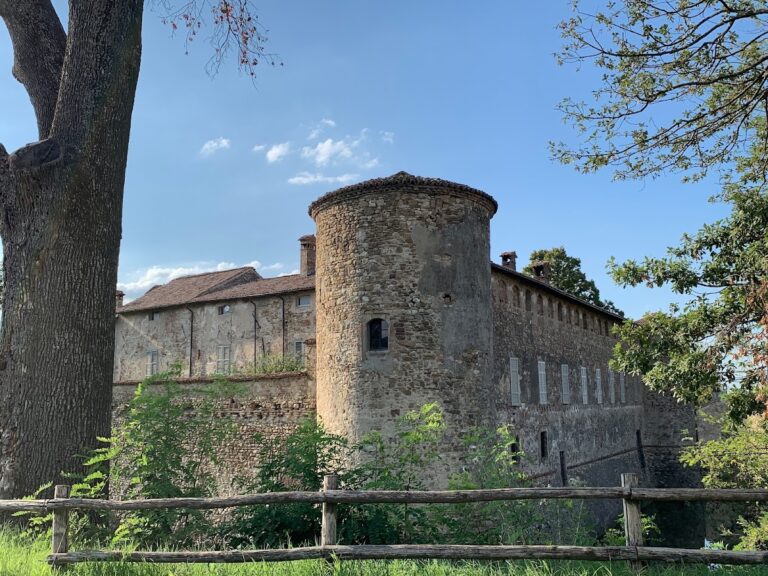
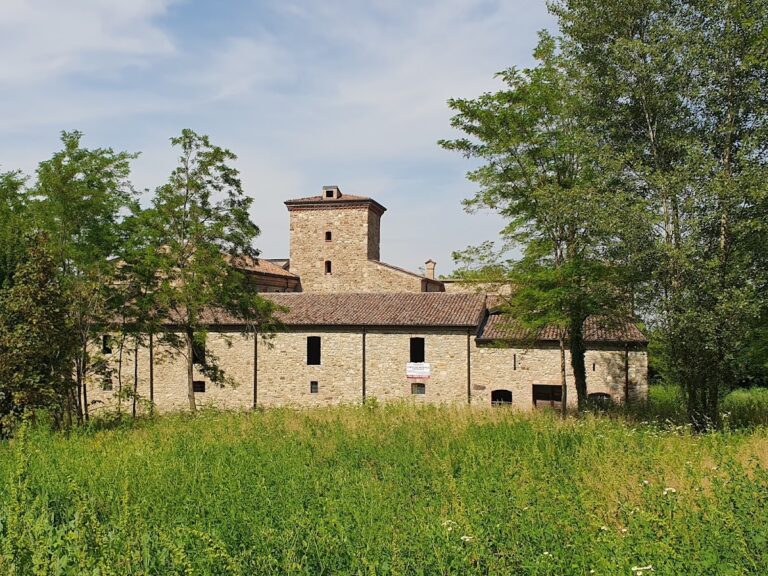
Castano Castle has a rectangular plan made up of several dissimilar buildings. Cylindrical towers stand at the sides of the perimeter walls, while the construction combines stone and brick, including rubble-stone masonry. Large loopholes, narrow openings used for observation or firing from a protected position, remain among the defensive features.
Houses were built against the curtain walls, the enclosing defensive walls of the castle, during later alterations. These additions changed the original appearance of the complex. The surviving fabric therefore combines medieval and Renaissance elements within a layout shaped by construction and modification over many centuries.
Interiors
Inside, the castle contains period furniture and several rooms decorated with frescoes. These furnishings and painted interiors form part of the complex’s later architectural character alongside its medieval defensive structures.