Castell de Torroella: A Medieval Castle and Lordly Residence in Spain


Site at a Glance
- Rating
- 4.6
- Popularity
- Very Low
- Country
- Spain
- Primary era
- Early Modern
- External website
- Open
- Eras represented
- Medieval, Early Modern
- Civilizations
- Crown of Aragon
- Site type
- Domestic
- Remains
- Manor House
On this page7 sections
History
Castell de Torroella is a medieval castle in Spain, near Santa Eulàlia de Riuprimer in Osona, Barcelona. The site occupied a hill southeast of the municipality and was fully organized by 1099, when Berenguer Sunifred de Lluçà, bishop of Vic, bequeathed it to the canonry of Saint Peter of Vic, an ecclesiastical community attached to a church.
Early references and ecclesiastical lordship
The surrounding area appears in records from 904 under the names “valley of Santa Eulalia” and “Torroella.” The first name came to identify the wider municipal territory, while Torroella referred to the area around the castle. The bequest of 1099 placed the castle under the authority of the canonry of Saint Peter of Vic and established its connection with the bishopric of Vic.
Feudal tenure and changing status
The castle was subsequently held in fief by several families. In medieval feudal practice, this meant that a holder possessed the property from a superior lord in return for defined obligations. In 1130, Bernat de Talamanca transferred the castle to Pedro Udalard de Sentfores, while the bishop of Vic remained its overlord, or superior authority. A 1203 oath of fidelity by Guillem Bernat de Manlleu to the bishopric of Vic records this relationship. The Talamanca, Manlleu, and later Malla families held the castle for limited periods.
The bishopric later granted Castell de Torroella to less prominent families. By 1367, its status had become uncertain. It was no longer clear whether the property remained a castle or had become a house, nor whether it still carried the military obligations associated with a castle. As its residential role declined, its lords moved to a domus west of the original site. A domus was a substantial medieval residence linked to an estate or lordly household.
From castle to fortified farmhouse
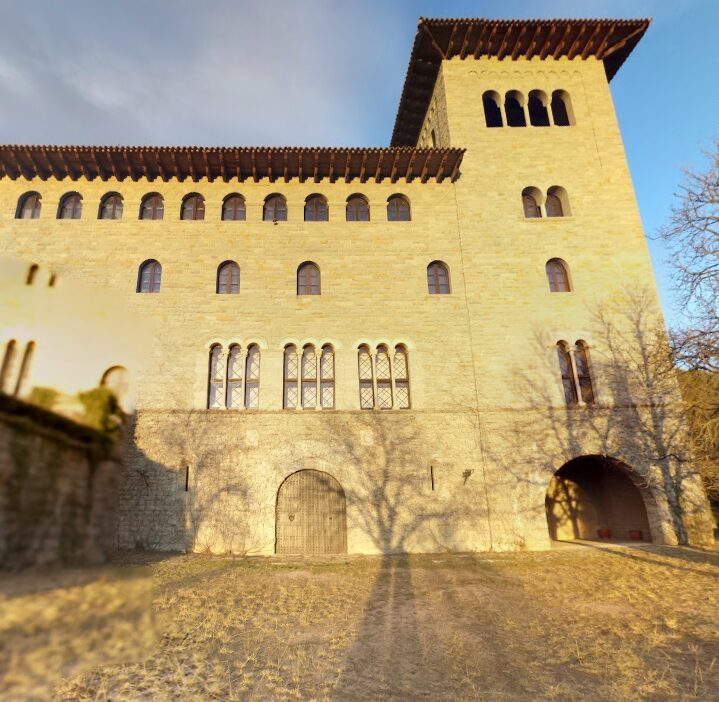
The later residence stood on the right bank of the Muntanyola stream, near its confluence with the Mèder, also known as the Santa Eulalia stream. This building developed into the fortified Mas de Torroella, a farmhouse dating from the fifteenth and sixteenth centuries. Restored during the 1970s, it was designated a Cultural Asset of National Interest and classified as a monument within Spain’s historical heritage on 8 November 1988.
Remains
Hilltop castle
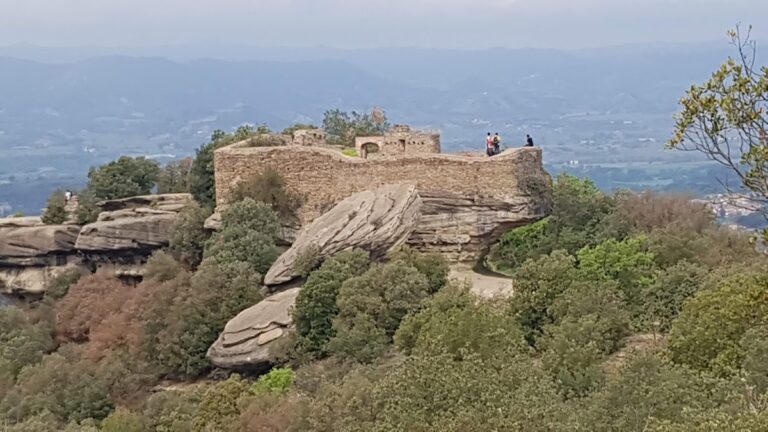
The original castle occupied a small hill and was adapted to the contours of the ground. Medieval wall remains, foundations, and other structures survive beneath the surface on the adjoining rise. These remains are accompanied by evidence of the site’s later development and use, preserving the physical relationship between the early fortified center and its subsequent phases.
Mas de Torroella
The western domus had a rectangular plan and a square-plan tower. The later fortified farmhouse retains this plan and incorporates some of the earlier defensive elements into the present building. Woodland and cultivated fields surround the house, which stands beside the Muntanyola stream near its meeting with the Mèder. Its main entrance has a lintelled portal, while some windows have ogee arches, pointed Gothic arches with a double-curved profile.
Inside the house, portals with Gothic mouldings survive in one room. The ceiling contains strongly moulded plaster panels arranged to produce a decorative coffered effect. Although the building has the form of a farmhouse, these features preserve indications of the site’s former importance as the civil center of the municipal area.
Nearby sites