Castell de Rocabruna: A Medieval Territorial Castle in Catalonia



Site at a Glance
- Rating
- 4.4
- Popularity
- Low
- Country
- Spain
- Primary era
- Medieval
- Eras represented
- Medieval
- Civilizations
- Unclassified
- Site type
- Military
- Remains
- Castle
On this page12 sections
History
Castell de Rocabruna is a medieval territorial castle in Spain, located in the Rocabruna district of Camprodon, between Camprodon and Beget. Its origins are attributed to the tenth century, and it was first recorded in 1070. As a territorial castle, it served as a fortified centre exercising authority over a surrounding district, settlement, or parish. The castle was also identified in 1087 as a territorial stronghold.
Origins and medieval lordships
A reference from 986 names Pedro de Rocabruna, who accompanied Oliba Cabreta, the tenth-century count of Besalú, during the reconquest of Barcelona from Almanzor, the powerful military and political leader of the Umayyad caliphate of Córdoba. After 1070 and before 1100, Arnau de Llers, lord of Rocabruna, swore allegiance to Bernat II of Besalú in connection with the castle. The Llers lineage continued to shape its history during the late twelfth and early thirteenth centuries.
The succession of lords is recorded through several generations. Raimon Adalbert held the castle in 1111–1112, followed by Guillermo Godofredo from 1117 to 1131 and Godofredo in 1158. Arnald de Creixell held it in 1198–1200. In 1258, the castle belonged to Guillem de Cervià and Ermengol de Cervià, with Ermengol selling it that year to Raimon de Milany.
Transfers and military activity
Marquesa de Milany, Raimon de Milany’s daughter, apparently received Rocabruna as a marriage dowry when she married Jaume de Besora. Jaume held the castle from 1279 to 1308, and their son later sold it to Ramon Desbac. Pedro de Rocabruna controlled it from 1320 to 1354 and took part in the expedition to Sardinia in 1330. Later members of the Rocabruna lineage included Dalmau de Rocabruna, recorded in 1366, and Ramón de Rocabruna, recorded in 1377. Another Dalmau de Rocabruna is associated with the period 1399–1447 and with a sale of the castle to Ramon Desbac in 1322.
Pere Desbac held Rocabruna from 1469 to 1477. He supported Joan II of Aragon and policies favouring the remensas, Catalan peasant tenants involved in disputes over feudal obligations and servile dues. During the Catalan Civil War, a conflict over political authority and social order in fifteenth-century Catalonia, Desbac led armed incursions in the Vallespir and Ripollès, including actions at Sant Joan, Camprodon, Olot, and Ripoll. In 1471, Joan II appointed him Captain General of the Mountain.
Other lords included Guillermo Gausfred, who served as executor of Ramon Berenguer III, although his precise period of tenure at Rocabruna is unknown. In the early seventeenth century, the castle passed to the Descatllar family through the marriage of a sister of Pere Desbac to a member of that family.
Parish authority and decline
The church of Saint Lawrence associated with Rocabruna was recorded in 1209. Between 1365 and 1370, the castle, parish, church, and associated settlement formed part of the vegueria of Camprodon, a medieval and early modern territorial district governed by a royal representative called a veguer. In 1698, Rocabruna was a royal locality.
After the end of the Catalan Civil War, the castle lost importance. It was completely abandoned during the seventeenth century and later served as a stone quarry for nearby communities. Local legends preserve other aspects of its reputation. One story describes a siege during Muslim rule in which the inhabitants supposedly dug a long tunnel to obtain water from the river. Another places a buried golden bull at the castle, while further traditions speak of spirits emerging in windy weather from the Tuta de Maimona beneath the cliffs of Coll de la Mola.
Study and conservation
Manuel Bassa produced the most important early study of the castle in 1932 and prepared its only known plan. That plan was subsequently copied and reproduced widely, although it requires revision. In 1976, Spain’s Directorate-General for State Heritage transferred the castle to the Provincial Government of Girona under Decree 141/1976. It is recognized as a Cultural Asset of National Interest, a high-level Catalan heritage designation for monuments and other culturally important properties, and as a historical monument. Its heritage registration code is RI-51-0005841, and the designation dates from 1988.
Archaeological research began in 2005, followed by annual campaigns from 2007. Restoration, consolidation, and investigation continued through 2017. The work strengthened the walls, protected floors by establishing circulation levels, and clarified the surviving remains. The project was directed by architect Lluís Bayona, with consolidation by Construccions Beget and archaeological work by In Situ. Ceramic material places the final phase of occupation in the fifteenth and sixteenth centuries, while coins from the excavations date to the second half of the fifteenth century.
Remains
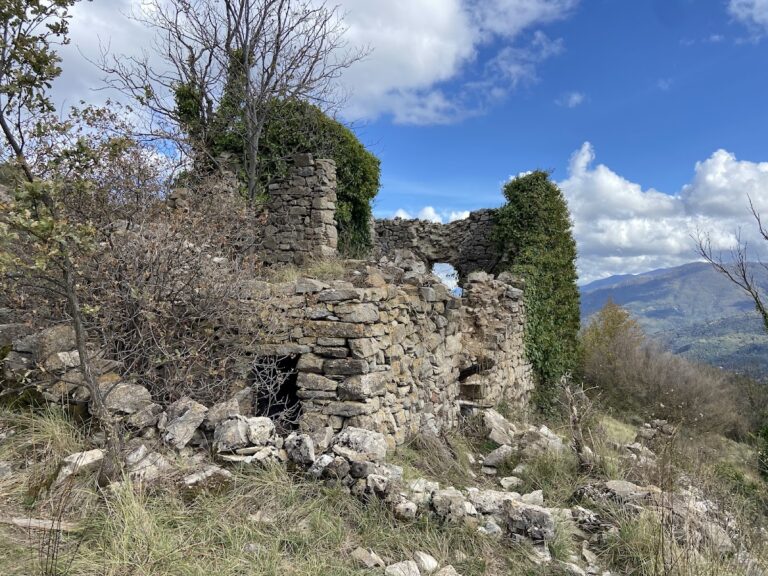
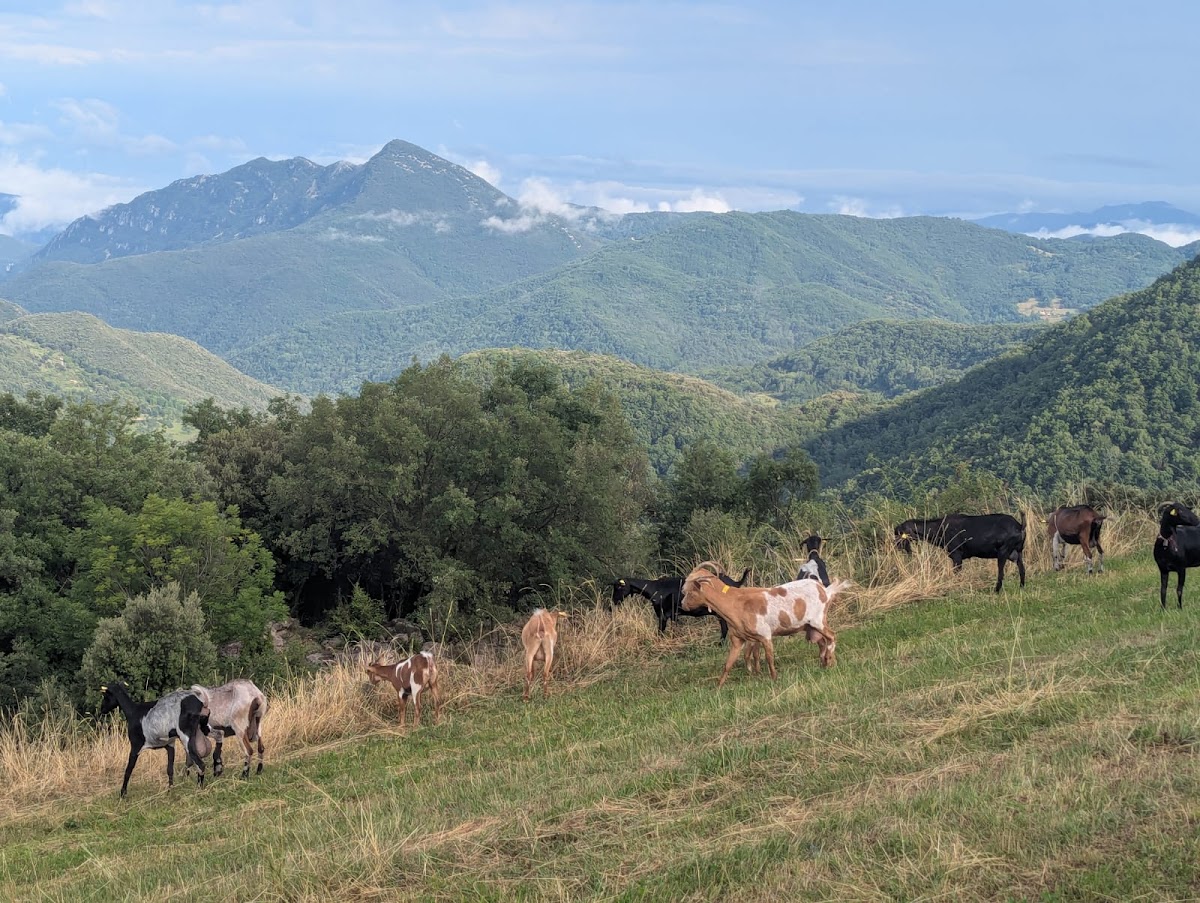
Castell de Rocabruna occupies the Tossal del Castell, a hill at 995 metres surrounded by cliffs. Its position overlooks the Pyrenees and Alta Garrotxa, while dense woodland now surrounds the abandoned remains. The fortification formed a complex of walls and towers arranged in two enclosures. The first enclosure received stronger defences on the north, where the natural protection of the hill was weaker. On the east, the wall followed the irregular terrain.
Walls and towers
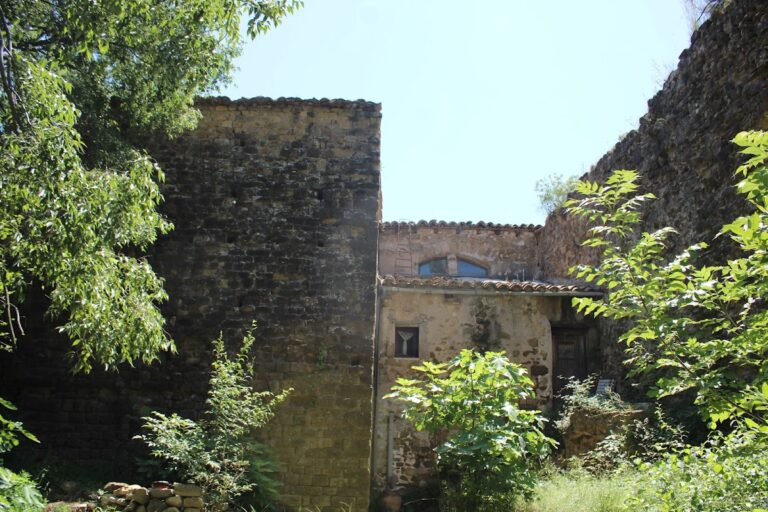
The surviving circuit includes a 39-metre stretch of wall and two towers, one of which may have served as the keep. A further 23 metres of wall connects the towers, while another 18-metre section leads toward the only part of the castle without a double wall. The eastern side of the inhabited sector was formed by an additional 21 metres of wall. These surviving lengths preserve the outline of a strongly enclosed hilltop complex.
The southern wall was defended by a circular tower and a square tower built from carefully cut ashlar, or regularly dressed stone blocks. An irregularly planned tower protected the north, and several square towers guarded the entrance. The keep stood at the edge of the walls on a rectangular plan. One side has partly collapsed, but several loopholes, narrow openings used for observation or missile fire, remain visible. A severely deteriorated circular tower also survives among the stone wall sections.
Entrance and central enclosure
The entrance was concealed among the features known as the gallows columns and occupied a difficult position. Beyond it lay a spacious parade ground surrounded by towers on three of its four sides. A cistern, a built reservoir for storing water, stood at the centre. The entrance area also contained a large defensive tower, the northern wall, the inhabited southern sector, and a possible barracks on the left.
Chapel and western hall
Chapel of Saint Lawrence
The chapel of Saint Lawrence forms part of the surviving castle complex. Its association with Rocabruna is recorded from 1209, linking the religious building to the medieval settlement and the wider territorial role of the castle.
Western hall
A large rectangular hall stood against the western wall, facing the settlement. Its walls were built with opus spicatum, a masonry technique in which stones are laid diagonally in a herringbone pattern. The construction is considered notably ancient. The hall had an upper storey, and parts of its walls remain together with sockets that held the floor beams.
Archaeological finds
Excavations recovered medieval weaponry, mostly dating from the fifteenth century. The inventory includes 68 pieces of defensive armament, 31 offensive pieces, 43 items related to projectile weapons, and 17 pieces associated with smithing. One third of the extracted armament was selected for restoration and study.
Other finds include glass, luxury objects made through bone working, furniture coverings, and tric-trac gaming pieces, from a historical table game related to backgammon. A recorder-type flute made from goat bone has elaborate decoration. Metal objects include earrings, brooches, buckles, copper-alloy pins, thimbles, rings, and stylets, slender pointed tools or daggers. Iron objects range from kitchen equipment to door locks, adding material evidence for domestic activity and the practical operation of the castle.
Nearby sites