Castell de Montpalau: A Medieval Fortress in Pineda de Mar


Site at a Glance
- Rating
- 4.3
- Popularity
- Low
- Country
- Spain
- Primary era
- Medieval
- External website
- Open
- Eras represented
- Iron Age, Classical, Medieval
- Civilizations
- Iberian, Roman
- Site type
- Military
- Remains
- Castle
On this page8 sections
History
Castell de Montpalau is a medieval fortress in Spain, located at Pineda de Mar, and associated with Romanesque architecture. It stands on a site occupied by an Iberian settlement from the fourth century BC, whose use continued into the Roman period. The settlement produced numerous archaeological remains, and much of its stone was probably reused when the medieval castle was built.
Medieval foundation and lordship
The castle is documented from the mid-eleventh century, when Umbert Odo and his wife Sicardis, lords of Sesaguades and later associated with Montseny, swore loyalty to Ramon Berenguer I, Count of Barcelona, for the castles of Montpalau and Gironella. Their oath placed the fortress within the political framework of medieval Catalonia.
During the twelfth century, the Viscounts of Cabrera acquired full control of the jurisdiction of Montpalau. A viscount was a high-ranking feudal officeholder subordinate to a count or comparable ruler, and the Viscounts of Cabrera were a major Catalan noble family. Their possession lasted until 1574, when Montpalau was sold to Francesc I de Montcada, Marquis of Aitona. In the eighteenth century, the lordship passed by marriage from the Montcada family to the Dukes of Medinaceli. A lordship was a feudal territorial jurisdiction whose holder exercised authority over land and dependent communities.
Territorial authority and military function
The lordship controlled a broad territory in the Upper Maresme, extending from Arenys to Hortsavinyà and toward the limits of the domains of Palafolls Castle. By the seventeenth century, its jurisdiction included Pineda de Mar, Sant Pere de Riu or Sant Pere de Pineda, Hortsavinyà, Sant Pol de Mar, Canet de Mar, Calella, Sant Cebrià de Vallalta, and Sant Iscle de Vallalta.
Montpalau functioned as a fortress rather than a permanent residence. Its purposes included intimidating local farmers and providing an occasional base for knights undertaking surveillance duties. Abandonment began around the middle of the thirteenth century. An attempt to rebuild the castle was made in the fifteenth century, but by that period it was already believed to have suffered extensive damage.
Heritage protection
In 1988, the ruins were designated an Asset of Cultural Interest and a Cultural Asset of National Interest. These are Spanish and Catalan heritage-protection categories that recognize and protect historic cultural properties.
Remains
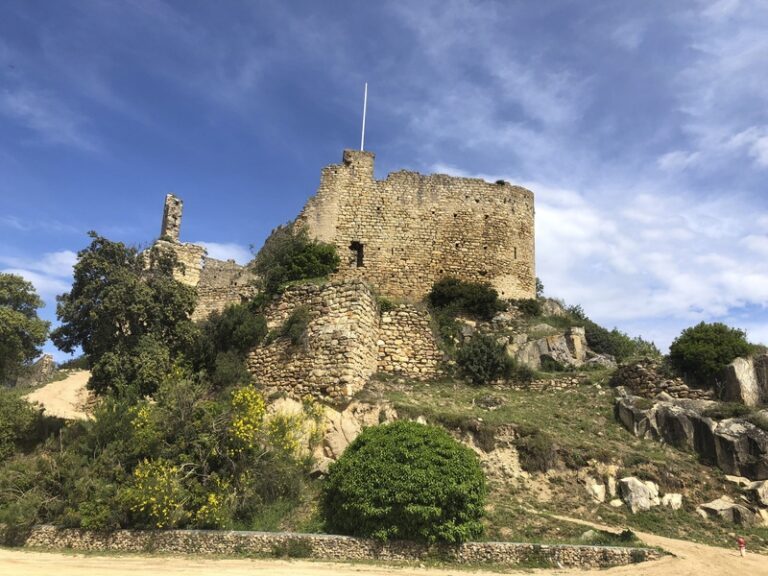
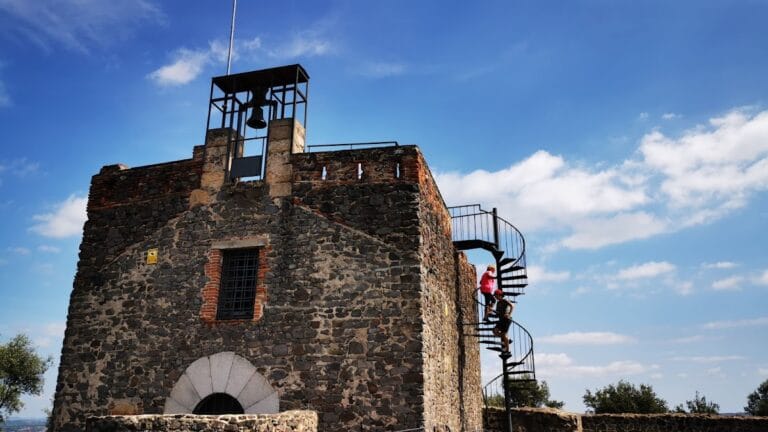
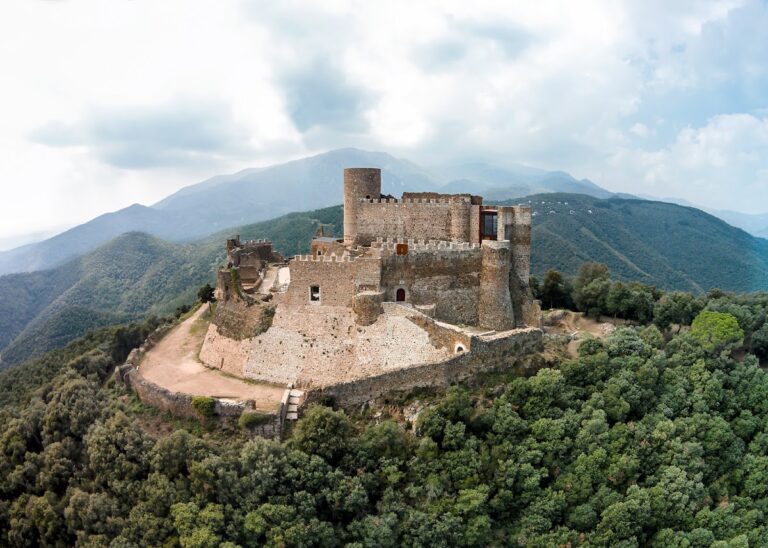
Castell de Montpalau occupies the summit of Montpalau Hill, on the pine-covered slopes of the Montnegre massif, at an elevation of about 269 metres. The surviving ruins cover nearly 1,500 square metres. They consist of parts of the medieval fortress, including wall sections, the keep, portions of the upper enclosure, and a chapel dedicated to Saint Michael. The castle was built from roughly dressed limestone bonded with lime-and-sand mortar.
Fortress walls and enclosures
Keep and upper enclosure
The keep, the principal fortified tower of a medieval castle, has collapsed into large blocks. Parts of the upper enclosure wall remain standing to a considerable height, reaching as high as the second storey. The upper enclosure was a defended area enclosed by walls, and its surviving masonry forms part of the clearest evidence of the castle’s medieval defensive structure.
Chapel of Saint Michael
Remains of a chapel dedicated to Saint Michael survive within the castle complex. In Christian tradition, Saint Michael is the archangel associated with protection and spiritual warfare. The chapel forms a religious element within the fortified site, alongside the surviving walls and tower remains.
Nearby sites