Castell Arnallt: A Medieval Welsh Fortified Court near Abergavenny

Site at a Glance
- Rating
- 5
- Popularity
- Very Low
- Country
- United Kingdom
- Primary era
- Medieval
- Eras represented
- Medieval
- Civilizations
- Welsh
- Site type
- Military
- Remains
- Castle
On this page7 sections
History
Castell Arnallt, also known as Castle Arnold, is a medieval fortified court in the United Kingdom associated with the Welsh rulers of Over Gwent. The court, or llys, served as both a residence and an administrative centre, and stood near Llanover in the Usk valley during the medieval period. Together with other local manors, it formed part of the estates of Dyfnwal ap Caradog, who may have been based at Penpergwm near Abergavenny.
Over Gwent and the Abergavenny lordship
Over Gwent, also called Gwent Uwchcoed, was a medieval Welsh lordship in the region of present-day Monmouthshire. King Henry II of England, the Angevin ruler from 1154 to 1189, recognised Dyfnwal’s son Seisyll ap Dyfnwal as its lord, together with the honour of Abergavenny Castle. An honour was a feudal territorial holding that included a castle and associated estates. Seisyll received this position in return for the release of the hostage Hugh de Beauchamp.
During negotiations for peace between the Lord Rhys and Henry II, Seisyll, who was the Lord Rhys’s brother-in-law, was persuaded to transfer the honour of Abergavenny Castle to William de Braose. De Braose was an Anglo-Norman lord whose power centred on Abergavenny and the surrounding Marcher territory. In 1175, Abergavenny Castle was attacked, and Henry Fitzmiles was reputedly killed by Seisyll. Fitzmiles’s estate, including the castle, then passed to de Braose, who was married to Henry’s sister Bertha.
The destruction of Castell Arnallt
At Christmas 1175, William de Braose invited Seisyll, Seisyll’s son Geoffrey, and other leaders from Gwent to Abergavenny Castle under the pretext of reconciliation. During a feast in the castle’s great hall, de Braose had the men killed in retaliation for Fitzmiles’s death. This episode became known as the Massacre of Abergavenny, after which de Braose seized Seisyll’s lands.
While Seisyll was at Abergavenny Castle, de Braose’s retainers launched a surprise attack on Castell Arnallt. They razed the fortification and killed Seisyll’s other son, Cadwaladr. Seisyll’s wife was either abducted or killed. The final destruction of Castell Arnallt is dated to 1177.
Later history and protection
In 1325, Castell Arnallt formed part of the estates granted to Sir William de Hastings, a relative of the lord of Abergavenny. After its destruction, the site was used for agriculture. It has been surveyed but not excavated, and has held legal protection as a scheduled monument, a protected archaeological or historic site, since 1947.
Remains
Setting and mound
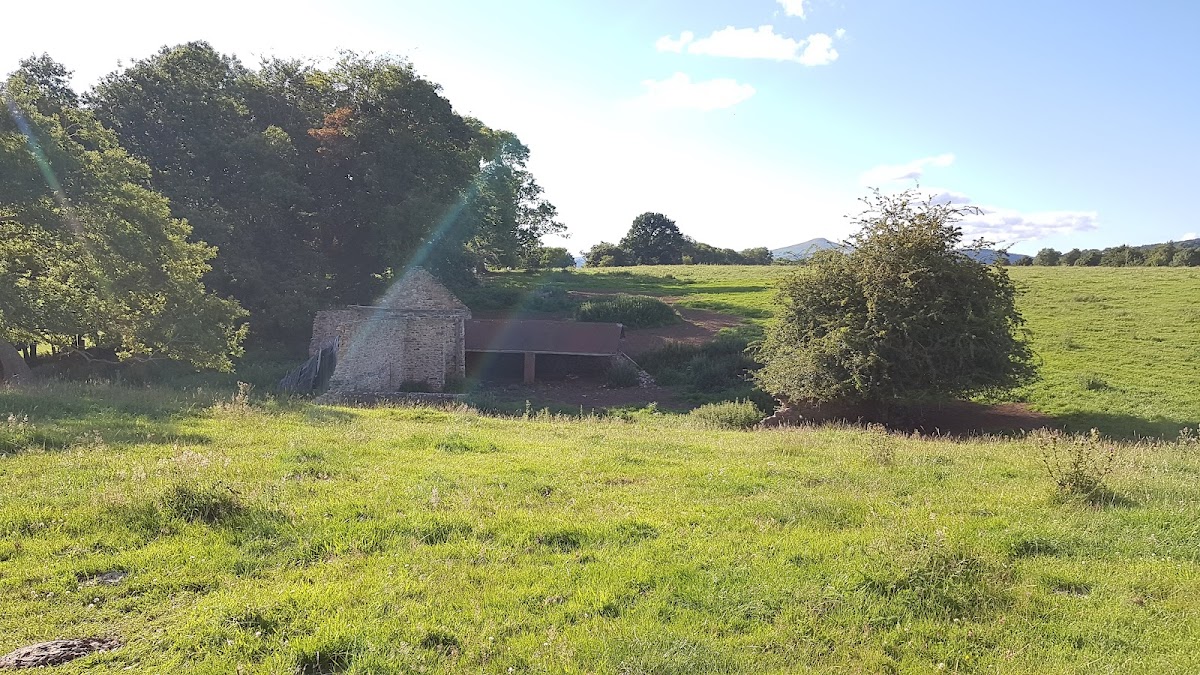
Castell Arnallt stands near Llanover, approximately 4 miles (6.4 km) southeast of Abergavenny, on the edge of the River Usk flood plain. The surrounding land is agricultural pasture used for grazing. The visible remains form a large, oblong mound, which preserves the principal surface expression of the medieval fortification.
Enclosures and buried structures
Two enclosures are recorded at the site. One occupies the top of the mound, while the other lies on its western side. Examination of the mound indicates that structures, a gate, and masonry walls may survive beneath the surface. These elements appear to represent more than one phase of construction.
The fortification appears to have been built without a motte, relying instead on natural formations. The mound therefore represents a complex built over successive phases, with its surviving form preserving evidence of the court’s changing physical organization despite the destruction of the medieval stronghold.