Carl Gustafs kyrka: A Church of Sweden in Karlshamn
Site at a Glance
- Popularity
- Low
- Country
- Sweden
- Primary era
- Early Modern
- Eras represented
- Early Modern, Modern
- Civilizations
- Swedish
- Site type
- Religious
- Remains
- Church
On this page13 sections
History
Carl Gustafs kyrka is a church in Karlshamn, Sweden, whose construction began in 1681 and whose masonry was completed in 1693. Built at the town marketplace, it replaced a wooden church and was named for King Charles X Gustav, Karlshamn’s founder. The church belongs to the Church of Sweden, within the Diocese of Lund and Karlshamn parish.
Foundation and construction
A wooden church had stood near Karlshamn’s harbor since 1664. After the new church was completed, the earlier building served as a grain store for several years. In 1680, mayor Christopher Schröder proposed a larger church. Work began the following year, using plans associated with Erik Dahlberg, a Swedish military engineer and architect. He reviewed and revised the plans, but his precise role in the building’s construction is uncertain.
Disagreements among townspeople and shortages of resources repeatedly slowed construction. On 1 August 1692, King Charles XI authorized a collection for the project among congregations throughout the kingdom. The masonry was completed in 1693, and master builder Peter Hising was engaged that year to carry the work forward. The tower was raised in 1695.
Bishop Mattias Steuchius consecrated the church on 26 October 1702. Work continued until 1714, delayed in part by conflict with Denmark and by the plague epidemic of 1709–1711, which killed about half of Karlshamn’s inhabitants.
Eighteenth-century changes
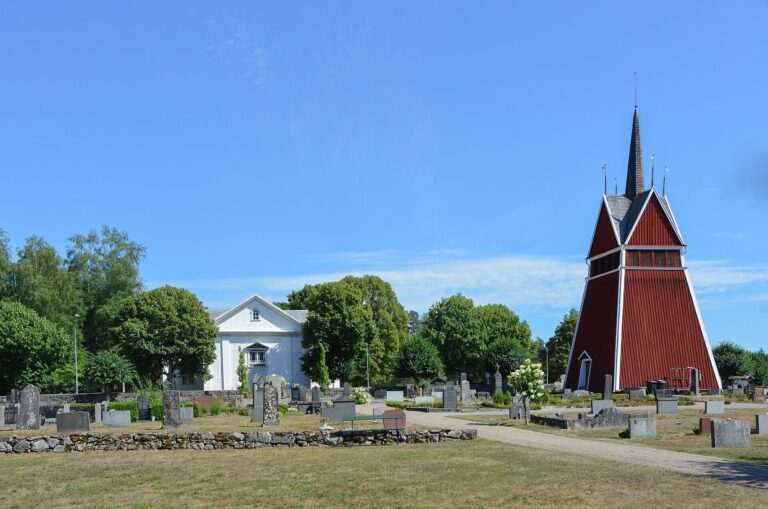
In 1738, the church tower was judged too weak to bear the ringing of its two bells. A separate belfry was built to the north and completed around 1760–1761, using 100,000 bricks donated by the town’s citizens from Hunnemara. Two new bells, cast by Elias Fries Thoresson, were installed in a purpose-built stone tower in 1765; a smaller striking bell was also transferred from the church tower. The larger bell cracked during a royal ringing on 28 May 1771 and was recast by Fries.
The plague dead were buried in a separate cemetery about 500 metres east of the church during the epidemic of 1710–1711. The same burial ground was used during cholera outbreaks in 1834 and 1854. A new cemetery was established north of town in 1879, now called Hvilans Cemetery. The churchyard around the church is no longer in use.
Nineteenth- and twentieth-century work
In the late nineteenth century, architect Helgo Zettervall carried out a major renovation and removed the organ gallery’s elaborate Baroque decoration. Some of that decoration was later preserved at Karlshamn Museum. A further restoration took place in 1981.
The church’s earliest known organ was built in 1702 by Johan Niclas Cahman of Stockholm and had 24 stops, or sound selections. Christian Rüdiger of Jönköping repaired it in 1738. Åkerman and Lund of Stockholm supplied a 25-stop organ in 1881, with air-powered action, followed by a 38-stop instrument built by Mårtenssons in 1940.
Remains
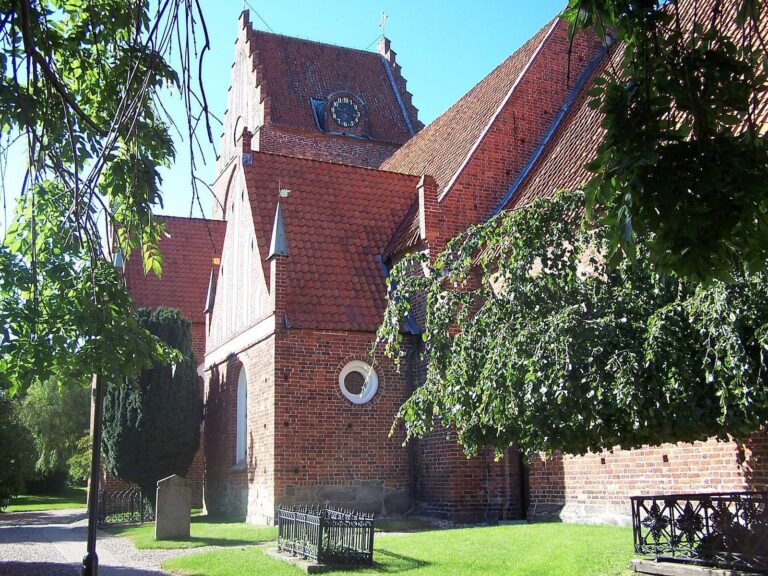
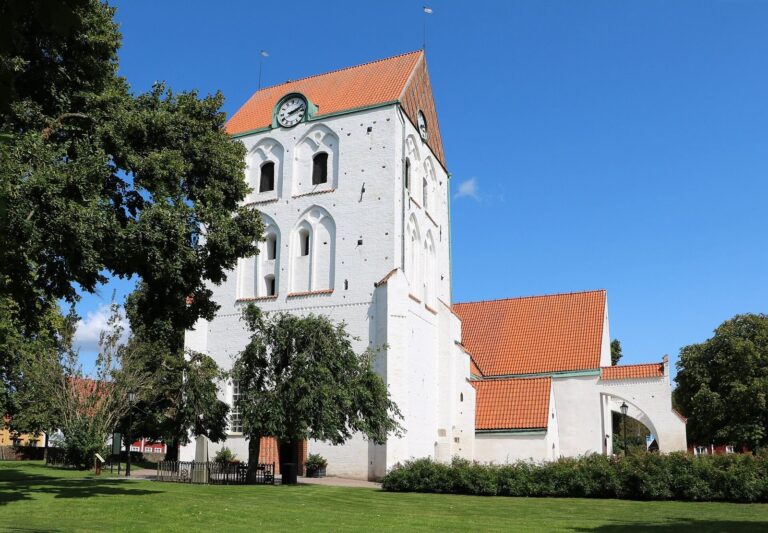
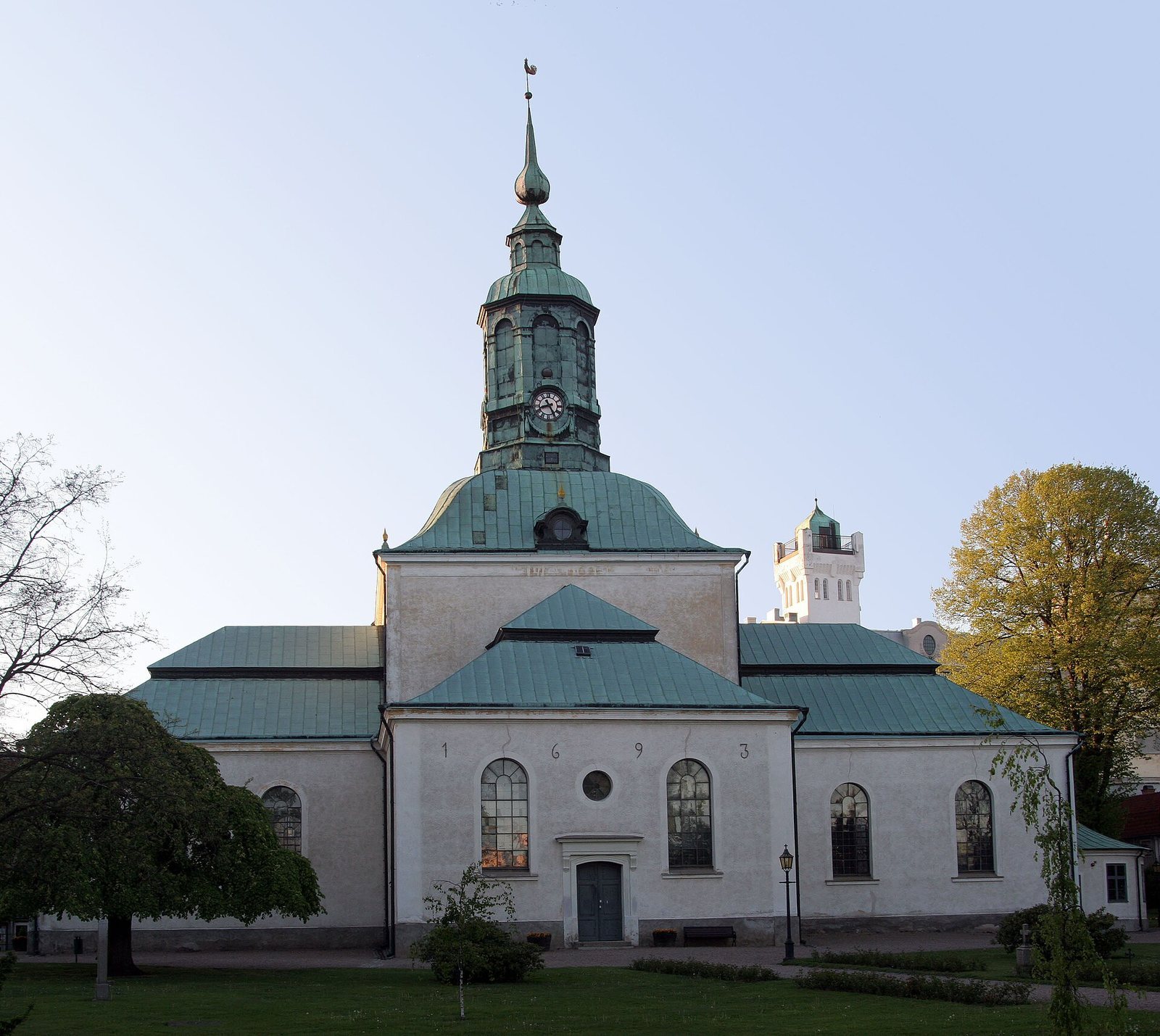
The church is a grey-white masonry building with a shortened cross-shaped plan. Its north and south arms are shorter than its west and east arms, making the overall form resemble a long nave. The alignment appears to follow the cardinal directions rather than the street grid. A central tower rises above the choir, while the separate belfry stands north of the church. The church roof, first covered with iron sheeting in 1695, was later clad in copper; the tower has sheet-metal cladding. A stone inscription on the south exterior wall gives the year 1693, and the churchyard surrounds the building.
Interior arrangement and furnishings
Sacristies and galleries
A semicircular sacristy was added east of and behind the choir in 1834. The 1981 restoration established a new sacristy in the vestibule, while the earlier one became a prayer room. The church has galleries on both the north and south sides. Built in 1751, the north gallery was intended for women and had space for 92 people; the south gallery was reserved for men.
Altar, paintings, and epitaph
The altar stands at the centre of the church. Its altarpiece, painted by Fredric Westin in 1832, depicts the Burial of Christ. Two eighteenth-century wall paintings, one on the north side of the west cross-arm and one on the south wall, present the Crucifixion and Resurrection alongside the altarpiece’s subject. A third wall painting is on the east wall of the south cross-arm. Perspective paintings of a temple flank the altar; Karl Albin Strömberg painted them in 1843. An epitaph on the choir’s south wall portrays Christopher Schröder and was made by court sculptor Caspar Schröder, his son.
Baptismal furnishings and pulpit
The richly ornamented brass baptismal font dates to 1717 and was made either in Sweden or the Netherlands. A separate baptismal basin, dated 1519, is the oldest item in the church’s inventory. Peter Lindh made the wooden pulpit in 1837.
Ceiling, windows, and lighting
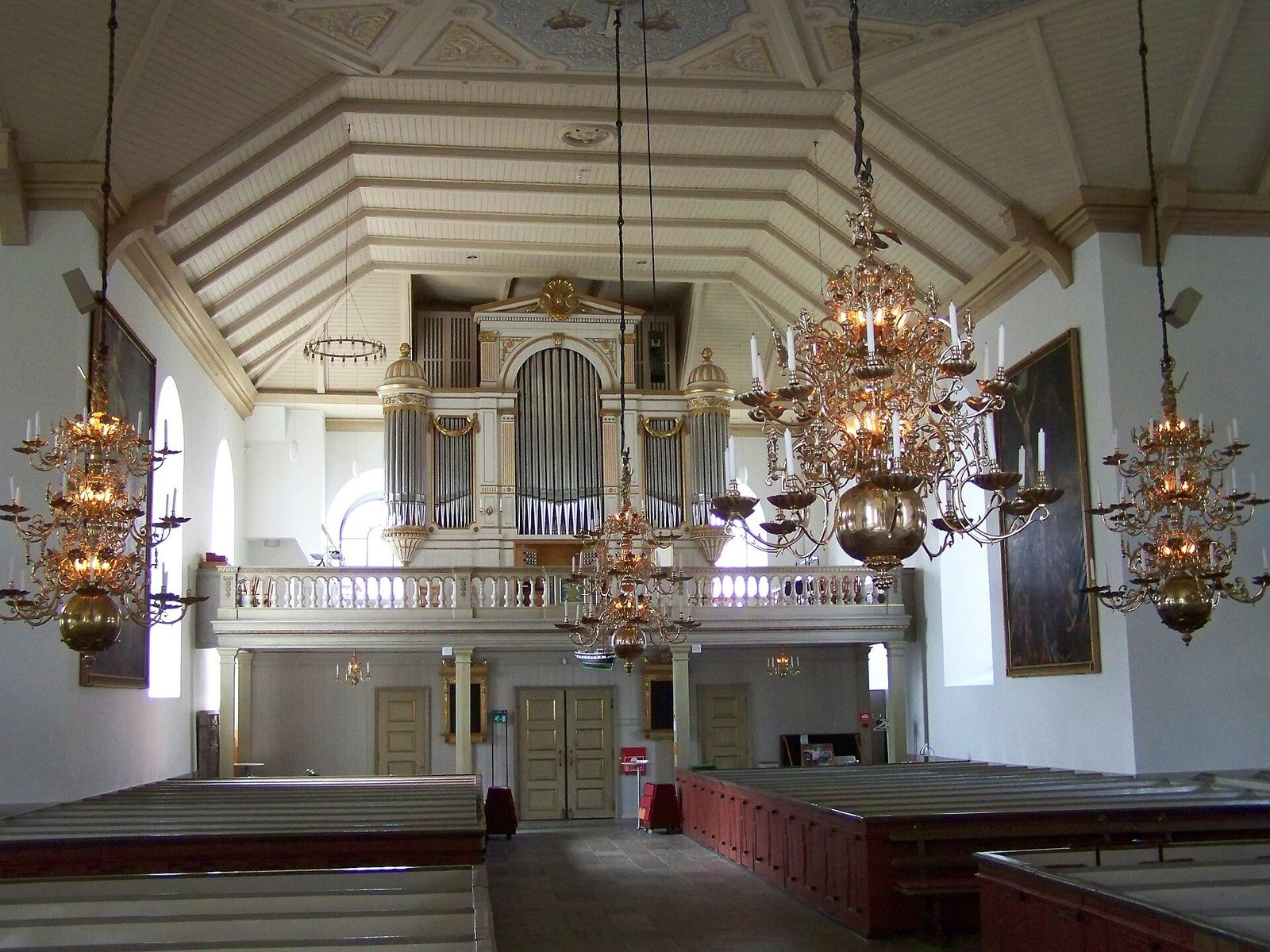
Allan Nordblad painted the ceiling at the church’s centre in 1901 and 1902, with crosses and thorns representing the four Evangelists. The brass chandeliers, gifts from merchants dating to around 1705, remain in the church. Twelve brass light rings were installed in 1981. During that restoration, the original coloured windows were replaced with clear glass, and the outer sides of the pews were painted reddish-brown.
Organs
Main organ
The present main organ was built by Bruno Christensen & Sønner in the 1970s and has 48 stops. It has three manuals, or keyboards, and a pedal played with the feet. Its mechanical action transmits key movements mechanically, while electric registration operates the stops electrically. The visible organ front comes from the 1881 instrument.
Choir organ
Bruno Christensen & Sønner also built a separate choir organ in 1975. It has four stops and mechanical action.