Backaryd Church: A Neoclassical Parish Church in Sweden
Site at a Glance
- Country
- Sweden
- Primary era
- Early Modern
- Eras represented
- Early Modern, Modern
- Civilizations
- Swedish
- Site type
- Religious
- Remains
- Church
On this page13 sections
History
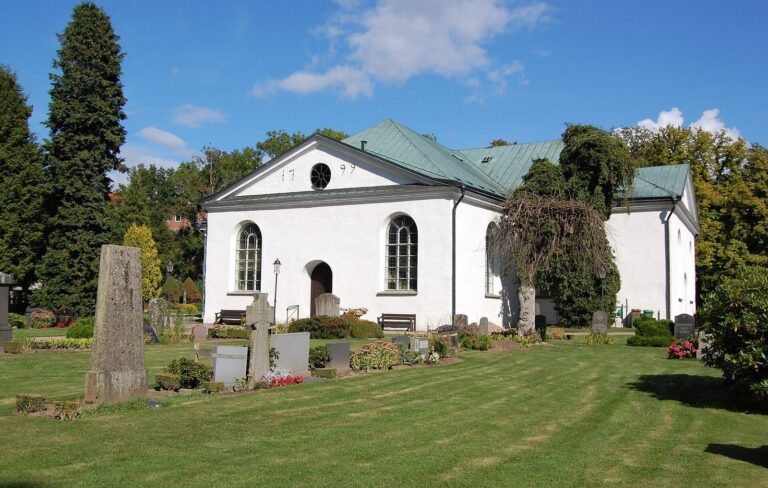
Backaryd Church is a Neoclassical church in Backaryd, Sweden, built for Backaryd Parish in the late 18th century. Neoclassical design draws on ancient Greek and Roman forms. Construction began in 1794, and the church was consecrated in 1799. It is identified as the oldest church of three-aisled form from its era in the region.
The new church and parish
Backaryd Parish received permission to build a new church on 21 March 1787. On 15 April 1794, the parish chose a plot given by innkeeper Mathis Tofvesson, and work began on 21 September. The design was prepared by Erasmus Gabriel Henschen and revised by Olof Tempelman. Superintendent Lars Anders Fahnehjelm, a senior church official, consecrated the church in Karlskrona on 29 September 1799. The building replaced a wooden church dating to 1630 and was formerly known as Holy Trinity Church.
The former Holy Trinity Chapel was sold at auction in 1800. Backaryd Church belonged to Backaryd Parish until 2006, when it became the parish church of Ronneby Parish within the Diocese of Lund, an ecclesiastical jurisdiction of the Lutheran Church of Sweden.
Bells and organs
The new church had no bell tower, so the parish kept the older bell frame, which probably dates to the 1660s. In 1782 it held one bell with an inscription in runic letters. By the 1790s that bell was nearly unusable, and a replacement was purchased in 1794. The 1794 bell was removed in 1928, when a newly purchased bell was installed.
The church’s first organ was made in 1838 by Pehr Jönsson and Andreas Åbergh of Hjortsberga Parish. C. J. Sandstedt paid for the instrument, and its raised gallery was completed in 1839. Carl Elfström of Ljungby supplied a replacement organ in 1903 or 1904, which remained in service until 1932. That year, Mårtenssons organ factory in Lund built a 14-stop organ. Each stop controls a set of pipes with a particular sound. The instrument used pneumatic action, which operates through air pressure, and Frede Aagaard substantially reorganized its stops around 1960.
The present organ was inaugurated on 30 October 1988, with music director Christer Magnusson at the keyboard. Olof Hammarberg of Gothenburg built it, while Nils Hammarberg planned and voiced it. Workshop staff Åke Karlsson, Bo Augustsson, and Sten Johansson made and assembled the instrument; Bo Hammarberg, Mats Persson, and Horst Schwarz assisted with voicing and final adjustment. Magnusson also advised and inspected the work for the congregation.
Remains
The church has a cross-shaped plan, with transepts meeting the main lengthwise space at its midpoint. Its three aisles comprise a central nave and two side aisles. The altar area ends at a straight eastern wall, with a sacristy behind it.
Building and bell frame
Church building
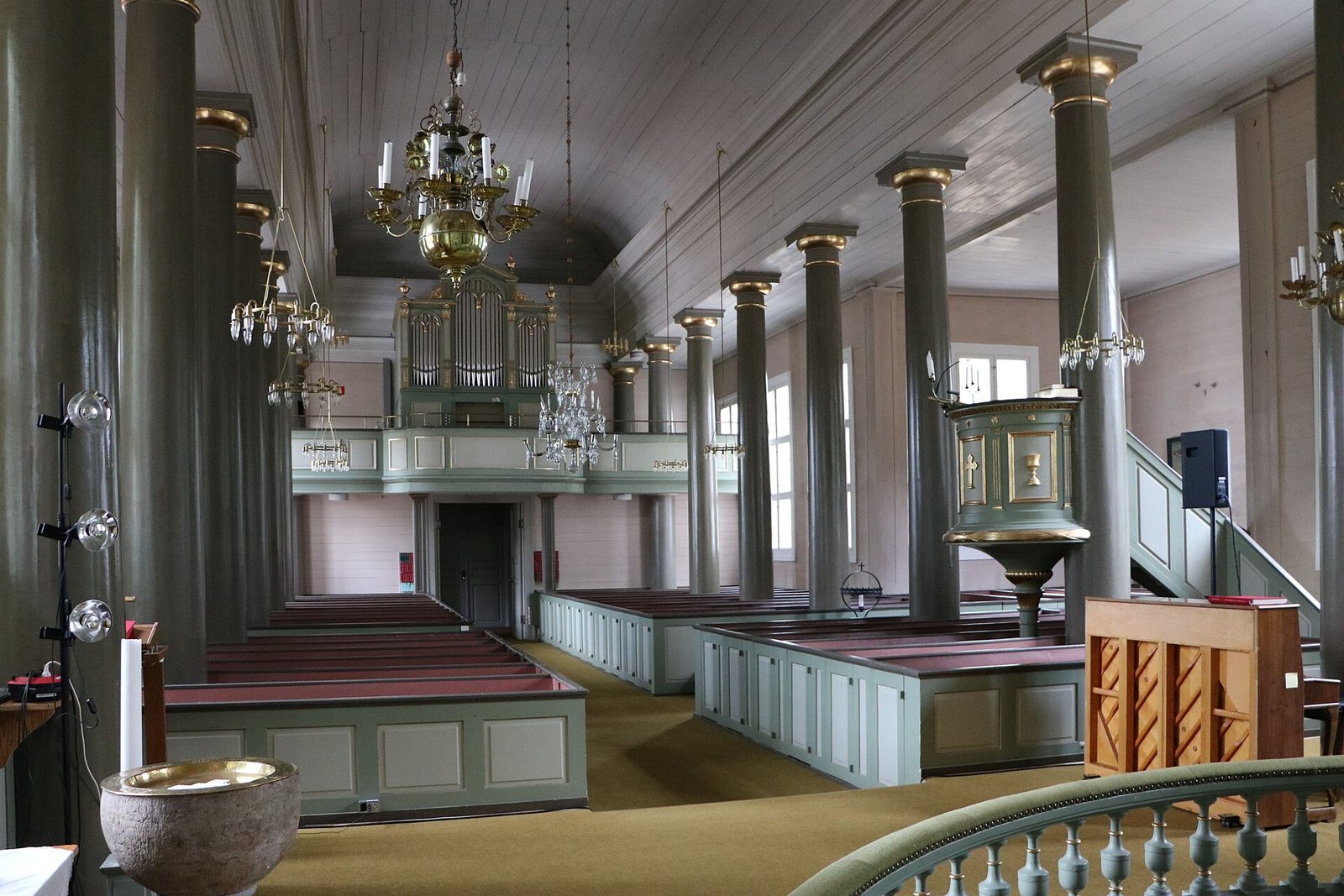
The church is built mainly from horizontally laid timber, while the attached sacristy is brick. Its exterior has a rendered, white-painted finish beneath a shingled roof. The main entrance is on the west side. Inside, a shallow curved ceiling spans the central nave, resting on a substantial horizontal entablature carried by wooden columns; the side aisles have flat ceilings.
Bell frame
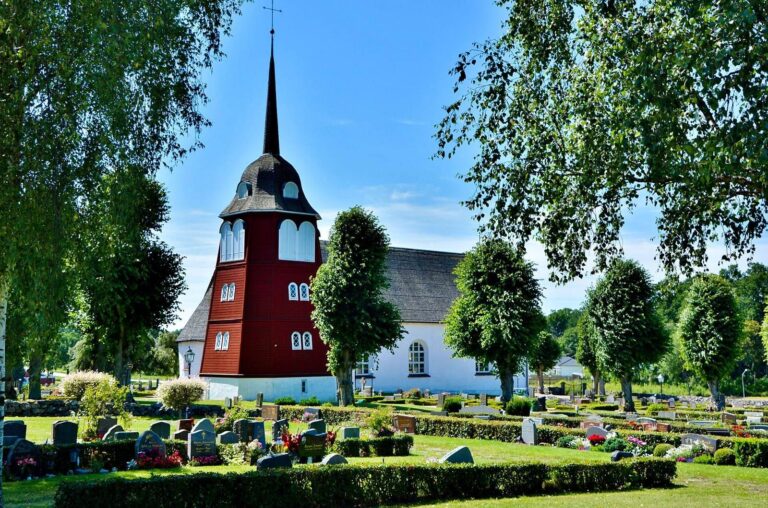
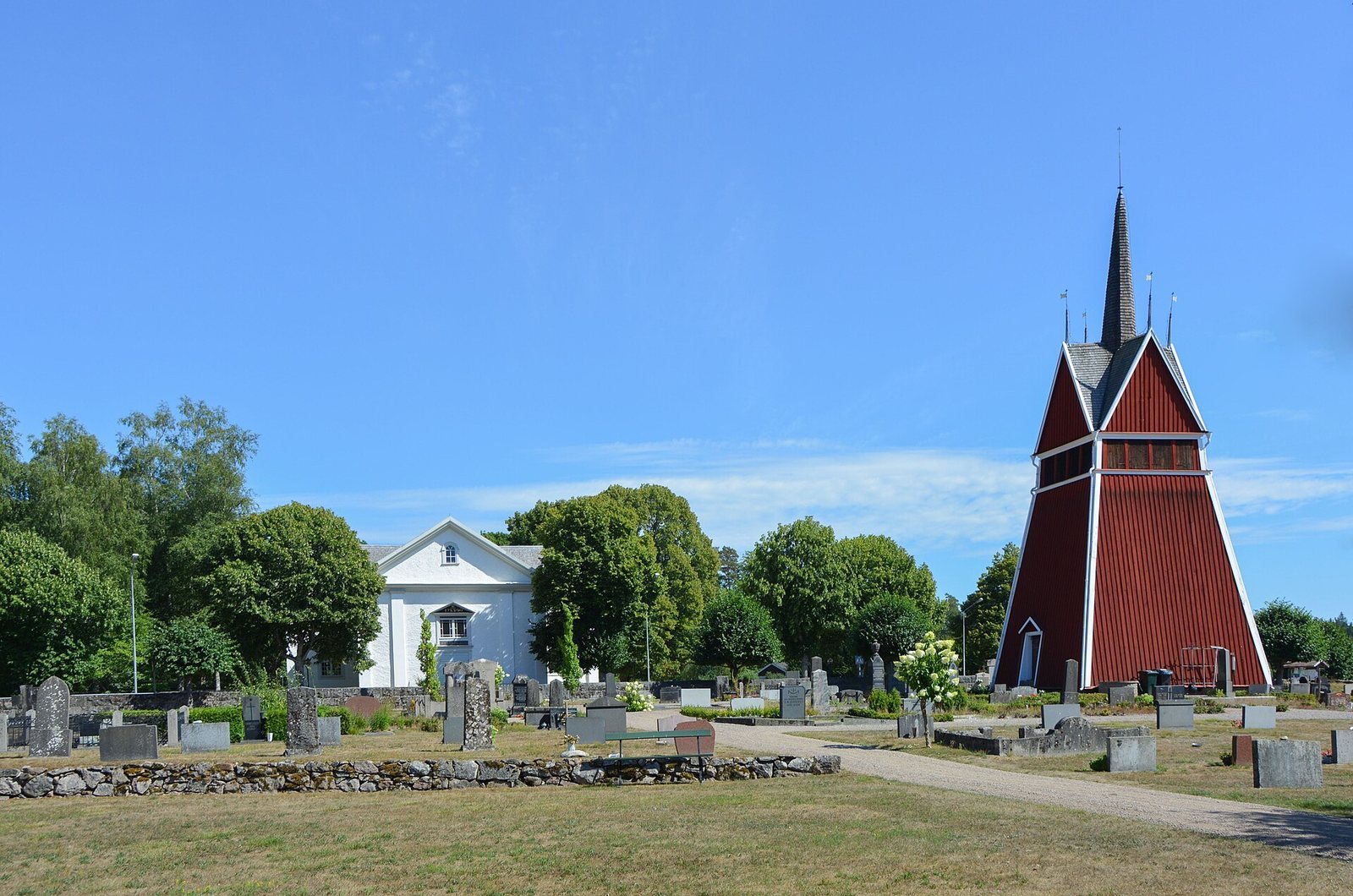
The bell frame is clad in boards and painted red. Iron weather vanes stand on its four gable ends, and a spire rises from the shingled roof, topped by a rooster-shaped weather vane. The frame contains a small museum; Hans Westerholm completed its exhibition in autumn 1998. The bell installed in 1928 was cast by M. & O. Ohlsson of Ystad. Its inscription asks that it ring for church services and for the peace of the grave, and names Sweden’s King Gustav V, Lund’s bishop Edv. Rodhe, pastor Lorens Hansson, and church wardens S. O. J. Dahl and Per Nilsson. The earlier bell, purchased in 1794, carried a message inviting people to worship and expressing hope of seeing Jesus at the end of life.
Interior fittings
Baptismal font
A red-limestone baptismal font in the church dates to the 13th century.
Altarpiece and altar painting
The altarpiece from the earlier church bears the royal cipher of Charles XII, king of Sweden from 1697 to 1718. Its inscription refers to Christ’s betrayal, gives 1713 as the year it was made, and names Pastor Samuel Cornerüs. The present altar painting, made by church painter Ludvig Frid in 1887, copies Carl Bloch’s Christus Consolator at Hörup Church.
Pulpit
The round pulpit was made in 1885 and is decorated with gilded symbols.
Votive ship
Adam Johan Bäck gave the church a model ship in 1748. Its inscription identifies the donor and the gift, and urges people to fear God and honor the king.
Organ
The present organ has 18 stops and mechanical action, in which physical linkages transmit movement from the keys to the pipes. An inscription on its door recalls earlier organ work and ends with Soli Deo Gloria, meaning “To God alone be the glory.”