Capuchin Church: Vienna’s Church of Saint Mary of the Angels and Habsburg Burial Place
Site at a Glance
- Rating
- 4.6
- Popularity
- High
- Country
- Austria
- Primary era
- Early Modern
- Eras represented
- Early Modern, Modern
- Civilizations
- Austrian Empire, Habsburg, Habsburg Austria, Holy Roman Empire
- Site type
- Religious
- Remains
- Church
On this page15 sections
History
Foundation and Habsburg burial place
The Capuchin Church, officially the Church of Saint Mary of the Angels, is a Roman Catholic church on Vienna’s Neuer Markt in Austria, founded for the Capuchin friars in the seventeenth century. Capuchins are a branch of the Franciscan order. Around 1599, friars led by Lawrence of Brindisi stayed in Vienna while travelling to Prague, where Pope Clement VIII had sent them as part of the Counter-Reformation, the Catholic Church’s response to the spread of Protestantism. The church belongs to the Archdiocese of Vienna and the parish of St Augustine.
Empress Anna of Tyrol made provision for the church and monastery in her will in 1618. After Ferdinand II succeeded her husband, Emperor Matthias, the foundation stone was laid on 8 September 1622 at the then-Mehlmarkt, near the Mehlgrube. The Thirty Years’ War, a major European conflict lasting from 1618 to 1648, delayed the work. The church was completed and consecrated in 1632. Habsburg burials began in the Imperial Crypt in 1633, and it became the dynasty’s principal burial place.
War, alteration, and pilgrimage
During the Ottoman siege of Vienna in 1683, a major military assault on the city, bombardment destroyed the church’s roof structure. The building underwent repeated alterations, including the addition of an entrance porch in 1760. The Imperial Chapel received gifts from members of the imperial family and became a pilgrimage destination for Viennese residents and the nobility.
Restoration and later use
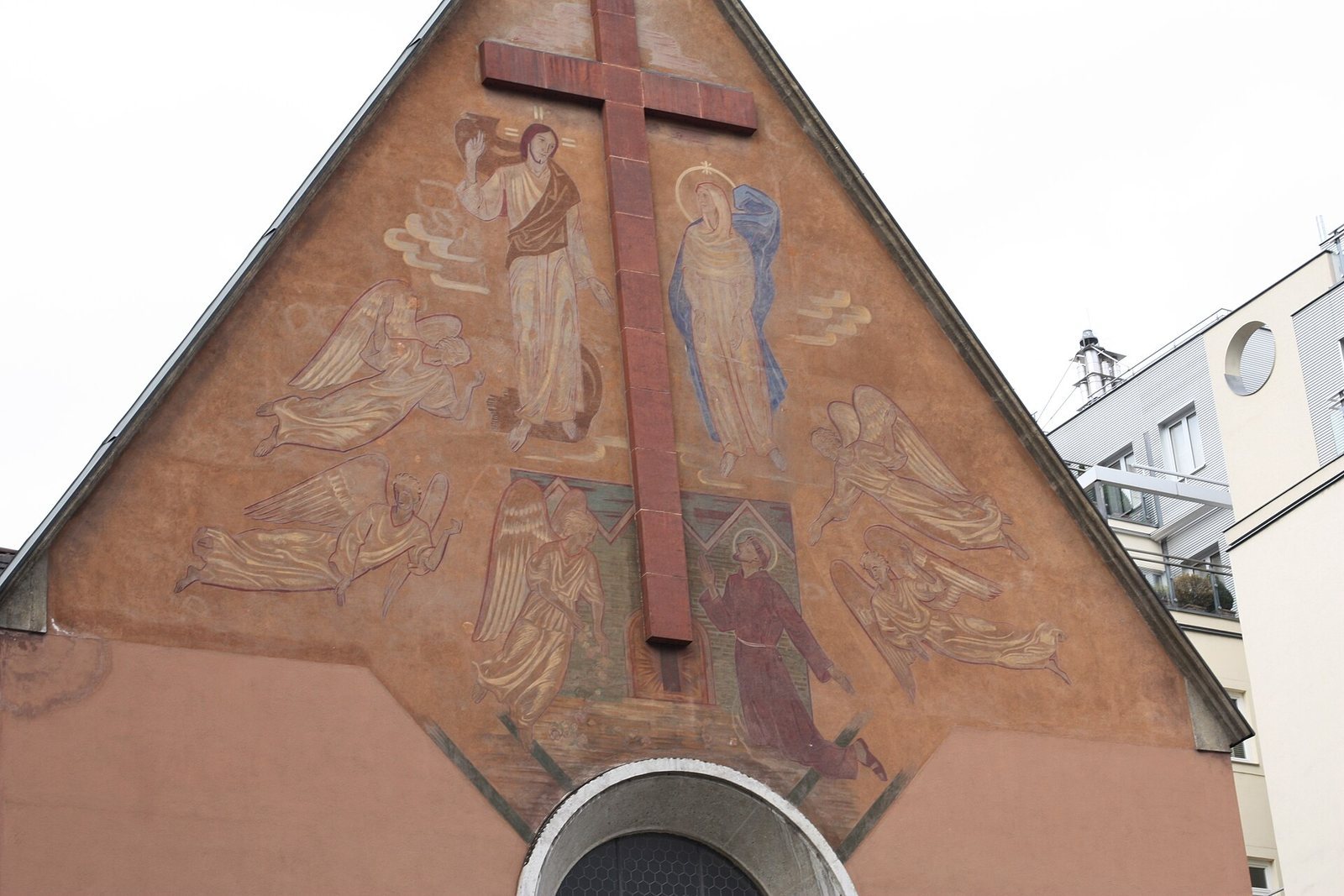
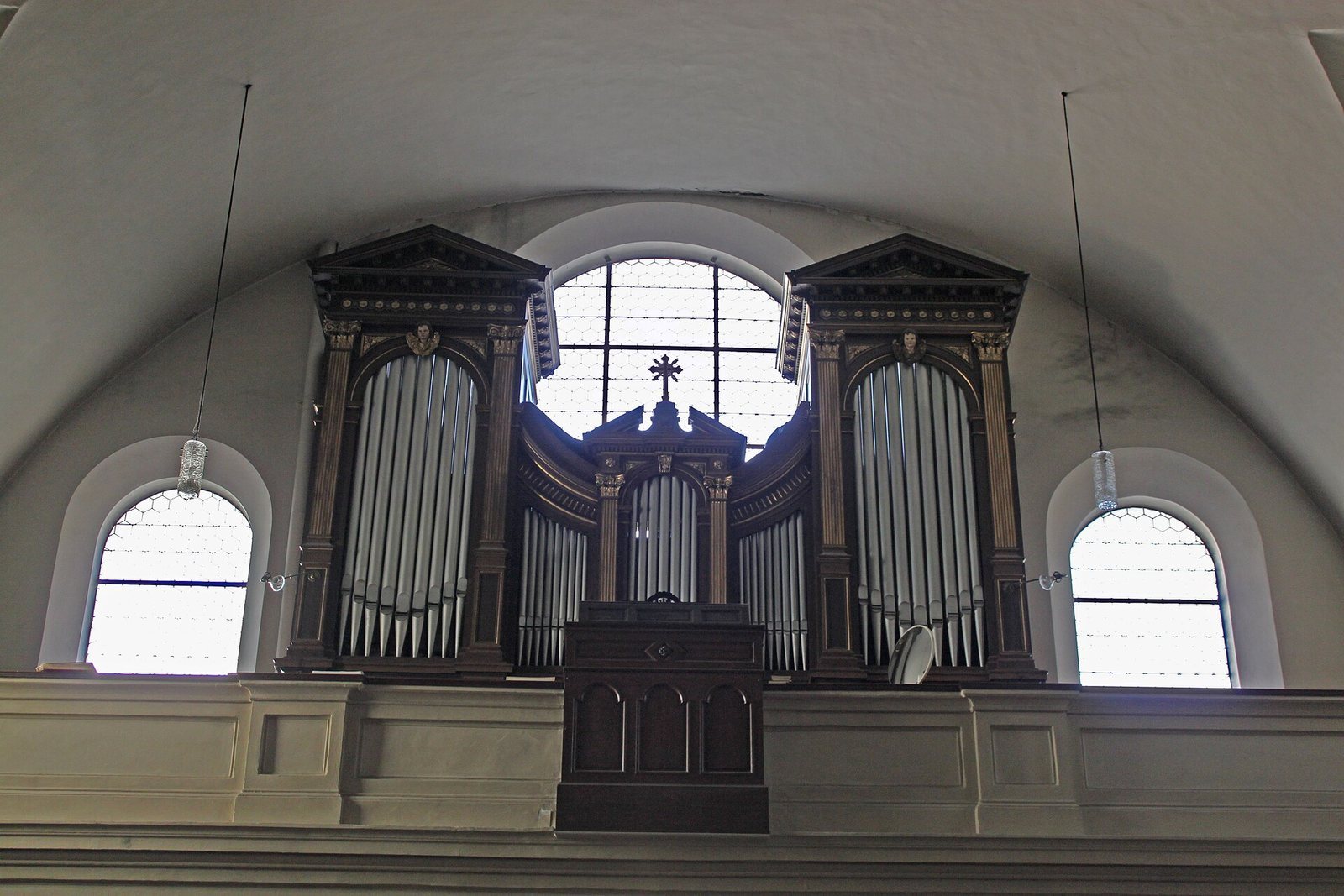
From 1934 to 1936, the façade was reconstructed with the aid of historical images. A fresco by Hans Fischer and a monument to the Capuchin friar Marco d’Aviano by sculptor Hans Mauer also date to this period. The interior received a major renovation in 1976. A broader renovation in 2016 covered the interior, façade, and roof, while also renewing the heating, electrical installation, and lighting. The 1893 Rieger organ was removed and replaced by an instrument made by Manufacture d’Orgues Kœnig, consecrated on 8 October 2017.
The Imperial Crypt’s most recent burial took place in 2011. Otto von Habsburg, the last heir to the Austrian and Hungarian thrones, and his wife Regina of Saxe-Meiningen lay in state in the Imperial Chapel before their burial. Otto lay in state there on 15 July 2011.
Remains
Plan and exterior
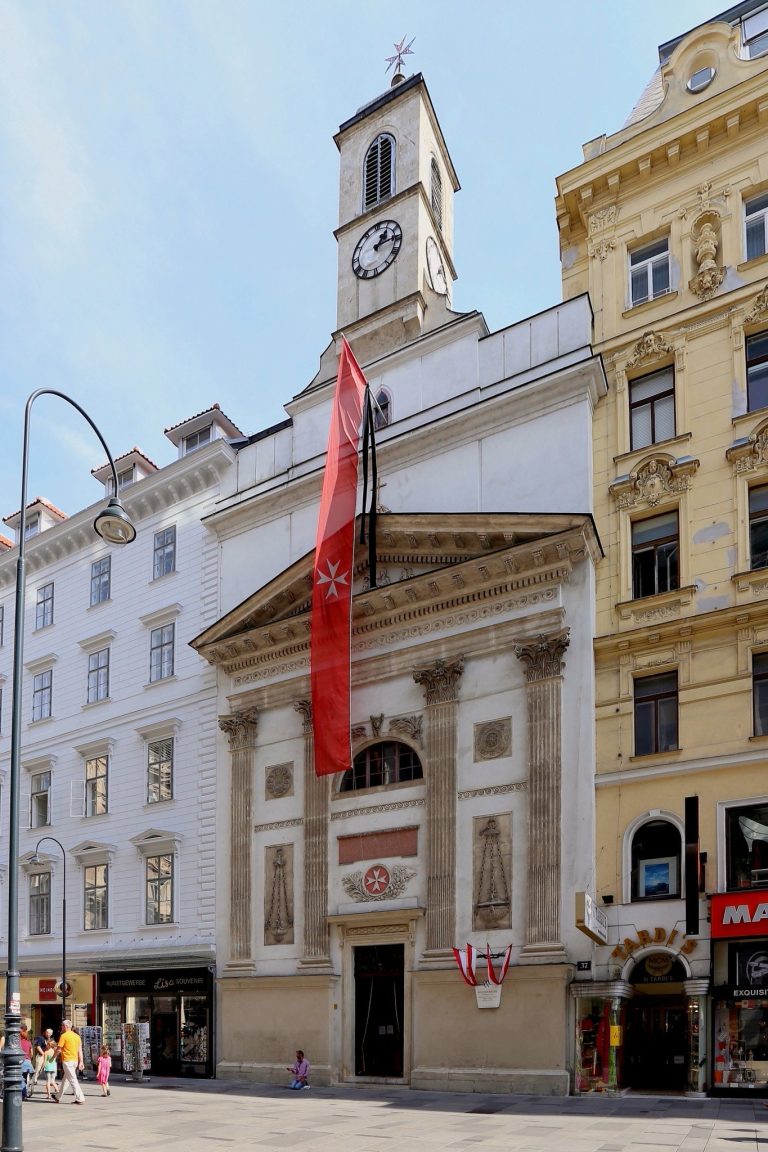
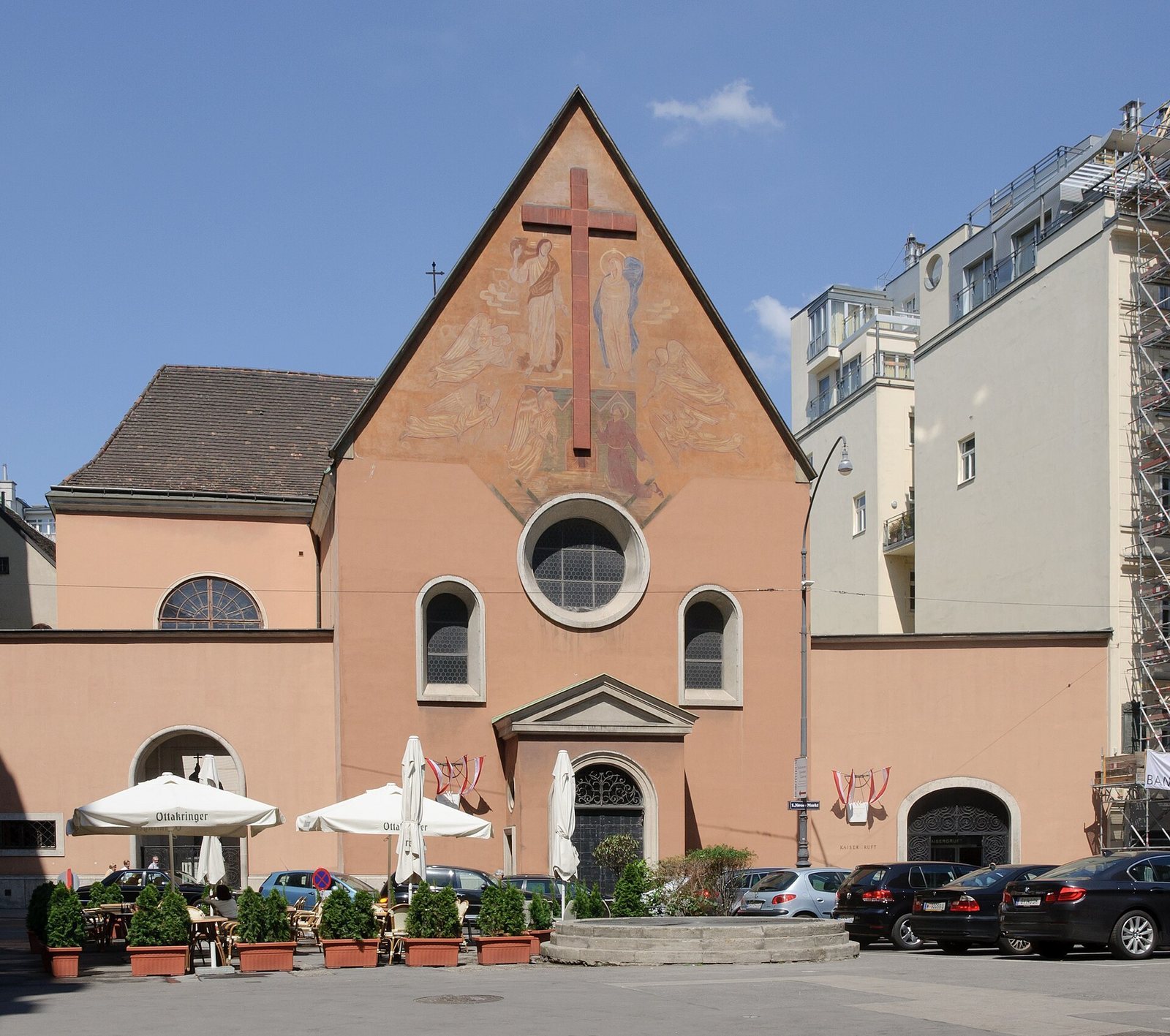
The church stands on Neuer Markt, near the Hofburg Palace. The square began in the mid-thirteenth century as a grain and flour market and was later lined with patrician houses; the church’s restrained exterior contrasted with its more elaborate surroundings. The building is a single-nave hall without side aisles, covered by a barrel vault, or continuous arched ceiling. It measures 35 metres long and 16 metres wide, with a nave 10 metres across. Its façade faces southeast. A small vestibule and two side chapels complete the plan, with the Imperial Chapel to the left and the Pietà Chapel to the right.
The plain exterior has a triangular gabled front. In the restored color scheme, the front is red-ochre and the other façades are off-white. The change in color along the side walls marks where the applied front ends and the main church structure begins. The façade fresco has also been restored.
Chapels and nave
Imperial Chapel
The richly decorated Imperial Chapel contrasts with the plainer interior of the church. Its high altar holds a particularly venerated image of Mary Help of Christians, and life-sized statues of Habsburg rulers stand in the chapel. The Silesian artist Hans Leonhard Wurster made wooden figures of Emperors Matthias and Ferdinand II for this space.
Pietà Chapel
The Pietà Chapel contains a marble altar by sculptor Peter Strudel. It was moved there from the crypt in the late eighteenth century and includes a life-sized Pietà, a depiction of Mary mourning Christ after his death. The floor in front of the altar holds the tombs of the beatified Capuchin friar Marco d’Aviano and Paul von Colindres, head of the Capuchin order, who died in Vienna in 1766.
Nave, flooring, and memorials
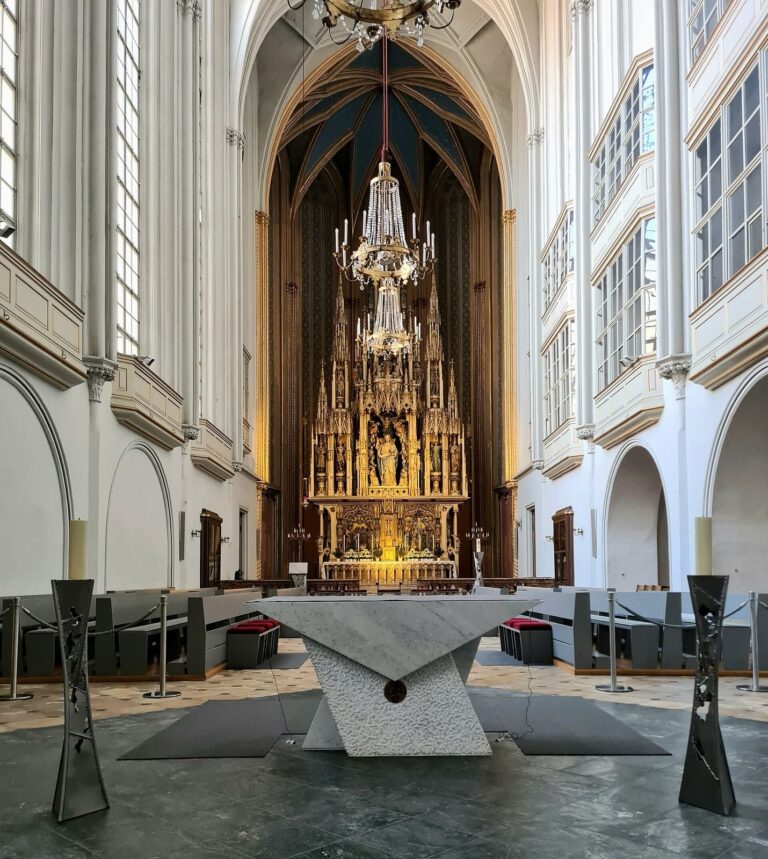
During the 2016 floor renewal, workers uncovered sandstone paving slabs known as Kelheim slabs beneath the pews. They were removed and relaid within the pews in a cross-shaped arrangement. Building-history drawings place this division in 1823. The Imperial Chapel floor was reconstructed from the same drawings in a diagonal checkerboard pattern, while the nave was paved with Untersberg marble from near Salzburg. Most of the nave’s paintings are by Norbert Baumgartner. Beneath the organ gallery, a stone stairway leads to the crypt through a wooden portal. The gallery holds the Kœnig organ that replaced the earlier instrument.
Memorial plaques on the church walls, particularly beneath the organ gallery, commemorate Austro-Hungarian units. They name Dragoon Regiments 1, 6, 7, 8, and 13, whose cavalry troops could also fight on foot; Uhlan Regiments 1, 2, 4, 11, and 13, light cavalry units; Mounted Artillery Regiment 4; and the 12th Infantry Troop Division. A plaque to the 2nd Uhlan Regiment carries a Polish inscription translated as Let us not give in. Another remembers Polish soldiers of the 13th Uhlan Regiment killed during the First World War at Rymanów, Litynia, Chreniów, Burczyce, Krzemieniec, and Korytnica.
Imperial Crypt
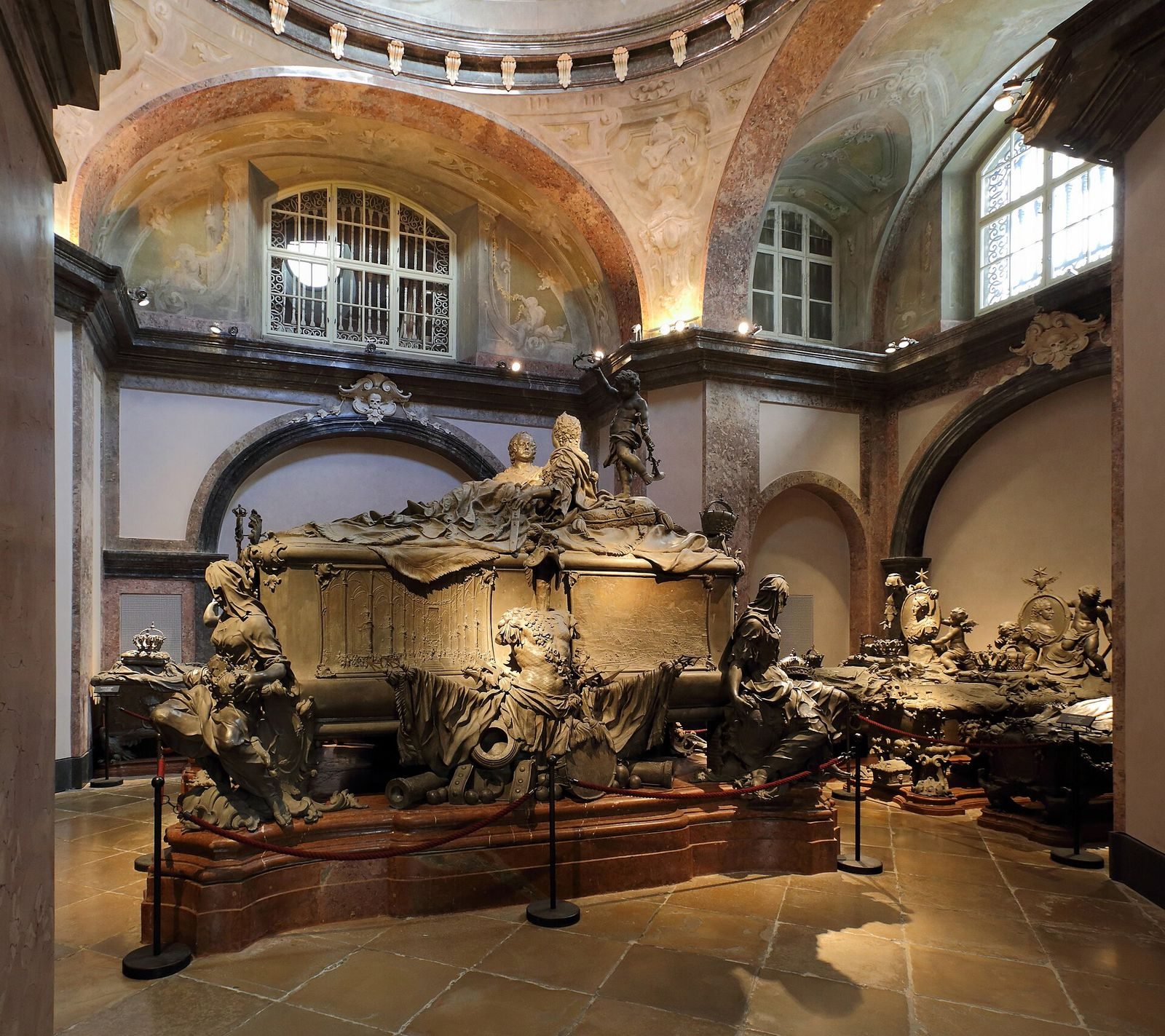
The crypt beneath the church and monastery has ten rooms containing 146 sarcophagi, or coffins, including 107 visible metal examples, as well as five heart urns. Its burials include 145 Habsburg royals, among them 12 emperors and 18 empresses. Urns hold the hearts or cremated remains of four other members of the dynasty. The coffins range from simple forms to richly ornamented examples in the Rococo style, an ornate artistic style that flourished in eighteenth-century Europe.
Founders’ and Leopold crypts
The oldest chamber, the Founders’ Crypt, lies beneath the Imperial Chapel. Lead coffins there hold Emperor Matthias and Empress Anna. The first crypt, known as the Leopold Crypt, contains the tomb of Queen Eleanor Maria of Poland, third from the entrance. Her sarcophagus bears the arms of the Polish-Lithuanian Commonwealth.
Dynastic sarcophagi
A richly ornamented double sarcophagus holds Empress Maria Theresa and her husband, Emperor Francis I, formerly Duke of Lorraine. Sculptor B. F. Moll made it at Maria Theresa’s request, sixteen years before her death, and also made the sarcophagus of Emperor Charles VI. Their son Joseph II has a notably plain tomb, in keeping with his wishes. Other identified tombs include those of Emperor Francis Joseph I, his wife Elisabeth of Bavaria, and their son Rudolf.
Heart burials
The crypt also holds the hearts of Claudia Felicitas of Habsburg and Wilhelmine Amalia of Brunswick, whose bodies were buried elsewhere. The church contains the heart of Stanislaus Potocki, a Polish nobleman and military officer.
Other memorials
A monument to Marco d’Aviano stands outside the church. Inside, the tomb of architect Donato Felice d’Allio commemorates a man who died in 1761.