Capilla del Rescate: A Baroque Street Chapel in Málaga
Site at a Glance
- Popularity
- Low
- Country
- Spain
- Primary era
- Modern
- Eras represented
- Modern
- Civilizations
- Spanish
- Site type
- Religious
- Remains
- Chapel
On this page7 sections
History
Origins and the street-chapel tradition
Capilla del Rescate is a street chapel in Málaga, Spain, commissioned by residents of Calle de la Victoria in 1797 and opened for worship in 1800. Marcos López and José Miranda were entrusted with the work, which the city authorized at the corner of Calle Agua and Calle de la Victoria. The chapel’s popular Baroque design uses an artistic and architectural style prominent in Europe during the seventeenth and eighteenth centuries. It was the only chapel founded by a brotherhood in nineteenth-century Málaga and is one of the few street chapels preserved in the city.
The chapel belongs to an older Andalusian tradition of street chapels, associated with street oratories in Hispano-Muslim cities and widespread in Andalusia from the sixteenth through eighteenth centuries. Often placed at crossroads or squares, these chapels gave religious meaning to public space. This practice reflected the idea of the city as a convent, a conception in which religious institutions helped shape urban life. The chapel has formed part of Calle de la Victoria’s character and served public worship.
Nineteenth-century decline and repair
The chapel opened for devotion to Cristo de la Expiración, a devotional title for Jesus Christ. Its associated brotherhood remained there until at least 1878. During the first half of the nineteenth century, Málaga’s brotherhoods lost activity and financial strength. Disposals of brotherhood property in 1790, 1795 and 1810, together with the Napoleonic occupation of Málaga from 1810 to 1812, contributed to reduced purchasing power and diminished social and institutional support.
The deteriorating building was refurbished by the city in the late 1890s and remained closed into the first half of the twentieth century. In 1912, a municipal councillor proposed demolishing it because he considered it detrimental to the street’s architecture. The proposal was rejected, and the city repaired the chapel. During the Spanish Civil War, the 1936-1939 conflict in Spain, a municipal committee appointed after Nationalist forces, the insurgent faction, entered Málaga restored the building around 1938.
The Rescate brotherhood and later restoration
The current Passion brotherhood, a Catholic brotherhood devoted to Christ’s Passion, reorganized in 1949 and made the unoccupied chapel its seat. Its devotional images, titled Nuestro Padre Jesús del Rescate and María Santísima de Gracia, were transferred there on 28 January 1951 for public veneration. The brotherhood’s first activity at the chapel was distributing food to people in need.
Exterior beautification began in 1975, and modest interior repairs were completed in 1977, limited by the brotherhood’s finances. Work toward a more substantial restoration started in 1981, and the Junta de Andalucía, the regional government of Andalusia, carried out restoration in 1995. An order dated 22 December 2009, published on 28 January 2010, entered the chapel in Andalusia’s General Catalogue of Historical Heritage as a General Catalogued Asset.
Remains
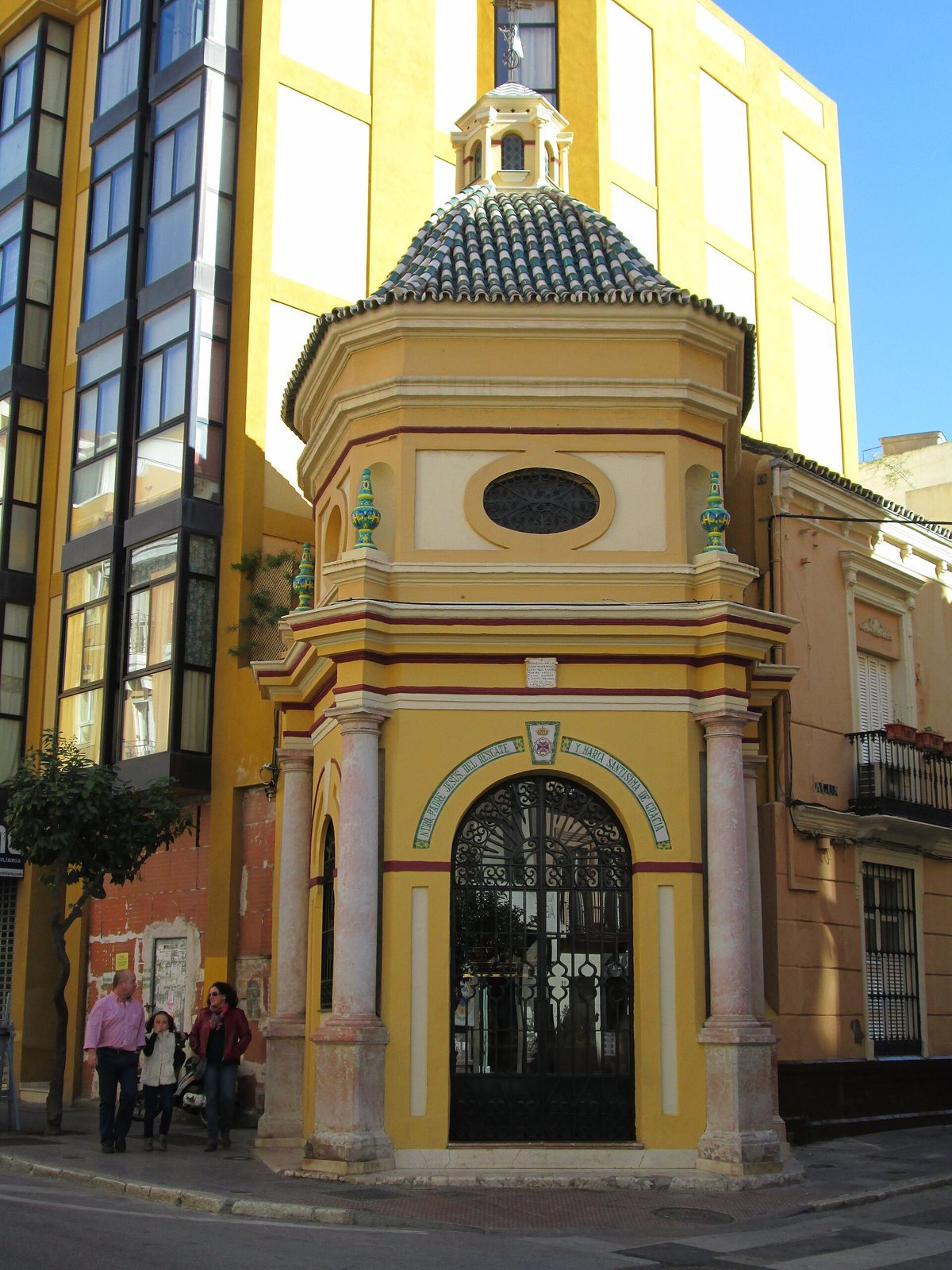
The chapel has an irregular six-sided central plan and an elliptical interior, while its exterior rises in three tiers across a chamfered corner frontage. Its popular Baroque design combines architectural detailing with a compact street-facing form.
Exterior
At the principal level, Tuscan columns, a plain classical column type, stand on stone pedestals and frame arches across the three exterior faces. Paired horizontal architectural bands rest above them, with a molded band and projecting ledge running over the columns. The angled frontage has three semicircular entrance arches set within recessed bands; the two side openings are blocked. The next tier has inset oval and rectangular panels, with ornamental vases at the corners in front of small niches. A conical roof covered with glazed tiles supports a ceramic-decorated hexagonal lantern. Ornamental exterior lighting was inaugurated on 15 March 2002. In 2003, work addressed dampness caused by an adjoining lot and added an ornamental cap with a weather vane to the lantern. Painted figures of two brotherhood members in penitential robes appear on the vane. A wrought-iron railing surrounds the chapel. The entrance plaque names the stewards Christobal Ramírez, Marcos López, Carlos Ramírez and Joseph Miranda.
Interior
Niches occupy the three central faces opposite the entrance, set among otherwise plain wall surfaces. Corinthian-style pilasters, flat supports attached to the walls, carry attached columns with fluted shafts. A large niche above the base holds the Rescate brotherhood’s principal devotional images. The ceiling is a plaster vault, a curved structure with raised ribs, rising from a projecting ledge supported by the wall pilasters.