Castle of Gibralfaro: A Historic Fortress Above Málaga



Site at a Glance
- Rating
- 4.5
- Popularity
- High
- Country
- Spain
- Primary era
- Medieval
- External website
- Open
- Eras represented
- Iron Age, Medieval
- Civilizations
- Nasrid, Phoenician, Umayyad
- Site type
- Military
- Remains
- Castle
On this page12 sections
History
Castle of Gibralfaro is a historic fortress on a hill above Málaga, Spain. The site began as a Phoenician lighthouse in the seventh century BC and later became a fortress, castle, and barracks. Its name derives from that early lighthouse and is explained as “mountain of the lighthouse.”
From lighthouse site to fortress
The hill served as a lighthouse from the seventh century BC. After the Roman occupation of the Iberian Peninsula, a fortress was built there, establishing the site’s long military role.
In the tenth century, Abd al-Rahman III transformed earlier ruins into a new fortress. He was the Umayyad ruler who established the Caliphate of Córdoba, a Muslim state based in Córdoba. The reconstructed stronghold continued the hill’s defensive function and became the foundation for later enlargements.
The Nasrid alcázar
In 1340, Yusuf I of Granada enlarged the fortress and converted it into an alcázar, a fortified palace or royal residence incorporated into a defensive complex. Yusuf I was a Nasrid sultan of the Emirate of Granada, the Muslim-ruled state that controlled Málaga when this work took place.
The enlarged fortress housed troops and protected the Alcazaba during sieges. Its position on the hill was particularly important because artillery had made elevated ground strategically valuable. A fortified connecting passage linked Gibralfaro with the Alcazaba, while a zigzagging coracha, an enclosed or irregular defensive wall or passage, also joined the two fortifications.
Conquest and later military use
The Catholic Monarchs, Ferdinand of Aragon and Isabella of Castile, besieged the castle throughout the summer of 1487 during their capture of Málaga. Their joint reign led to the conquest of the remaining Muslim territories in Iberia, including Málaga. After the conquest, Ferdinand used Gibralfaro as a residence, while Isabella preferred to live in Málaga.
The site remained associated with military life from the tenth through the twentieth century, serving successively as a fortress, castle, and barracks. It was declared a Historic-Artistic Monument in 1931 and is protected as a Spanish cultural-interest property in the monument category under the 1985 heritage law.
Remains
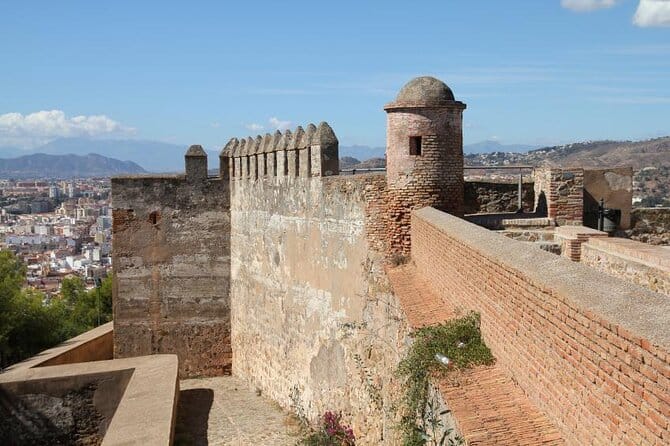
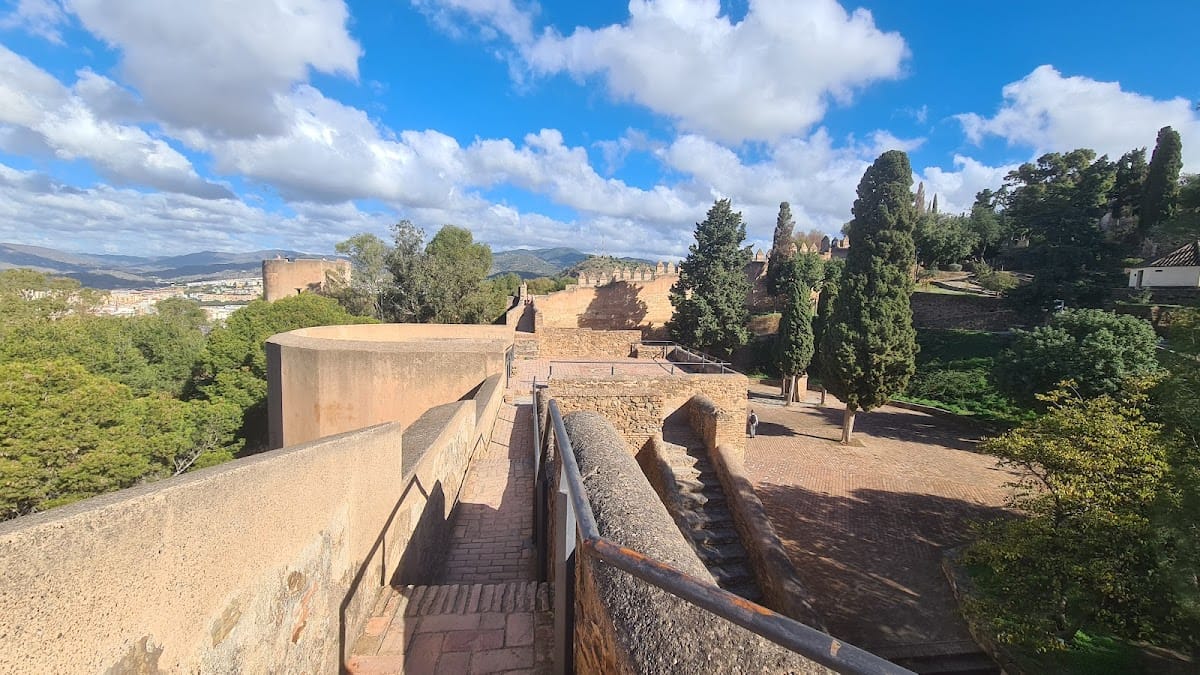
Castle of Gibralfaro occupies a hill approximately 130 metres above sea level, positioned above the Alcazaba. Two lines of walls enclose the fortification, which has eight towers. The inner wall supports a continuous wall-walk around the perimeter. Within these defenses, the castle is divided into an upper section containing the Main Courtyard and a lower section known as the Arms Courtyard.
Upper section and defensive works
Main Tower
The upper section contains the Main Tower, which rises 17 metres. Its position forms part of the castle’s elevated defensive arrangement above Málaga. The keep provides views over the city, and in clear weather the Rif Mountains in Africa and the Strait of Gibraltar can also be seen.
Phoenician well and baths
A Phoenician well and baths survive in the upper section. The Airón Well is cut into living rock and reaches a depth of 40 metres, making it a prominent water-related feature within the hilltop complex.
Lower section and subsidiary structures
Arms Courtyard
The lower Arms Courtyard contained troop barracks and stables. These facilities reflect the castle’s role as a military installation and its capacity to support the soldiers stationed there.
Albarrana Tower
The Albarrana Tower, also called the White Tower, faces northeast and is one of the castle’s most visible features. Its interior preserves a cistern, rooms, and storage areas, combining defensive and practical functions within the fortification.
Military interpretation centre
The interpretation centre occupies the former powder magazine. Its exhibition presents aspects of military daily life at the castle through uniforms and other equipment associated with soldiers from the sixteenth to the twentieth centuries.