Cambridge Castle: A Norman Motte-and-Bailey Fortress in England


Site at a Glance
- Rating
- 4.3
- Popularity
- Low
- Country
- United Kingdom
- Primary era
- Medieval
- Eras represented
- Medieval
- Civilizations
- Norman
- Site type
- Military
- Remains
- Castle
On this page13 sections
History
Cambridge Castle is a Norman motte-and-bailey fortress in the United Kingdom, built at Cambridge in late 1068 after the Norman Conquest. It was established by William the Conqueror, the Norman ruler who took control of England in 1066, to command the route north from the town, then called Grantabridge, along the former Roman road from London to York. Its position within the existing settlement also helped deter rebellion. The first castle was one of three built in eastern England after William’s campaign to capture York.
Foundation after the Norman Conquest
Picot, the high sheriff of Cambridgeshire and Huntingdonshire, carried out the initial construction. Building the fortress inside the town required the demolition of 27 houses to clear the site. Picot later founded a priory beside the castle. The early fortress used earth and timber, following the motte-and-bailey tradition, in which a raised mound supports a fortified strongpoint and an enclosed lower area forms the bailey.
Cambridge Castle remained under Norman royal control until the Anarchy, the civil war between King Stephen and Empress Matilda from 1139 to 1153. In 1143, Geoffrey de Mandeville, who supported Matilda, attacked Cambridge, raided the town, and captured the castle for a short time. Stephen counterattacked and drove Geoffrey into the Fens, the low-lying and historically marshy region of eastern England, before recovering the fortress.
Royal control and medieval wars
Because Cambridge Castle remained exposed to attack, Stephen ordered an additional fortification at Burwell. Geoffrey de Mandeville died while attacking Burwell Castle in 1144, and Cambridge was no longer immediately threatened by him. During Henry II’s reign, the castle was maintained and received only modest improvements. A castle-guard arrangement assigned surrounding lands to local lords in exchange for troops to defend the royal fortress. The castle also housed the sheriff’s court and administrative records.
King John enlarged the castle before the First Barons’ War, fought between the Crown and rebellious barons from 1215 to 1217. His work focused on a new hall and chamber and cost £200. Rebel barons supported by Prince Louis of France seized the castle in 1216, but it returned to royal control after the war. Henry III made basic repairs to the fortifications.
Cambridge was attacked again during the Second Barons’ War, a later conflict between the Crown and rebellious barons that lasted from 1264 to 1267. The town and castle resisted until Henry III’s forces arrived. Afterward, Henry strengthened Cambridge’s defences with a large ditch that became known as King’s Ditch.
Edwardian rebuilding and decline
Cambridge Castle remained a basic fortification until Edward I began a major rebuilding campaign in 1284. Over the following 14 years, at least £2,630 was spent rebuilding it in stone. The project created a large fortress that was never fully completed. Edward stayed at the castle for two nights in 1294.
The fortress declined during the fourteenth century and stood in ruins by the fifteenth. From the reign of Edward III onward, little money was allocated to its maintenance. The hall and chamber lost their roofs, and Henry VI ordered their demolition in 1441 so their stone could be reused at King’s College. Other masonry went into Trinity College Chapel, while further stone was taken during the sixteenth century for a mansion near Sawston and for Emmanuel and Magdalene Colleges.
By 1604, only the gatehouse and keep remained intact. Contemporary descriptions characterized the surrounding walls as demolished and ruinous. The circular keep, the castle’s principal fortified tower, survived intact at least until that date, but it no longer stands.
Civil War and later reuse
During the English Civil War, which began in 1642 as a conflict between the Royalists and Parliament, Parliamentary forces occupied Cambridge Castle. Oliver Cromwell ordered emergency repairs that added two earthwork bastions and a brick barracks in the former bailey. The castle saw no further fighting during the war. In 1647, Parliament ordered the remaining fortifications slighted, meaning that they were deliberately damaged so they could not be used again.
The surviving walls and bastions were demolished in 1785, leaving the gatehouse and motte. The gatehouse continued to serve as the county jail during the nineteenth century as a private business, and its keeper received £200 annually from the county in 1807. A new county prison was built in the former bailey between 1807 and 1811 by G. Byfield. Its innovative octagonal design was influenced by the ideas of prison reformer John Howard.
The gatehouse was later demolished to make way for a new county court building. By the end of the nineteenth century, the prison was considered surplus to requirements. It became a branch repository of the Public Record Office by 1920 and remained in that use until 1928, when Cambridgeshire County Council acquired it. The prison was demolished in 1932, and its bricks were reused to build Shire Hall on the same site. Shire Hall became the headquarters of Cambridgeshire County Council and occupies the former bailey and nineteenth-century prison grounds.
The motte and surviving earthworks are protected as a Scheduled Ancient Monument, a nationally protected archaeological or historic site in England whose unauthorised alteration or damage is restricted.
Remains
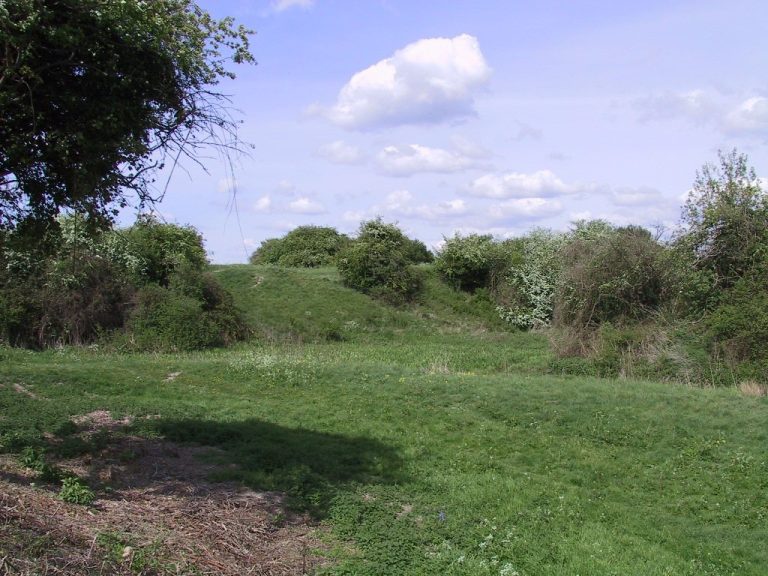
Cambridge Castle survives principally as an earthen motte about 10 metres high, standing on the highest point in Cambridge, together with fragments of the surrounding earthworks. The original fortress was built in earth and timber, while Edward I’s later rebuilding introduced a substantial stone four-sided enclosure. The present mound is reached by a flight of steps and stands above the area of the former bailey and the later prison grounds.
Medieval fortress
Stone enclosure and defensive works
Edward I’s expanded castle had a four-sided plan with a circular tower at each corner. A gatehouse and a barbican, an outer defensive work protecting an entrance, strengthened its approach. The castle also included a circular stone keep built on the motte. The medieval expansion remained unfinished, and later deterioration left the walls in a ruined state before their removal in 1785.
Hall and chamber
King John’s enlargement included a hall and a chamber. Both buildings were roofless by the fifteenth century, after which their masonry was dismantled and reused elsewhere. Henry VI ordered their demolition in 1441 for the reuse of their stone at King’s College, preserving their place in the history of the site through the changes made to the surrounding city.
Seventeenth- and nineteenth-century remains
Civil War earthworks
The Parliamentary occupation added two earthwork bastions and a brick barracks within the old bailey. These works formed part of the emergency strengthening ordered by Oliver Cromwell. The fortifications were later damaged beyond further military use, and the surviving walls and bastions were demolished in 1785.
Prison and former bailey
The octagonal county prison built between 1807 and 1811 occupied the former bailey. Its design was influenced by John Howard’s prison-reform principles. The prison was demolished in 1932, and its bricks were reused for Shire Hall, which now occupies the site of the former prison and bailey. The surviving mound and earthworks therefore stand within a landscape shaped by successive medieval, military, administrative, and civic uses.
Surviving mound and setting
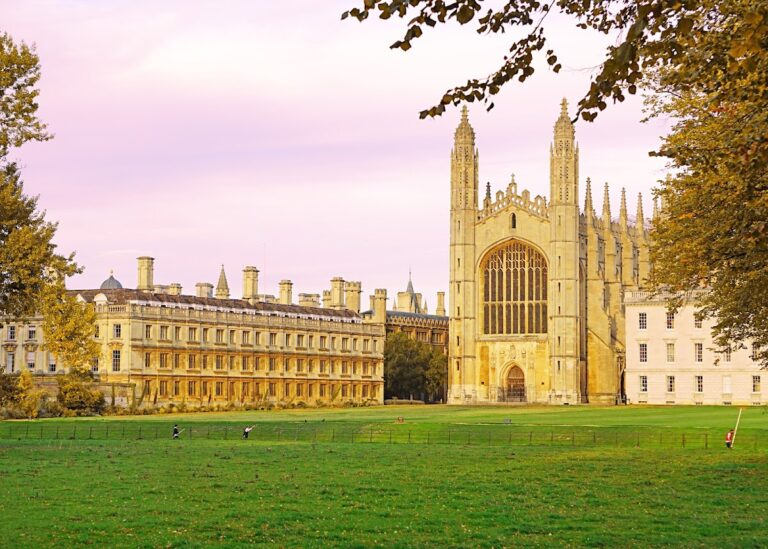
The mound and fragments of the earthworks provide the principal physical evidence of Cambridge Castle today. From the summit, the site overlooks the former bailey and the historic city skyline, including St Giles’ Church, part of All Saints’ Church, St John’s College Chapel, and King’s College Chapel.