Calatubo Castle: A Norman Fortress and Sicilian Estate Complex


Site at a Glance
- Rating
- 4
- Popularity
- Low
- Country
- Italy
- Primary era
- Medieval
- Eras represented
- Iron Age, Medieval, Modern
- Civilizations
- Italian, Norman
- Site type
- Military
- Remains
- Castle
On this page13 sections
History
Calatubo Castle is a medieval fortress near Alcamo in Italy, whose origins are associated with the Norman period around 1093. Built on a site occupied by the Elymians, an ancient people of western Sicily, it later became part of a medieval defensive system along the coast between Palermo and Trapani.
Ancient and Norman foundations
The hill had been occupied long before the castle was established. An Elymian settlement stood there, together with a necropolis dating to the seventh century BC. These remains place Calatubo within the early history of western Sicily and connect the later fortress with a much older settlement landscape.
In around 1093, Roger I of Sicily, the Norman count who helped establish Norman rule on the island, defined the boundaries of the Diocese of Mazara, an ecclesiastical district administered by a bishop. The settlement was included in the grant as “Calatubo with all its dependencies,” linking the site to the Norman political and religious organization of Sicily.
A village developed around the castle. Its economy included the export of cereals and the extraction of stone from quarries near the Finocchio stream. The stone was used for water-powered and wind-powered mills. Calatubo was also mentioned in 1154 by Muhammad al-Idrisi, a twelfth-century Arab geographer whose geographical work was produced for Roger II of Sicily, in The Book of Roger.
Medieval defense and feudal administration
From the Middle Ages, Calatubo had a strategic role within a chain of coastal towers and forts extending between Palermo and Trapani. The outposts used light signals to warn of attacks by the Saracens, a medieval term for Muslim peoples regarded as possible attackers of Christian territories. Calatubo relayed information between the strongpoints at Carini, Partinico, and Castellammare del Golfo.
In 1338, the castle was assigned to Raimondo Peralta, Count of Caltabellotta. Its history therefore belonged not only to coastal defense but also to the feudal administration of Sicily, in which a fief was a landed territorial holding governed through a feudal relationship.
After Frederick II conquered the area, the village of Calatubo was abandoned and the castle lost its original military function. Frederick II was the Hohenstaufen ruler and king of Sicily whose conquest was followed by this change in the settlement’s history. The complex was converted into a baglio, a fortified or enclosed Sicilian rural estate combining agricultural buildings, storage, and administrative facilities. Warehouses, stables, and other service buildings were added to manage the Calatubo fief.
Later decline and protection efforts
At the end of the nineteenth century, warehouses were installed in the second courtyard for the production of Calatubo wine. The castle remained in good condition until the 1968 Belice earthquake. Its deterioration then increased through use as a sheepfold and through illegal excavations aimed at finds from the associated seventh-century-BC necropolis.
A fire in July 2013 blackened the internal and external walls and probably caused further structural damage. The Municipality of Alcamo purchased the castle from the Papè family of Valdina in 2007. Between 2003 and 2014, the site was repeatedly included in the Italian Environmental Fund’s Places of the Heart initiative, and it ranked third in the 2014–2015 campaign, making it eligible for funding from the organization, commonly known as FAI.
In March 2017, the Municipality of Alcamo and the association Save Calatubo Castle reached an agreement to safeguard the castle, its rocky site, its caves, the surrounding archaeological area, and the nearby Cuba delle Rose. The complex remains abandoned and endangered, while the municipality has expressed a desire to recover and restore it.
Remains
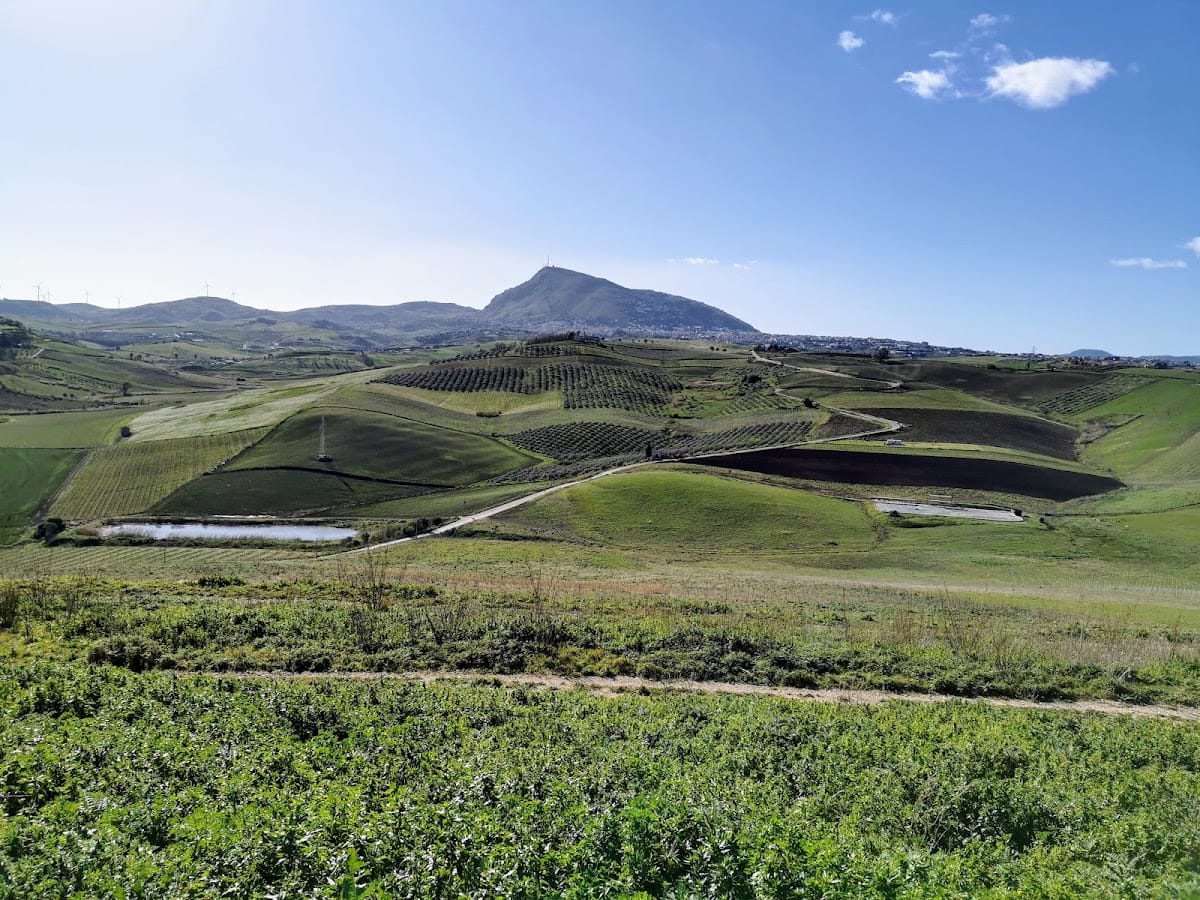
Calatubo Castle is an elongated architectural complex arranged mainly from east to west. It occupies a limestone rock about 152 metres above sea level and measures approximately 150 by 35 metres. Steep rock faces protect three sides, while the practicable approach lies to the west, where a stepped ramp rises toward the first defensive line. The position gives the site views toward Mount Bonifato and the Gulf of Castellammare.
Defensive circuits and principal core
First defensive line
The western approach reaches the first defensive line, which contains a well, a single-nave church, and other rooms. From this area, a courtyard leads through a portal toward the second circuit of walls. The arrangement connects the approach, the first enclosed area, and the deeper defenses in a sequence shaped by the rocky ground.
Third circuit and main castle
The third circuit of walls includes an oblong tower. The principal core occupies the southern part of the rocky site and has a rectangular plan measuring approximately 7 by 21.5 metres. Together, the wall circuits, tower, and central core form the principal castle structure, which was modified several times as the complex acquired new functions.
Chapel
The chapel has an entrance door bearing the coat of arms of the De Ballis family. Its entrance was burned, and a castle tower collapsed through neglect. These damaged elements belong to the surviving fabric of a complex now in a state of abandonment and disrepair.
Agricultural and archaeological remains
Estate buildings and wine warehouses
The later agricultural phase is represented by warehouses, stables, and other service structures added when the fortress became an estate centre. The second courtyard contains the warehouses installed at the end of the nineteenth century for Calatubo wine production. These buildings preserve the physical organization associated with the complex’s transformation from a military site into a rural administrative estate.
Elymian settlement and necropolis
The rocky site also contains the remains of the Elymian settlement and its associated necropolis, which dates to the seventh century BC. The necropolis contributed to the archaeological importance of the hill and attracted illegal excavations during the castle’s decline.
Caves and rocky setting
Caves associated with the castle form part of the wider rocky site. They are included with the castle, its surrounding archaeological area, and the nearby Cuba delle Rose within the safeguarding agreement concluded in 2017.