Church of Saint Francis of Assisi: A Franciscan Church in Alcamo, Italy


Site at a Glance
- Rating
- 4.7
- Popularity
- Very Low
- Country
- Italy
- Primary era
- Early Modern
- External website
- Open
- Eras represented
- Medieval, Early Modern
- Civilizations
- Kingdom of Sicily, Spanish
- Site type
- Religious
- Remains
- Church
On this page12 sections
History
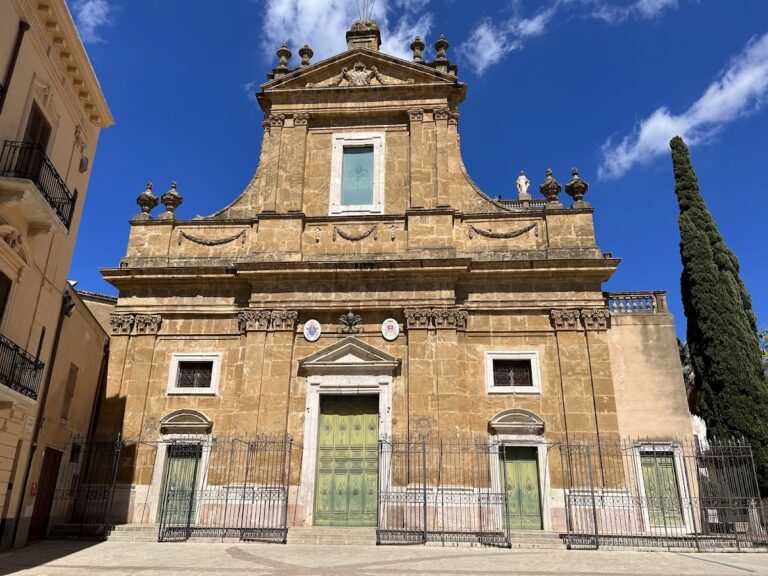
The Church of Saint Francis of Assisi is a Catholic Franciscan church in Alcamo, Italy, dedicated to Saint Francis of Assisi and rebuilt in the seventeenth-century architectural style between 1608 and 1648. It belongs to Italy’s Fund for Religious Buildings and has remained closely connected with the Franciscan presence in the town.
Foundation and rebuilding
Historiographic tradition attributes the church’s foundation to Blessed Angelo Tancredi of Rieti, an early companion of Saint Francis, between 1224 and 1226. A document sealed by Pope Clement VI records the church’s acquisition by the Sicilian Franciscan province in 1348. This date also marks the beginning of the Friars Minor’s long-established presence in Alcamo.
The church was rebuilt between 1379 and 1380. A more extensive reconstruction followed between 1608 and 1648, when the earlier building was demolished and rebuilt together with the adjoining convent. The church was enlarged and embellished in 1716. From the sixteenth century, it gave its name to one of Alcamo’s oldest quarters, alongside San Giacomo de Spada, San Calogero, and Maggiore Chiesa.
Franciscan institutions and parish history
The Friars Minor, later known as the Conventual Franciscans, remained in Alcamo from 1348 until 1866. The Conventual Franciscans are the branch of the Franciscan order associated with established convent communities and a less strictly austere interpretation of the Rule of Saint Francis. In 1866 the municipality confiscated the convent. The complex became the Boarding School for Young Artisans in 1871, a Carabinieri station, and the Nino Navarra junior school in 1946–47. It later housed a vocational agricultural school and now accommodates a unit of the Luigi Pirandello primary school.
The Franciscan Fathers returned in 1962 and were entrusted with the church and some rooms of the former convent. The church became a parish in 1969. The 1968 Belice earthquake damaged both the church and convent, and restoration work carried out from 1975 to 1976 repaired the damage.
Confraternities and devotional life
The Compagnia dell’Immacolata was founded in the church in 1596 by respectable citizens, teachers, and priests. In 1613, its members added 34 paintings of saints to the chapel of the Immaculate Conception. Each painting bore the name of a confraternity member, and the series remained in the chapel until 1884. The Congregation of the Most Precious Blood of Christ was founded there in 1916, followed by the Congregation of Our Lady of Health in 1944.
Remains
The church is organized as a single nave covered by a barrel vault, with eight altars and a side chapel dedicated to the Immaculate Conception. It adjoins a Franciscan cloister and the Oratory of the Immaculate Conception Brotherhood. The adjoining bell tower and the main portal are the elements that remain unchanged from the original project.
Nave and altars
Main altar and left side
The main altar contains Andrea Carrera’s 1677 painting of Saint Francis of Assisi requesting the Indulgence of Porziuncola. The Porziuncola is the small church associated with Saint Francis and the beginnings of the Franciscan movement; the indulgence refers to the devotion traditionally connected with that place.
The first altar on the left has a marble ancona, or framed painted or sculpted altarpiece, showing the Madonna and Child. It was probably made by Giacomo Gagini in 1568. The second altar contains a wooden statue of Purity by an unidentified artist, while the third has a wooden statue of Saint Francis of Assisi made by Giuseppe Ospedale in 1933.
The fourth left altar contains a white-marble statue of Saint Mark by Antonello Gagini, dated 1520. The fifth has a seventeenth-century wooden Crucifix of the Most Precious Blood by an unidentified artist, accompanied by an oval painting of Our Lady of Sorrows attributed to the Alcamo painter Giuseppe Renda. The Gagini family was a prominent group of Renaissance sculptors active in Sicily.
Apse and right side
On the right side of the apse is a seventeenth-century painting of the Virgin of Mercy conversing with a cardinal, surrounded by a group of men of color. On the right side of the church, the first altar after the Immaculate Conception chapel contains a statue of Saint Maximilian Kolbe. The second has a wooden statue of Saint Anthony of Padua by an unidentified artist.
The third right altar contains Francesco Alesi’s 1942 canvas dedicated to Our Lady of Health. The fourth has a marble statue of Mary Magdalene carved by Antonello Gagini in 1520. The statue bears the coat of arms of the Scalisi family, which commissioned it. It originally stood in a chapel to the right of the entrance and was moved when the Immaculate Conception chapel was later built there.
Four paintings are placed high on the nave walls. Two represent Saint Francis, while the other two depict Saint Clare and Saint Bonaventure.
Immaculate Conception chapel
The Immaculate Conception chapel contains Giuseppe Carrera’s painting of the Immaculate, made in 1610 and restored in 1980. A wooden statue of the Immaculate Conception, carved in 1695 by the Trapani sculptor Ignazio Ingrassia, also stands in the chapel.
Four paintings by Rosalino la Mattina depict key moments concerning the Conception of Mary. The chapel also has a marble altar made in 1951 by Giovan Battista Di Girolamo of Castellammare del Golfo.
Convent and brotherhood oratory
Franciscan convent
The Franciscan convent contains two oval paintings, an Ecce Homo and an image of Our Lady of Sorrows, probably dating from the eighteenth century.
Immaculate Conception Brotherhood’s oratory
The Oratory of the Immaculate Conception Brotherhood contains Nicolò Pizzitola’s 1888 painting of Saint Benedict Joseph Labre.
Nearby sites