Caerau Hillfort: An Iron Age Stronghold in Cardiff


Site at a Glance
- Rating
- 4.4
- Popularity
- Low
- Country
- United Kingdom
- Primary era
- Iron Age
- External website
- Open
- Eras represented
- Iron Age, Medieval
- Civilizations
- Unclassified
- Site type
- Military
- Remains
- Fort
On this page8 sections
History
Neolithic and Iron Age occupation
Caerau Hillfort is a large Iron Age stronghold in Cardiff, United Kingdom, built by people associated with the Silures, an Iron Age tribal population based in what is now southeastern Wales. The hillfort occupies the western tip of a ridge-top plateau and began as a fortified settlement around 600 BC. Its location had already been used during the Neolithic period, with occupation extending back to the early Neolithic.
Excavations in 2013 and 2014 produced evidence for this early activity, including flint tools and weapons dating to 3600 BC. The later hillfort belonged to a community living in the territory of the Silures, whose region eventually came into conflict with Roman expansion. Iron Age pottery found at the site reflects this phase of occupation, while Romano-British pottery and a fragment of a first-century AD Roman mortarium, a ceramic vessel used for grinding or mixing ingredients, show activity after the Roman arrival.
Medieval occupation
During the medieval period, the hillfort interior became the setting for St Mary’s Church and a small ringwork on the north-eastern side. St Mary’s probably dates from the thirteenth century. The ringwork may have been an unrecorded castle belonging to the Bishops of Llandaff, the successive heads of the Diocese of Llandaff, and was probably contemporary with the church.
Restoration and decline
St Mary’s Church was restored around 1885 by John Prichard, the Llandaff diocesan architect, who rebuilt its chancel. The church closed in 1957 and then fell into ruin until Father Victor Jones restored it in 1961. After his departure from the diocese, the building again deteriorated.
Enclosing 5.1 hectares, Caerau is the largest Iron Age site of its type in south Wales, one of the largest in Great Britain, and the third-largest Iron Age hillfort in Glamorgan. Its combination of prehistoric occupation, Iron Age fortification, Roman-period activity, and medieval remains places several major stages of Welsh history within one enclosure.
Remains
Hillfort defences and interior
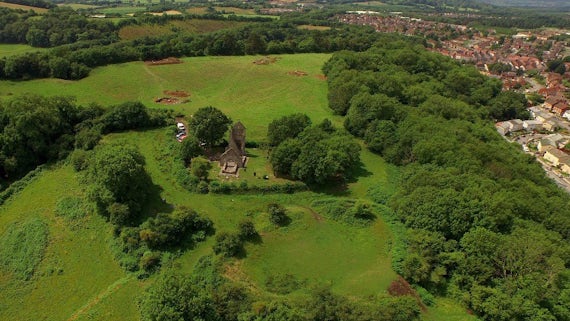
Caerau Hillfort has a large triangular plan and occupies the western end of an extensive ridge-top plateau. Its interior is now pasture, with earlier cultivation preserved in the form of rig-and-furrow traces, long raised ridges separated by parallel furrows. Steep northern and southern slopes are defended by three substantial earthen ramparts and accompanying ditches. A rampart is a raised defensive bank, while a ditch is an excavated defensive trench.
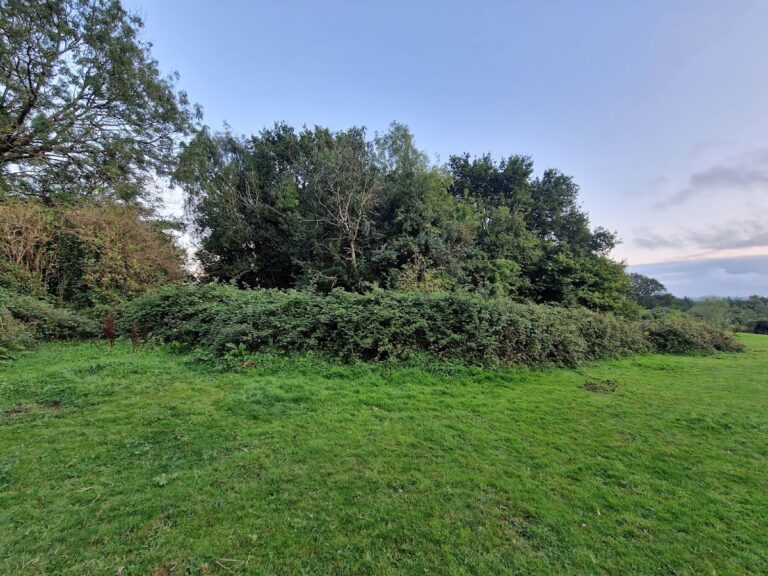
The eastern defences appear to have been reduced to two ramparts in the north and one in the south. Trees and scrub conceal much of this earthwork. Two entrances appear to have served the enclosure, one at the middle of the eastern side and another west of the southern corner. At the eastern entrance, the ramparts curve around the approach. A possible third entrance at the north-western apex has been heavily eroded by water flowing from a spring.
Two earthworks cross the interior. They may have been field boundaries, the remains of a smaller and earlier hillfort, or part of a Neolithic causewayed enclosure, a prehistoric enclosed area defined by interrupted ditches. Their precise interpretation remains uncertain.
Church and medieval ringwork
St Mary’s Church stands within an oval churchyard on the hillfort’s north-eastern side. The ruinous building is formed mainly from stone rubble walls and includes a nave, a south porch, a north vestry, a chancel, and a tower. The vestry was added around 1920. The medieval ringwork lies north-east of the church. It is an oval enclosure measuring 35 by 20 metres, defined by a rampart and ditch, with an entrance facing south-west towards St Mary’s.
Archaeological finds
Flint tools and weapons dating to 3600 BC provide material evidence for the site’s early Neolithic occupation. Iron Age and Romano-British pottery has also been found, including north-west of the southern entrance. The Roman mortarium fragment comes from a first-century AD pouring vessel and connects the enclosure with activity during the Roman period.