Ca’ Rezzonico: A Venetian Palace and Museum of Eighteenth-Century Venice


Site at a Glance
- Rating
- 4.5
- Popularity
- Medium
- Country
- Italy
- Primary era
- Early Modern
- External website
- Open
- Eras represented
- Early Modern
- Civilizations
- Venetian
- Site type
- Domestic
- Remains
- Palace
On this page32 sections
History
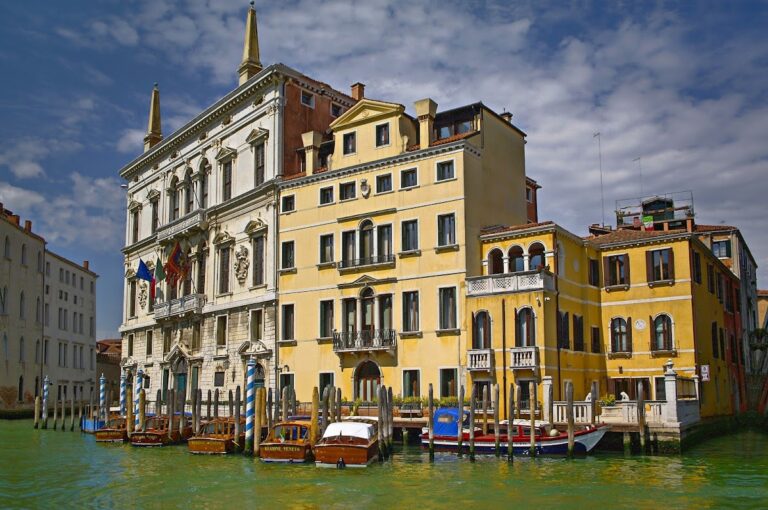
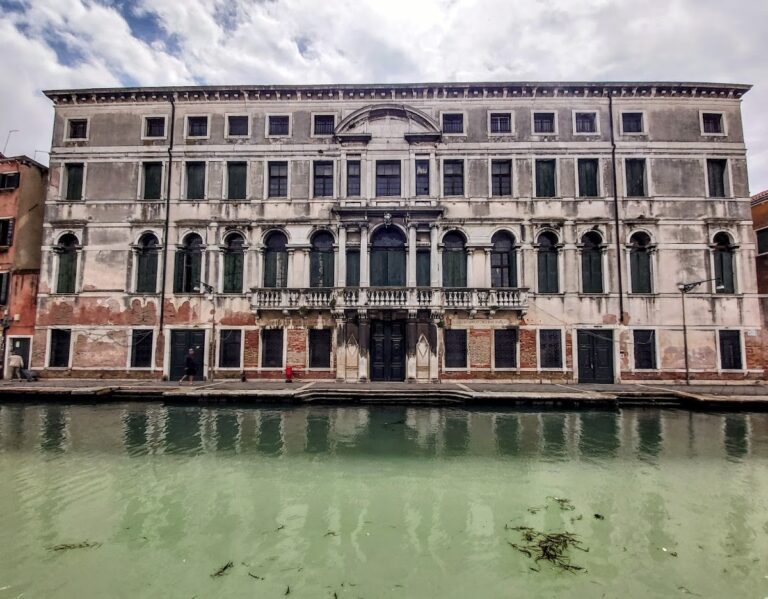
Ca’ Rezzonico is a Venetian palazzo in Venice, Italy, begun in 1649 in the Baroque period and completed in the Rococo style. It stands on the Grand Canal in Dorsoduro, beside the Rio San Barnaba, and now houses the Museum of Eighteenth-Century Venice. The building is one of the venues managed by the Fondazione Musei Civici di Venezia.
The Bon commission
The site was occupied by two houses belonging to the Bon, a Venetian patrician family. In 1649 Filippo Bon, a city procurator and patron of the arts, commissioned Baldassarre Longhena to combine them into one grand residence. By 1661, Longhena had joined the earlier buildings and carried the Grand Canal facade up to the first ceremonial floor, known as the piano nobile, the principal and most richly decorated level of a traditional Venetian palace.
The work stopped after Longhena’s death in 1682. Construction costs had ruined Filippo Bon’s finances, and the unfinished palace deteriorated after his death in 1712. Ownership passed among his sons and grandsons, while the building remained incomplete.
Rezzonico completion
In 1750 the Bon family sold the palazzo to Giambattista Rezzonico, a banker and fabric merchant from Lombardy, for 60,000 gold ducats. The Rezzonico family had purchased a Venetian noble title in 1648, during the War of Candia, the conflict in which Venice fought the Ottoman Empire for control of Crete and required additional funds.
Municipal inspectors considered much of the building ruinous and at risk of collapse. Only the rear section, which had reached the second floor and still retained its roof, could be preserved. Giambattista Rezzonico therefore commissioned Giorgio Massari to complete and reconstruct the palace. Massari followed Longhena’s general design while adapting it to the lighter taste of the Rococo. He replaced some heavy double columns with slender pillars, removed a substantial columned base, and added small oval windows above the larger second-floor openings. The facade was completed between 1750 and 1752, and the interior was nearly finished by 1756. A scaffolding collapse in 1752 caused five stonemasons to fall to the ground, but construction continued.
Massari also altered the arrangement of the interior. The principal ceremonial room was placed at the rear rather than beside the canal, and its ceiling was made double height. From the Grand Canal entrance, the ceremonial route passed through the courtyard and a triumphal passage before reaching the monumental stairway and grand salon.
The Rezzonico family at its height
The palace reached the height of the family’s influence in 1758. Carlo Rezzonico became Pope Clement XIII, while Ludovico Rezzonico married Faustina Savorgnan, bringing together two of Venice’s wealthiest families. Giovanni Battista Tiepolo, Gaspare Diziani, and Jacopo Guarana were commissioned to decorate the interiors, including two ceilings by Tiepolo.
Further celebrations followed in 1759, when Aurelio Rezzonico became Procurator of San Marco, and in 1762, when Ludovico Rezzonico received the same office. On both occasions the palace was lit with torches and candles for three nights. Carlo Rezzonico later transferred much of the family’s art collection from Venice to Rome after becoming pope. The palace also retained religious and ceremonial associations. Ludovico and Faustina’s wedding took place there in 1758, and the Throne Room served as their bridal chamber. In 1778 Pope Pius VI made a brief visit while travelling from Rome to Vienna. A papal legate also informed Cardinal Rezzonico of Carlo’s election as pope in the Salon of Pastels.
Changing owners and occupants
The Venetian Rezzonico line ended in 1810 with the death of Cardinal Abbondio of Pisa, its last member. The palace narrowly escaped conversion into a Jesuit college and then passed through several owners and tenants. Carlo Pindemonte acquired it in 1832 and sold its furnishings and art collection, leaving the frescoes in place. He sold the empty building in 1837 to Count Ladislao Zelinsky. The palace was subsequently rented to Baron von Bülow and Count Zichj Cerner, and from 1840 to 1857 it housed the Duke of Modena and his family, including Don Carlo, the Duke of Madrid and pretender to the Spanish throne.
From about 1850, the antiquarian and art dealer Jacobo Querci della Rovere used the second floor as a gallery for works by Rubens, Rembrandt, Caravaggio, Canaletto, and other old masters. In the 1880s the palace became the residence of the painter Robert Barrett Browning. His father, the poet Robert Browning, died in a mezzanine apartment in 1889. John Singer Sargent also maintained a studio there.
Robert Barrett Browning sold the building in 1906 to Count Lionello von Hierschel de Minerbi, an Italian parliamentary deputy and collector of modern art, rather than to the German Emperor Wilhelm II. Under Minerbi, Ca’ Rezzonico hosted costume balls, concerts, and celebrations illuminated by candles and torches. Cole Porter rented the palace in the 1920s and staged elaborate entertainments involving gondoliers and high-wire performers.
Municipal museum
The economic crisis of the 1930s ended Minerbi’s ability to maintain the palace. After four years of negotiations, Venice purchased it in June 1935 and began converting it into a museum devoted to eighteenth-century Venetian art. The museum was established on 25 April 1936. The city assembled works from municipal properties and collections, including ceiling frescoes, and acquired additional paintings and sculpture by artists such as Tiepolo, Francesco Guardi, and Antonio Canova.
In 1936 the museum also reconstructed an eighteenth-century Venetian pharmacy from original period materials. Giovanni Maria Morlaiter’s terracotta sculptures were acquired in 1935, while Costantino Cedini’s ceiling fresco was transferred from Palazzo Nani during the 1930s. A major restoration begun in the late 1970s was completed in 2001. The museum later acquired three Canaletto paintings in 1983. Ferrucio Mestrovich donated his collection in December 2001 and October 2009, and the museum also presents Egidio Martini’s collection of 264 paintings dating from the fifteenth through the nineteenth century.
Remains
Facade, entrance, and ceremonial route
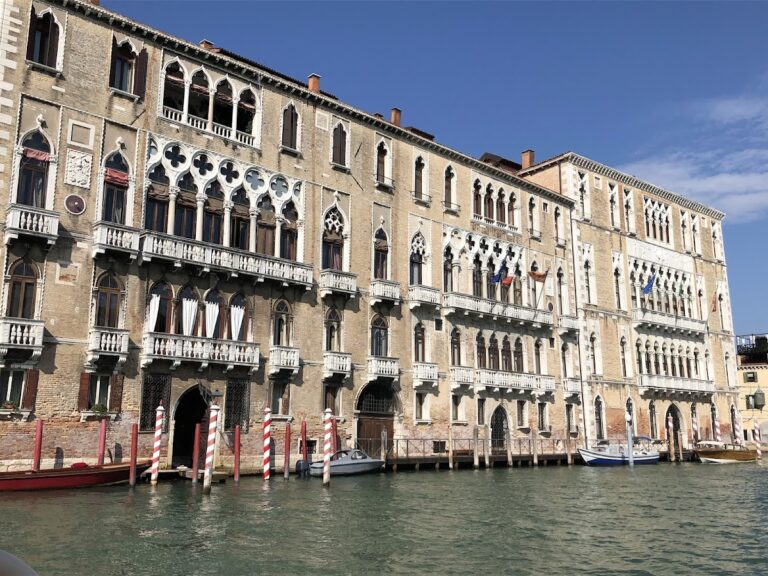
Ca’ Rezzonico occupies a narrow, deep plot on the right bank of the Grand Canal, with the Rio San Barnaba adjoining it. Its white marble Grand Canal facade is only three rooms wide. Longhena’s Venetian Baroque composition survives together with Massari’s Rococo changes, including the small oval windows set above the larger openings of the second floor.
Canal entrance and courtyard
The ground-floor entrance opens directly from the canal onto a long passage leading to the interior courtyard. A separate street entrance lies behind the fountain. The passage forms the first part of the ceremonial route through the palace, which continues across the courtyard and through a triumphal passage. The courtyard fountain is surmounted by the Rezzonico coat of arms carved in marble.
Staircase of honour
The staircase of honour rises from the ground floor to the piano nobile. Its marble balustrades carry statuary by Giusto Le Court, linking the entrance sequence with the ceremonial rooms above.
Principal ceremonial rooms
Grand salon
The grand salon, or ballroom, occupies the rear of the piano nobile and measures approximately 14 by 24 metres. Its double-height ceiling reflects Massari’s rearrangement of the palace’s ceremonial focus. Girolamo Mengozzi Colonna covered the walls and ceiling with trompe-l’oeil, a painting technique that creates the illusion of three-dimensional architecture. Giovanni Battista Crosato painted the central ceiling fresco, The Chariot of Apollo, in which Apollo appears between Europe, Asia, Africa, and the Americas.
The wall facing the entrance displays the Rezzonico arms, including a double-headed eagle. Two large chandeliers made of wood and gilded metal date from the middle of the eighteenth century and are among the few fixtures preserved from the palace’s original period. The room also contains eighteenth-century statues by Andrea Brustolon, including an ebony figure of an Ethiopian warrior.
Salon of the Allegory
The Salon of the Allegory commemorates the 1758 marriage of Ludovico Rezzonico and Faustina Savorgnan. Its ceiling fresco by Giambattista and Giandomenico Tiepolo shows the bride and groom in Apollo’s chariot. Allegorical figures, the three Graces, putti, doves, Fame, Merit, the lion of Venice, and the arms of the two families fill the composition. Tiepolo completed the fresco in twelve days, while Mengozzi Colonna painted the surrounding architecture and a false balustrade.
The room contains Anton Raphael Mengs’s portrait of Pope Clement XIII Rezzonico, a retable, or decorated panel behind an altar, by Francesco Zugno, and a carved walnut prie-dieu, a piece of furniture designed for kneeling and prayer, in the Italian Rococo style.
Chapel
A passage from the Salon of the Allegory leads to a small chapel suspended over the Rio San Barnaba. Built in the second half of the eighteenth century, probably for Aurelio Rezzonico or Cardinal Rezzonico, it retains sculpted and gilded Rococo stucco on white walls. Its retable, The Virgin and Saints, is by Francesco Zugno, and the room also contains a Rococo prie-dieu.
Salon of Pastels
The Salon of Pastels was originally an audience room. Its ceiling frescoes show The Triumph of the Arts over Ignorance within an illusionistic architectural frame, with allegories in the corners. The paintings are generally attributed to Giambattista Crosato or Gaspare Diziani. Pastel portraits by Rosalba Carriera and other Venetian artists include images of Faustina Bordoni and Cecilia Guardi Tiepolo, the latter painted by Lorenzo Tiepolo in 1757.
Tapestry Hall
The Tapestry Hall contains three large Flemish tapestries dating from the late seventeenth century, together with sculpted and gilded furniture. Jacopo Guarana painted the ceiling fresco, The Triumph of Virtue. A yellow door bears a lacquered image of a Chinese figure with a parasol among floral motifs, dated 1760.
Throne Room
The Throne Room faces both the Grand Canal and the Rio San Barnaba. Its elaborate throne of carved and gilded wood was used during Pope Pius VI’s visit in 1778. Tiepolo and his sons painted the ceiling fresco, The Allegory of Merit, in twelve days. Sculpted and gilded tables, mirrors, candlesticks decorated with putti and personifications of virtues, and Chinese porcelain vases complete the room’s furnishings.
Collections in the palace rooms
Tiepolo Hall
The Tiepolo Hall contains Nobility and Virtue Defeating Ignorance, a ceiling fresco painted by Giambattista Tiepolo in 1744 and 1745 for Pietro Barbarigo’s house in Santa Maria del Giglio. Venice purchased it in 1934 and installed it at Ca’ Rezzonico. The room also displays works by Pietro Longhi and Francesco Guardi, two early oval paintings by Tiepolo dating from 1715 and 1716, Venetian Baroque furniture, a gaming table, and an ornate German cabinet.
Library and Lazzarini Hall
The Library, also called the Morlaiter Hall, has four large bookcases filled with small baked-earth sculptures by Giovanni Maria Morlaiter. Mattia Bortoloni painted its ceiling fresco, The Allegory of Merit.
The Lazzarini Hall is named for the Venetian painter Gregorio Lazzarini. Three large mythological paintings were attributed to him in the nineteenth century, although more recent attribution assigns Orpheus Massacred by the Bacchanals to Lazzari and the other two to Antonio Bellucci and Antonio Molinari. Five oval mythological ceiling paintings are by Francesco Maffei. A marquetry desk inlaid with ivory and decorated with gilded bronze bears the signature and date of cabinetmaker Pietro Pifetti, 1741.
Brustolon Hall
The Brustolon Hall displays carved furniture and figures by Andrea Brustolon, dated 1706 and made from differently coloured woods including ebony. Their elaborate Baroque curves and twisting forms convey movement and emotion. A mid-eighteenth-century Murano glass chandelier with multicoloured floral forms comes from the workshop of Giuseppe Briani.
Portego
The portego, the large central or passage room of a Venetian palace, follows the traditional plan of making the building’s largest room a place for circulation, gatherings, and performances. Its walls are faced with Red Verona marble, and it contains eighteenth-century marble busts and allegorical figures. Works include Filippo Parodi’s Lucretia, Giusto Le Court’s Allegory of Envy, two marble Atlas figures supporting a chimney lintel by Alessandro Vittoria, a bust of Pope Innocent XI, and busts of Democritus and Heraclitus by Giuseppe Torretti.
Upper galleries and transferred frescoes
Upper gallery
The upper gallery floor presents Venetian paintings and decorative arts from the eighteenth century. Canaletto’s Architectural Caprice and two views of the Grand Canal, painted in 1719 and 1720, appear with Gaspare Diziani’s The Festival of Saint Martha and Venetian scenes by Francesco Guardi.
The Parlor Room takes its name from Guardi’s The Parlor of the Nuns at San Zaccaria, painted between 1740 and 1745. It also contains Guardi’s The Foyer of Dandolo’s Palace in San Moise and Pietro Longhi’s portrait of Francesco Guardi. Costantino Cedini’s ceiling fresco, Conjugal Concord Crowned by Virtue in the Presence of Justice, Prudence, Temperance, Fame, and Abundance, was transferred from Palazzo Nani in the 1930s. Its surrounding frame is by the architectural illusionist Antonio Felice Ferrari.
Villa Zianigo frescoes
A second-floor section contains frescoes removed from Villa Zianigo near Mirano. The group includes Giandomenico Tiepolo’s Renaud Abandoning the Garden of Armida, The New World, Promenade, Minuet, and scenes of Pulcinella, the masked comic character of Italian improvised theatre. Nicolò Bambini is represented by Achilles and the Daughters of Lycomedes and The Rape of the Sabines, while Francesco Fontebasso painted Apotheosis of Venice.
Pulcinella Room
The Pulcinella Room contains three frescoes by Giandomenico Tiepolo from Villa Zianigo: Pulcinella in Love, Pulcinella and the Saltimbanques, and The Departure of Pulcinella. Made between 1793 and 1797, the works continue the character’s use in satire and physical comedy. The ceiling shows Pulcinella walking across a tightrope when viewed from below.
Cabinets of the Centaurs and Satyrs
The Cabinet of the Centaurs and Cabinet of Satyrs contain Giandomenico Tiepolo’s monochrome scenes of mythological creatures and subjects. The Cabinet of the Centaurs has a red monochrome ceiling image called Rhapsody, medallions, mythological scenes, and a large rectangular painting of Scenes from Roman History. Images of male and female satyrs appear above the doors.
Chapel section
A further chapel section preserves paintings by Giandomenico Tiepolo made for Villa Zianigo’s chapel, which was consecrated in 1758. The works were signed and dated 1759 and depict Saint Jerome Emiliani, including his imprisonment by soldiers of the Holy Roman Empire in 1511 and his legendary liberation through the intervention of the Virgin Mary.
Antonio Guardi Room
The Antonio Guardi Room contains three frescoes commissioned by Maria Barbarigo Savorgnan from Antonio Guardi: Minerva, Venus and Love Before Vulcan’s Forge, and Apollo. They were plastered over in the nineteenth century, rediscovered during restoration of Palazzo Barbarigo Dabalà in 1936, detached, mounted, and transferred to Ca’ Rezzonico. Plasterwork frames and Antonio Corradini’s Veiled Lady, an allegory of Purity dated 1772, are also displayed there.
Longhi Hall
The Longhi Hall places Giambattista Tiepolo’s Rococo ceiling painting Zephyr and Flora beside Pietro Longhi’s scenes of Venetian daily life. Tiepolo’s work was originally made for Ca’ Pesaro in the 1730s. Longhi’s paintings show visits to a painting studio, hairdressing, family life, concerts, and entertainments.
Green Lacquer Room
The Green Lacquer Room contains green-and-gold furniture with chinoiserie motifs, a European decorative style inspired by adapted Chinese designs. Known as the Salotto Calbo-Crotta, the furniture was transferred from Palazzo Calbo Crotta in Cannaregio. Antonio Guardi’s ceiling fresco, The Triumph of Diana, came from Palazzo Barbarigo-Dabalà at Angelo Raffaele. The walls display view paintings, known as vedute, and landscapes by Marco Ricci, Luca Carlevarijs, Johann Anton Eismann, Jacob de Heusch, and Giuseppe Zais.
Collections on the upper floors
The top floor contains a reconstructed eighteenth-century Venetian pharmacy made from original period materials. It also houses the Martini Collection, comprising 264 paintings from the fifteenth through the nineteenth century. Artists represented include Bernardo Strozzi, Francesco Maffei, Pietro Vecchia, Giambattista and Giandomenico Tiepolo, Giambattista Piazzetta, and Gaspare Diziani.
The mezzanine, reached by the ground-floor stairway, contains the Mestrovich Collection of about 30 paintings dating from the fifteenth to the twentieth century, including works by Jacopo Tintoretto and Bonifazio Veronese. The upper-floor displays also include Giovanni Battista Piazzetta’s The Death of Darius, three portraits by Pietro Bellotti, and a pastel by Maria Molin.
Nearby sites