Santa Maria dei Carmini: A Gothic and Renaissance Parish Church in Venice


Site at a Glance
- Rating
- 4.7
- Popularity
- Low
- Country
- Italy
- Primary era
- Medieval
- External website
- Open
- Eras represented
- Medieval, Early Modern
- Civilizations
- Venetian
- Site type
- Religious
- Remains
- Church
On this page18 sections
History
Santa Maria dei Carmini is a Roman Catholic parish church in Venice, Italy, in the Dorsoduro district. Its present Gothic building was begun in 1286 and consecrated on 6 April 1348, while later rebuilding introduced important early Renaissance elements. The church belongs to the Patriarchate of Venice and remains closely connected with the history of the Carmelite order and the former Scuola Grande dei Carmini opposite it.
Foundation and Carmelite community
Tradition places an earlier church on the site in 1125, dedicated to Santa Maria Assunta. Carmelites were established in the Santa Margherita area by at least 1285. The Carmelites are a Catholic religious order whose spirituality developed from hermit communities associated with Mount Carmel. After the order’s reform, the community followed an eremitical tradition while providing spiritual care in Venice.
The Gothic church begun in 1286 was consecrated by Marco Morello, prior of the Carmelite convent, in the presence of seven bishops. The monastery beside it became an important setting for the Venetian Carmelites. Its community produced numerous bishops, and a reform of the Carmelite order was prepared there at the request of Pope Clement VII, the head of the Catholic Church at the time.
Lay associations and Renaissance rebuilding
A Carmelite tertiary charitable association developed beside the monastery from about 1300. Its female members, popularly called the Pinzocchere or Pizzochere dei Carmini, initially lived in their own homes and made scapulars for the Carmelites. A scapular is a strip or pair of cloth panels worn as part of religious dress, and it became an important sign of Carmelite affiliation and protection. In 1498, Luigi Vielmo gave the women a house called Santa Maria della Speranza.
The church was substantially remodelled during the Renaissance. Sebastiano Mariani of Lugano, also known as Sebastiano da Lugano, rebuilt the facade, presbytery, and side chapels between 1506 and 1514, adapting the earlier Gothic structure to contemporary Renaissance taste. The principal work on the facade took place between 1507 and 1514, while the rebuilding of the presbytery and chapels belongs to the wider campaign.
A charitable confraternity for men and women was formally established in 1597. In Venice, a scuola was a charitable or devotional confraternity with its own premises, finances, and artistic commissions. This confraternity became associated with the Scuola Grande dei Carmini, built opposite the church, and maintained an altar dedicated to the Madonna del Carmine, the Carmelite dedication of the Virgin Mary. The church and confraternity therefore formed an enduring religious and institutional pair in the Dorsoduro district.
Monastic decline and parish foundation
The monastery was rebuilt in the mid-seventeenth century, but its religious community was later affected by the suppression of Venetian monasteries under Napoleon’s decrees. The Carmelite community was dissolved in 1810. On 28 October 1810, the patriarch established the parish of Santa Maria del Carmelo in the former convent church, which was placed under secular clergy.
The new parish incorporated territory from the suppressed parishes of San Barnaba and Santa Margherita, together with parts of San Raffaele and San Pantaleone. Some of the former monastic buildings were later used as a laundry. The cloister subsequently became associated with a state art school, adding an educational use to the former monastery complex.
The campanile through successive repairs
The church’s campanile, or bell tower, was originally built in 1290. Earthquakes damaged it in 1347, 1410, and 1511. After the damage of 1511, the first tower was demolished and replaced by a taller structure in 1520. Subsidence caused the new tower to lean, so Giuseppe Sardi reinforced or straightened its base in 1688.
Lightning struck the campanile in 1756 and destroyed its original statue of the Madonna del Carmine. During the panic that followed, a monk fleeing while the bells were being rung struck his head against a wall and died. Romano Vio made the replacement statue in 1982. The church has also entered later cultural representations: it appears in paintings by John Singer Sargent and Walter Sickert and serves as a location in the computer game Assassin’s Creed II.
Remains
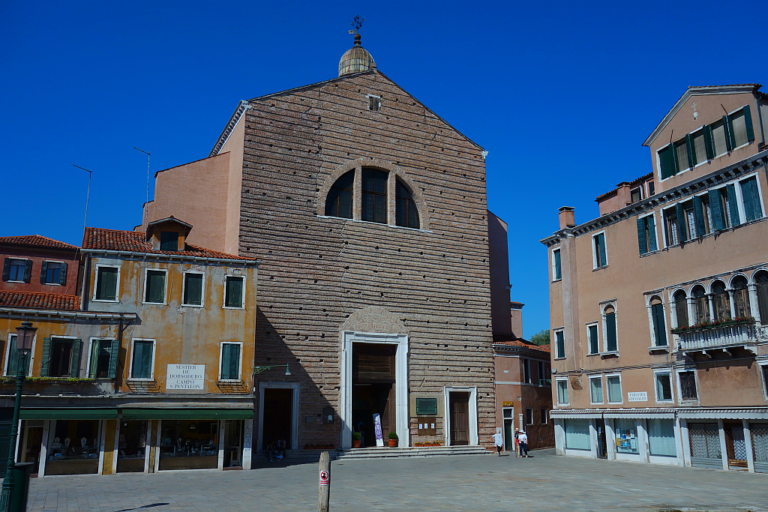
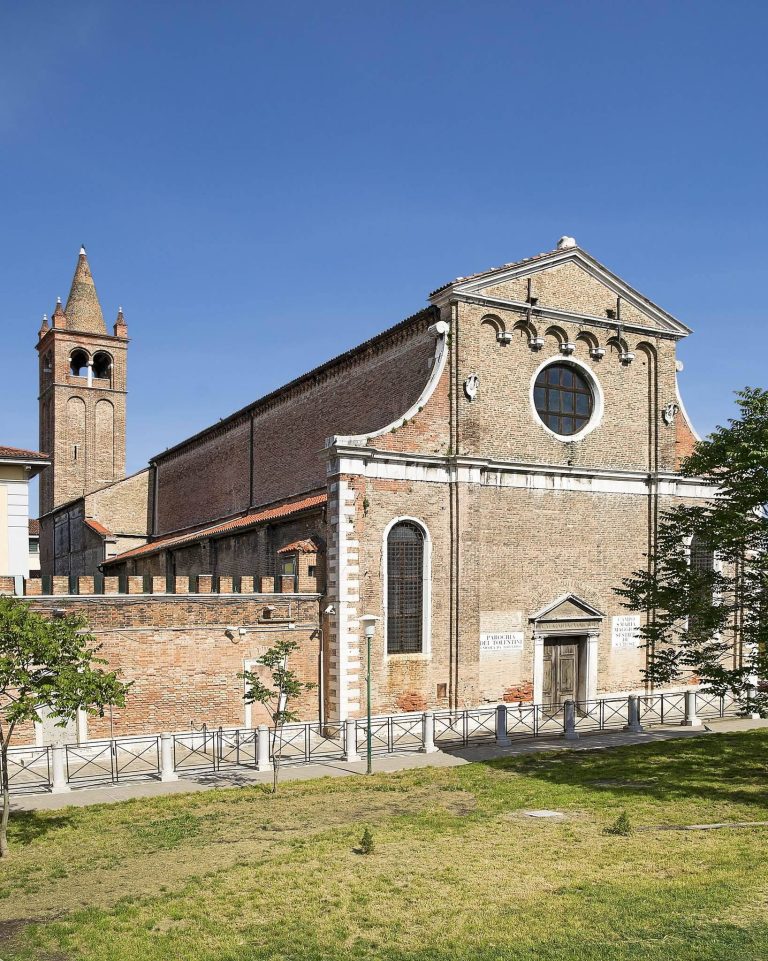
Santa Maria dei Carmini survives as a large, elongated brick basilica with three naves, a transept, and a deep presbytery flanked by chapels. Its fabric combines Venetian Gothic planning with early Renaissance rebuilding. The former monastery’s cloister stands to the right of the facade, and a well dated 1762 occupies its centre, bearing a Carmelite emblem.
Facade, side entrance, and bell tower
Renaissance facade
The three-part Renaissance facade is built of red brick with white marble decoration. Tuscan pilasters and cornices divide the elevation, which ends in curved gables. A marble portal is flanked by two round-arched windows, while an octagonal oculus with a window rose lights the upper part. The round gable contains a sixteen-rayed sun or star motif surrounding a rose.
Five sculptures crown the facade. They include the Savior, the Virgin Mary, the archangel Gabriel, and the prophets Elijah and Elisha, who were traditionally connected with the origins of the Carmelite order. Giovanni Buora is credited with the sculpted lunettes, and a seventeenth-century statue of the Madonna and Child occupies the niche above the main portal.
Campo Santa Margherita portal
The side portal opening toward Campo Santa Margherita dates from the fourteenth century. Its porch has palmettes, paterae, and panels in a Veneto-Byzantine style, together with a relief bust of the Madonna and Child. Beneath the canopy is a marble medallion with two peacocks. Several carved roundels derive from, or imitate, forms of the twelfth and thirteenth centuries.
Campanile and cloister
The campanile rises 66 metres and has an octagonal upper structure. The replacement statue of the Madonna del Carmine made by Romano Vio in 1982 stands above it, and the bells are operated electromechanically. Beside the church, the former monastery’s cloister is arranged around an enclosed courtyard. Its central well, dated 1762, carries the emblem of the Carmelites.
Gothic interior and Renaissance sanctuary
Nave and apse
The interior retains a Gothic spatial structure. A high central nave with a ribbed Gothic vault is separated from two lower aisles by two rows of twelve columns. The columns have plain, archaic-looking Byzantine-Romanesque forms. Their number may allude symbolically to the tribes of Israel and the apostles. Above the arcades, carved, painted, and partly gilded wooden decoration carries figures of saints and prophets, while angels appear above the arches. Semicircular divided thermal windows illuminate the upper interior.
The presbytery, the sanctuary area reserved for the clergy, and the side chapels were rebuilt by Sebastiano Mariani between 1506 and 1514. The apse, the rounded termination of the church, has three levels of windows. Two lower rows contain vertically oriented rectangular windows, while the upper row has arched openings. Large choir galleries occupy both sides of the apse.
Nave painting cycle and ceiling
The upper register of the nave contains 24 large oil paintings on canvas made between 1666 and the 1730s. They depict saints and episodes connected with the Carmelite order. The artists include Giovanni Antonio Pellegrini, Gaspare Diziani, Girolamo Brusaferro, Pietro Liberi, Sebastiano Mazzoni, Gregorio Lazzarini, and possibly Giovanni Battista Lambranzi.
Sebastiano Ricci painted the ceiling fresco Glorification of the Scapular in 1709. Angels hold up a scapular, and the painted inscription identifies it as a sacred object from Mount Carmel. Pietro Bianchini completed the stucco decoration to designs by Abbondio Stazio. Ricci’s ceiling decoration is distinguished by its use of a gold ground.
Altars and artworks
Right side of the church
The second altar on the right contains Cima da Conegliano’s Adoration of the Shepherds, painted in 1509–1511. The third altar holds a Madonna del Carmelo with Saints and Souls in Purgatory, attributed to Pace Pace and Giovanni Fontana and dated to the late sixteenth century. The accompanying statues of Virginity and Humility were made by Antonio Corradini and Giuseppe Torritti in 1722–1723.
A bronze angel on the balustrade was made by Girolamo Campagna. The carved wooden frontal showing the Miracles of the Madonna dates from 1724 and was made by Francesco Bernadoni, while the tabernacle is by Giovanni Scalfarotto. The fourth altar on the right was erected in 1548 by the fishmongers’ guild and contains Jacopo Tintoretto’s Presentation of Jesus at the Temple, painted in 1541–1542 when he was still a young artist.
Left side and sacristy
The sacristy contains an Annunciation by Jacopo Palma the Younger. In the left aisle are Padovanino’s Saint Liberale Causes the Emperor to Free Two Condemned Men, painted in 1638, Flaminio Grapinelli’s The Education of the Virgin Mary by Saint Anne from 1738, and Pietro Liberi’s Saint Alberto of Trapani.
The second altar on the left contains statues of the prophets Elijah and Elisha by Tommaso Rues. Elijah holds a flaming sword. The first altar contains Lorenzo Lotto’s Saint Nicholas of Bari in Glory between Saint John the Baptist and Saint Lucy, painted in 1529 for the Scuola dei Mercanti and set within its original Istrian-stone frame.
Near Lotto’s painting, above a confessional, hangs Paolo Veronese’s small Holy Family with the Infant Saint John the Baptist. This early work was formerly in the church of San Barnaba. The third chapel on the left contains Francesco di Giorgio Martini’s Lamentation of the Dead Christ, dated around 1476. Works by Marco Vicentino, Palma the Younger, and Gaspare Diziani are displayed opposite the chapel and around the presbytery.
Presbytery and choir
The presbytery contains four large paintings. They include Tintoretto’s Miraculous Catch of 1548 and his Presentation of Jesus at the Temple of 1541–1542, together with works by Palma the Younger, Gaspare Diziani, and Marco Vicentino. Their biblical subjects include the multiplication of bread and fish, Paradise, Saint Helena with the Cross, the Brazen Serpent, and the Miracle of the Manna.
Above the high altar is a painted fourteenth-century Crucifix by Paolo Veneziano. The wooden choir stalls on both sides of the presbytery include three paintings by Andrea Meldolla, dating from about 1545, as well as sculptures of saints.
Memorials and associated features
The counter-facade contains a funerary monument by Francesco Contin to Jacopo Foscarini, who died in 1602. Foscarini was a procurator of San Marco and admiral of the Venetian fleet, and his family palace stood across the canal from the church. The monument’s design was inspired by Jacopo Sansovino’s tomb monument to Francesco Venier in the church of San Salvador.
Near the entrance to the cloister is a relief of the Madonna and Child dated 1340 and attributed to Arduino Tagliapietra. The fourth altar on the left, beyond the entrance to the sacristy, retains the historical name of the fishmongers’ guild altar, Altare dei Compra Vendi Pesce. The funerary monument of Andrea Civran, a Venetian general who died in 1572, is also associated with the right side of the church.