Buttevant Franciscan Friary: A Medieval Franciscan House in Ireland

Site at a Glance
- Rating
- 4.8
- Popularity
- Very Low
- Country
- Ireland
- Primary era
- Medieval
- Eras represented
- Medieval
- Civilizations
- English, Norman
- Site type
- Religious
- Remains
- Monastery
On this page12 sections
History
Buttevant Franciscan Friary is a ruined medieval Franciscan house in Buttevant, Ireland, dedicated to St Thomas Becket, the murdered twelfth-century Archbishop of Canterbury who became a major Christian martyr and saint. Its foundation is traditionally placed around 1251, while other historical and architectural assessments associate it with David de Barry, also known as David Óg Barry, during his lifetime between 1272 and 1279, or more narrowly between 1276 and 1279. The friary became an important religious and local institutional centre in medieval Buttevant.
Foundation and Franciscan administration
By 1324 the friary housed both Irish and Anglo-Norman Franciscans. It maintained its own studium, a religious house’s centre for advanced study and training, indicating that the community had an educational role as well as a pastoral one. Tensions between the two groups led to the transfer of the Gaelic lector. After a papal investigation, the friary’s obedience was transferred from the Irish Province to the newly established Anglo-Norman custody of Cork. A custody was an administrative subdivision of a Franciscan province, so the change placed Buttevant under Anglo-Norman rather than Irish Franciscan administration.
The friary also had a role in the civic life of the medieval burgage. Its porch was used for legal agreements, including the granting and renewal of leases on Lady Day and Michaelmas. These feast days, traditionally observed on 25 March and 29 September, were commonly used for legal and agricultural transactions. Oaths of fealty, acts of homage, and marriage contracts were also conducted there.
Dissolution and changing ownership
The friary was formally dissolved during the Reformation around 1540. At that time the property included the church, conventual buildings, a garden and cemetery covering about 1.5 acres, and a watermill. One valuation placed the property at 36 shillings and 8 pence, while a separate assessment in 1541 valued the entire monastery at slightly more than 26 shillings.
A lease of the friary site was granted to James de Barry, 4th Viscount Buttevant, in 1570, although the grant has also been dated to 1568. After his involvement in the Desmond Rebellions, the confiscation of his estates transferred the friary and its glebe to Edmund Spenser as part of the Munster Plantation. This was an English Crown colonization scheme established after the rebellions, involving the confiscation and redistribution of land in Munster.
The friary may have been reoccupied after the accession of James I, but it had reverted to Lord Barry by 1615 or earlier. Two friars continued to live in the town and officiated at burials, although they could not reside in the conventual buildings. Lord John de Barry, who held the monastery from the Crown, was described as a Catholic who was unwillingly required to restrict the friars’ residence while otherwise favouring them.
Persecution and war
A complaint made in 1607 by William Lyon, the Protestant bishop of Cork, stated that friars at Buttevant wore their habits, travelled through the countryside, and conducted daily Masses and assemblies. By the beginning of the seventeenth century the friary was also associated with the Franciscan Observants, members of the order who followed a stricter interpretation of its rule.
During the persecution of the Franciscans, some friars from Buttevant escaped while others were imprisoned. A Franciscan report from between 1626 and 1629 stated that the friars had been expelled repeatedly, statues in the church had been broken, and the convent buildings had been destroyed. The church was left standing because it contained the tombs of noble families.
After the Irish Rebellion of 1641, the community welcomed the Confederate Catholic army of Lord Mountgarret. Confederate Ireland was the Catholic political and military movement formed during that rebellion. The friary’s guardian, Father Boetius Egan, accompanied the army and took part in the Confederate Parliament at Kilkenny in 1642. During the later Munster war, Murrough O’Brien, Earl of Inchiquin, assembled his Parliamentarian army in Buttevant and burned the friary church. A large quantity of bones from the nearby Battle of Knocknanuss in 1647 was said to have been placed in the crypt beneath the church choir.
Decline and later preservation
Eighteenth-century reports still referred to a friary or former friary precinct at Buttevant. One or two elderly friars were said to have lived in a thatched house. By about 1750 much of the complex had fallen into ruin, although some ancillary buildings remained usable. The last members of the Franciscan community included Pat Daly, Pat O’Neill, David Roche, and Daniel McAuliffe. The Franciscan presence ended with the death of the last friar, dated to 1820 or, in another dating, 1822.
The nearby Church of St Mary was built between 1831 and 1837 and incorporated an isolated medieval tower associated with the friary. In 1851 Richard Brash, working with the parish priest, arranged for fallen masonry to be removed and rebuilt much of the northern wall. The ruined friary remains in the centre of Buttevant. A chalice dating from about 1600 is associated with the former Franciscan house.
Remains
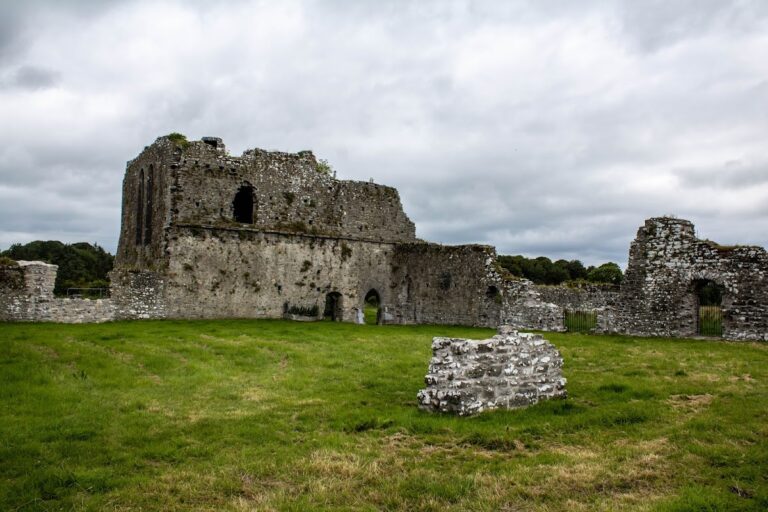
The surviving medieval complex is centred on a ruined church standing on the steep bank of the River Awbeg. The church comprises a nave and choir, while the cloister and domestic buildings once lay to the north. That arrangement was typical of Irish Franciscan friaries. The grounds included a cemetery and garden of about 1.5 acres, and a watermill formed part of the medieval property.
Church and surviving structures
Nave and choir
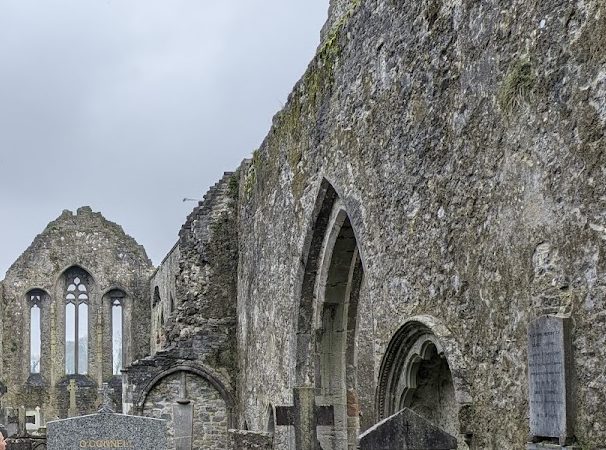
The church was constructed in three principal phases. The nave belongs to the mid-thirteenth century, and its early lancet windows support that date. A central tower was later inserted between the nave and choir, while a south transept or chapel was added towards the end of the thirteenth century. Extensive repairs and alterations followed during the fifteenth or early sixteenth century. In those later works, the lancets in the east and west gables were shortened, divided vertically, and finished with pointed ogee or keel arches. Several windows along the south side of the nave were blocked.
Central tower
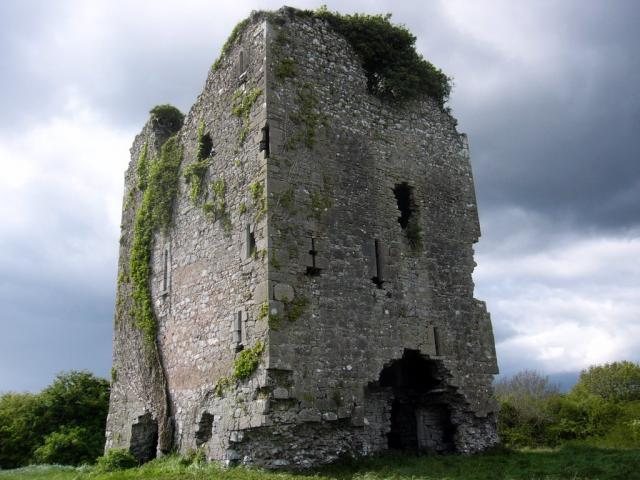
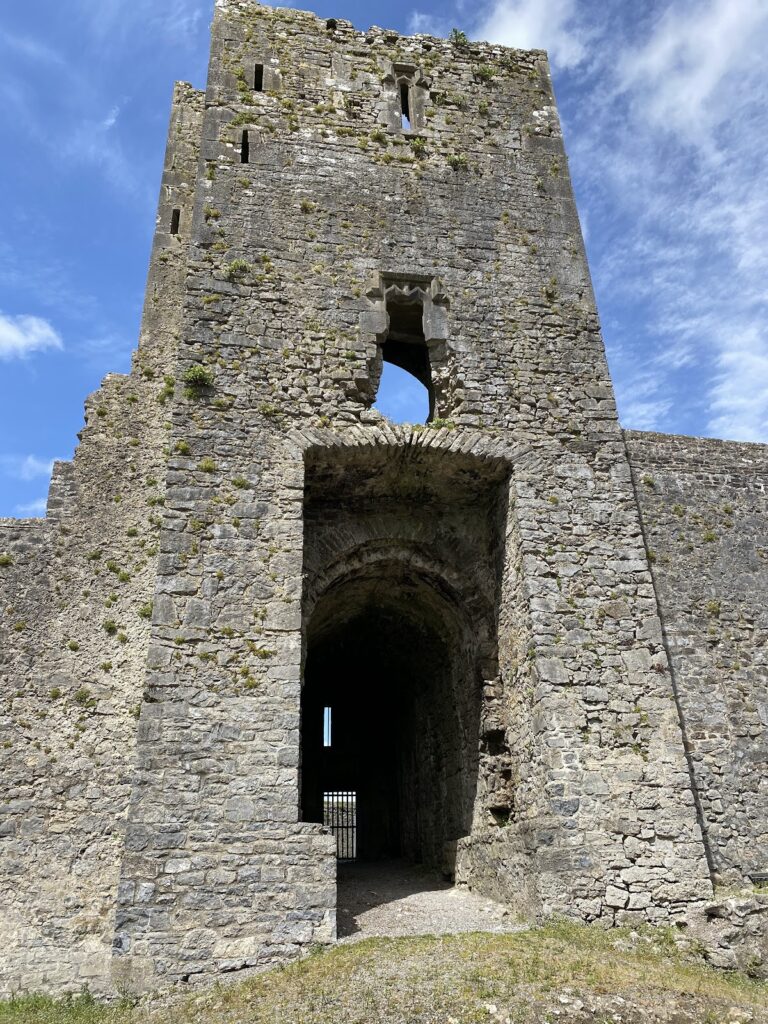
The central tower stood on light, graceful arches and separated the choir from the nave. It collapsed in the early nineteenth century, leaving substantial fallen masonry. Some of that material was used in 1851 to rebuild the largely destroyed middle section of the north wall. The medieval tower incorporated into the nearby Church of St Mary is a separate friary-associated structure in the surviving evidence. The relationship between that tower and the collapsed central tower has not been established.
South chapel
A finely proportioned chapel survives on the south side of the nave. Together with the nave and choir, it contains numerous tombs and inscriptions commemorating members of the Barry, Fitzgerald, and Lombard families, as well as other people connected with the friary.
Tombs and inscriptions
The founder’s tomb is traditionally placed at the centre of the choir. It is now marked only by broken stones that appear to have formed an enclosure. The noble burials and inscriptions within the church help explain why the church was left standing after the destruction of the convent buildings.
Grounds and associated remains
The friary’s former cloister and conventual buildings are largely lost, although the 1615 description portrayed them as spacious and numerous, with poor proportions. The church itself is now roofless and ruined. The medieval cemetery, garden, and watermill belonged to the wider property, while the nearby Church of St Mary preserves a medieval tower associated with the friary. The site is also linked with a chalice dating from about 1600, almost identical to the Timoleague Dale-Browne Chalice.