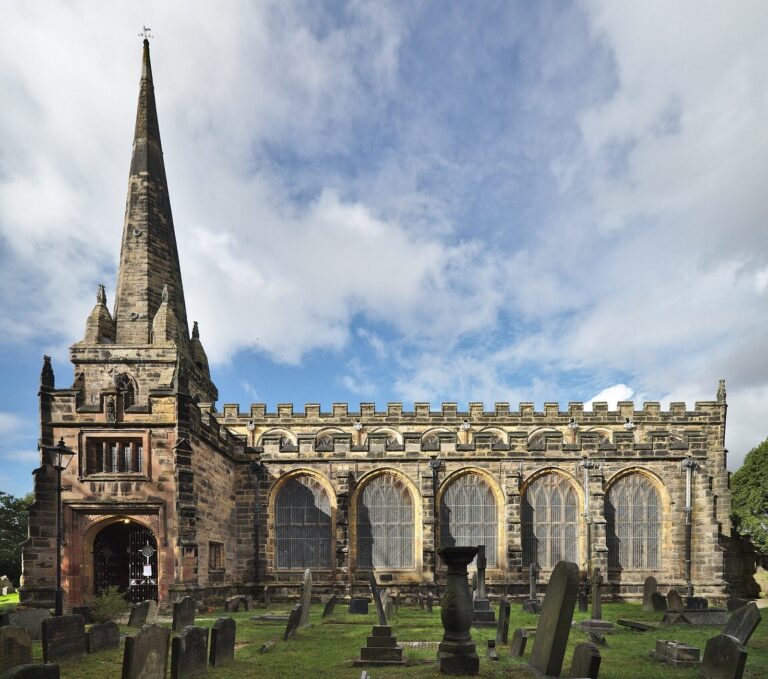
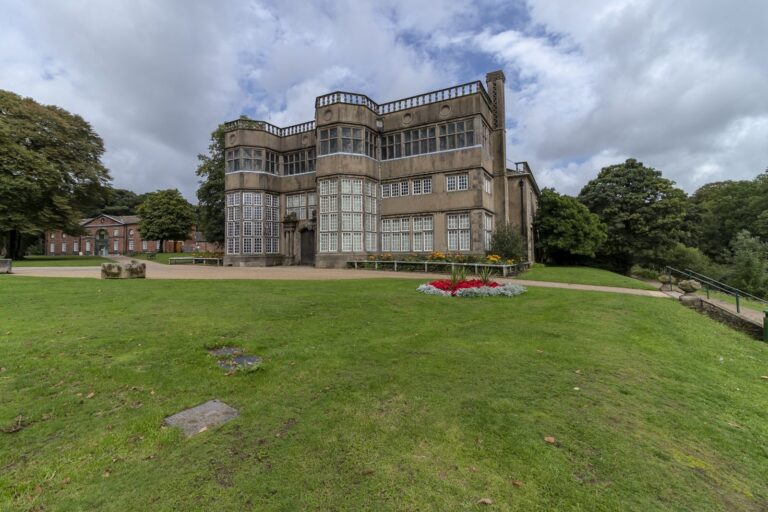
Burscough Priory: An Augustinian House Dedicated to St Nicholas
Site at a Glance
- Popularity
- Medium
- Country
- United Kingdom
- Primary era
- Medieval
- Eras represented
- Medieval
- Civilizations
- English
- Site type
- Religious
- Remains
- Monastery
On this page12 sections
History
Foundation and endowments
Burscough Priory was an Augustinian house dedicated to St Nicholas, an early Christian bishop venerated as a saint, in the United Kingdom. Robert Fitz-Henry, lord of Lathom, founded it around 1190. Its canons were religious members who lived in community under the Rule of St Augustine. An associated leper hospital is also recorded.
Robert endowed the house with land at Burscough and in the adjoining township of Marton, St Leonard’s chapel at Knowsley, mills on his estate and the right to nominate clergy for the churches of Ormskirk, Huyton and Flixton. The prior of Norton, near Runcorn, attended the foundation, suggesting that Burscough’s first canons may have come from Norton. Simon, Robert’s father-in-law, joined the community as a brother. Bishop Hugh Nonant confirmed the foundation charter, as did his successors Geoffrey de Muschamp and William de Cornhill.
In 1228 Pope Gregory IX allowed the canons to hold church services during a general interdict, a regional restriction on some religious services, and to permit burials in their church while preserving parish churches’ rights. The canons were also forbidden to leave the priory without permission, subject to any stricter rule they followed.
Church rights and local authority
The priory’s claim to the right to nominate a priest for Flixton church, known as its advowson, was contested. Roger son of Henry, apparently Robert’s brother, and Henry son of Bernard, probably Robert’s nephew, won a legal hearing over the right to present a cleric. They presented Henry of Tarbock, another of Robert’s brothers. Henry later surrendered his claim for an annual payment and promised to help secure the church for the priory. The church was not legally assigned to the priory, but the canons received an income from it. Around 1280, Bishop Roger Longespée acquired the advowson and made the church an income-bearing cathedral office.
Burscough secured greater authority over Ormskirk and Huyton. William de Cornhill assigned Ormskirk to the canons while reserving an appropriate income for a parish priest. His successor, Alexander de Stavenby, granted Huyton to the priory after its incumbent died, while retaining the right to appoint a priest. A parish priest’s position at Huyton was established in 1277. In 1285 the canons gained permission to nominate one of their own priests as Ormskirk’s parish priest when the position became vacant. After the convent once presented a secular priest through negligence, Bishop Northburgh renewed the privilege in 1339. From then until the Reformation, Ormskirk’s parish priest was a Burscough canon.
Questions about the division of income between the priory and parish priests continued. In 1340 an inquiry considered a petition from Alexander of Wakefield, Ormskirk’s priest. A dispute with John Layet, Huyton’s priest, was settled by arbitration in 1387. In 1461 Ralph Langley, a Burscough canon serving at Huyton, secured a review of his share because he considered it inadequate. Other priory canons also held the Huyton position during the fifteenth century.
Pope Boniface VIII temporarily allowed the prior in 1295 to appoint six canons over the age of twenty so that they could become priests. Once ordained, they could vote in elections for a new prior and could themselves be elected. In 1300 the pope confirmed the priory’s privileges more broadly.
The priory also held rights in Ormskirk as a town. A charter from Edward I in 1286 authorized a regular market, and the king and Edmund of Lancaster granted a five-day fair. Edward II confirmed these grants and other gifts in 1323. Burscough claimed fines for breaches of the rules regulating bread and ale, a claim that brought it into conflict with officers of Henry, Earl of Lancaster. In 1339 the earl secured the privilege in exchange for an annual payment.
Later medieval fortunes
In 1347 Prior Thomas of Litherland was accused of helping Sir John de Dalton seize Margery, widow of Nicholas de la Beche, from her manor at Beams. Dalton’s men killed two people and wounded others, despite the presence of a royal son. Lancashire gentlemen testified that the prior was innocent. Released on bail, Thomas appears to have cleared himself and remained in office for nearly forty years.
John de Winwick, a Lancashire cleric favored by Edward III, left funds for a proposed Oxford college where students would study church and secular law. Difficulties over the bequest led to permission to transfer the endowment to Oriel College. About twenty years after Winwick’s death, his executors secured Richard II’s licence to transfer the right to nominate a priest at Radcliffe on Soar to Burscough. Archbishop Alexander Neville approved its assignment to the priory to ease hardship caused by plague, poor seasons and other misfortunes, and to support a chapel at Huyton for two priests. The chapel was established in 1383, and the bishop of Coventry and Lichfield set each priest’s stipend at ten marks, a medieval unit of account equal to two-thirds of a pound.
In November 1386 Pope Urban VI ordered the abbot of Chester to compel unnamed people to return lands and goods taken from the priory, on pain of excommunication, exclusion from church communion. The seizure may have taken advantage of the political unrest of that year. Pope Boniface IX granted a four-year indulgence, a remission of temporal punishment for sin, to penitents who visited the priory church on St Nicholas’s Day and gave alms for its preservation.
The lordship and lands of Lathom passed to the Stanley family in 1390. The Stanleys were an English noble family associated with the earldom of Derby, and several were buried at Burscough. Those named include Sir John Stanley, who died in 1414; Sir Thomas Stanley, 1st Baron Stanley, buried in February 1459; his wife Joan, buried in 1466; and their son Thomas Stanley, 1st Earl of Derby. Other burials included John I Stanley of the Isle of Man and Joan Goushill Stanley, daughter of Elizabeth Fitzalan, Duchess of Norfolk.
In 1454 Prior Robert Woodward, canon Thomas Fairwise and William Bolton, Ormskirk’s parish priest and a former canon, faced an episcopal inquiry into alleged divination, sorcery and black magic. They had hired a necromancer named Robert for ten pounds to find hidden treasure. The inquiry described a ritual with three triangular circles, a consecrated Eucharistic bread and a divining rod. The accused denied invoking demons or sacrificing to them. Bishop Boulers suspended the three men from priestly duties and the sacraments for two years, except at the point of death. Bolton lost his parish position and Woodward had to resign as prior. The bishop lifted the suspensions after a few months, but none returned to their former posts; Woodward received a pension.
Roughly fifty years later, Prior John Barton was removed from office rather than permitted to resign. The nature of his offences is not known. A canon from Kenilworth, another house of the Augustinian order, was appointed in his place, an indication that Burscough was in poor condition.
Dissolution and later history
The priory was dissolved in 1536 under the February act affecting religious houses with incomes below £200. Its community consisted of five canons, including the prior, all of them priests. The church and other buildings required repair. Edward Stanley, 3rd Earl of Derby, tried to save the church, where many members of his family were buried, and sought to provide a priest at his own expense to pray for his ancestors and local people. High valuations of the property frustrated the plan. During the Pilgrimage of Grace, a major northern English uprising against the religious and political changes of Henry VIII’s government, Stanley sought to delay the demolition of the buildings and the melting of their lead and bells.
After the dissolution, many bodies were moved to Ormskirk, which became the Stanley family’s burial place. Eight bells went to Ormskirk Parish Church, whose steeple could not bear them and was replaced by a new tower; the remaining bells went to Croston church. James Bromley directed a systematic exploration of the church site in 1886. The ruins are a Grade I listed building, with the listing dated 11 May 1953, and are also a scheduled monument.
Remains
Layout and excavated foundations
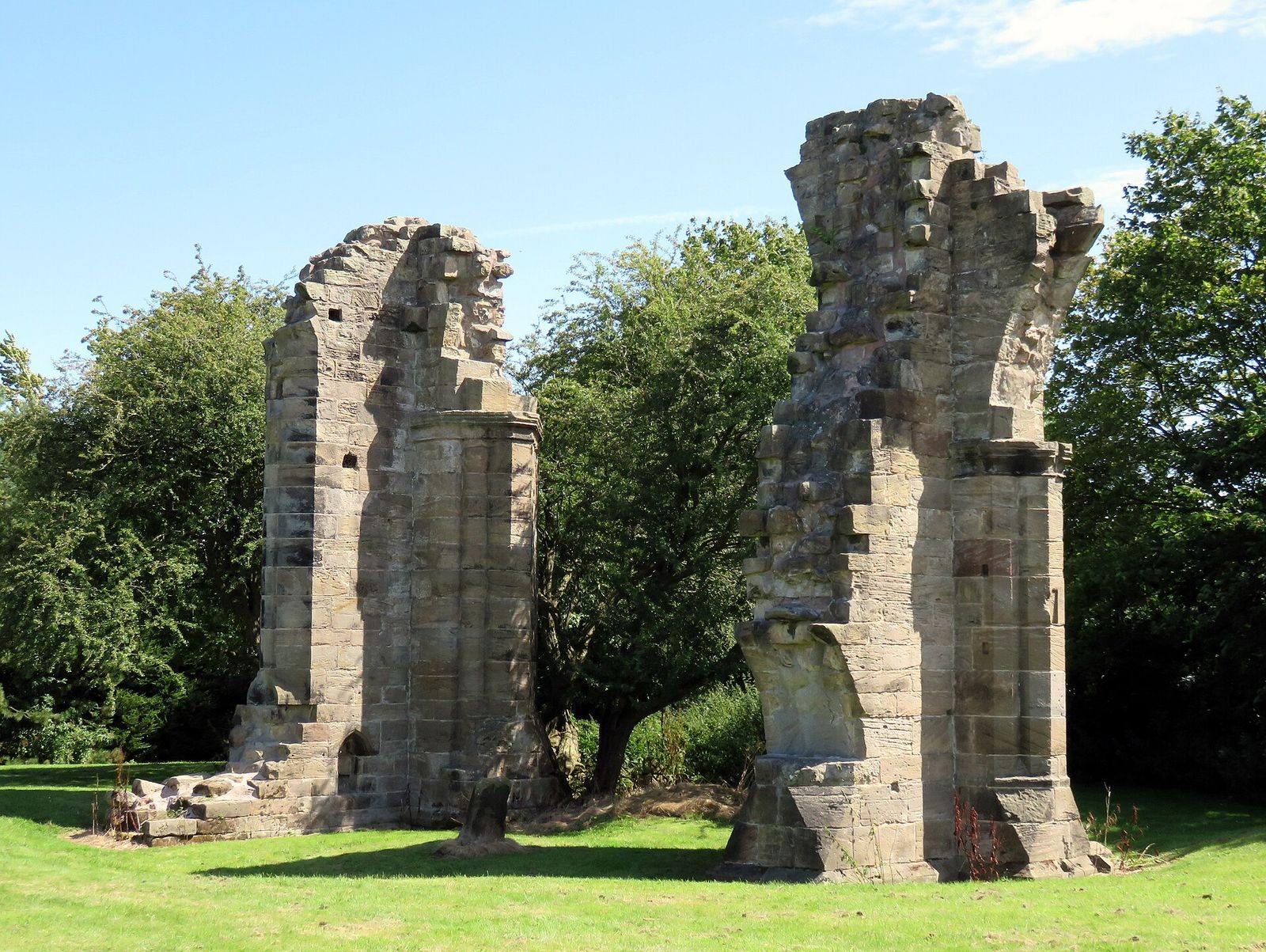
The surviving plan centers on a cross-shaped church, with a square tower at the meeting of the nave and transepts and a cloister to the south of the nave. The priory’s church remains chiefly as foundations and two substantial piers, while excavation has exposed parts of the cloister and nearby building foundations.
Church plan
The church had a presbytery, the eastern area around the altar used by the clergy, measuring 42 by 24 feet (about 13 by 7.3 metres). Its central tower measured 22 feet 6 inches (about 6.86 metres) on each side, and north and south transepts extended from the crossing. The nave measured 100 by 24 feet 6 inches (about 30 by 7.5 metres) and had a north aisle. Foundations of the transepts and presbytery are between one and 1.6 metres wide and up to 0.4 metres high. The ground around the remains has been excavated to nearly one metre below the surrounding level.
Cloister and adjoining foundations
The cloister, a square open space around which the community’s buildings were arranged, measured about 67 feet (20 metres) on each side and lay south of the nave. The 1886 exploration uncovered about half of its west side and cleared foundations of a building beside the north side of the north transept. The east and south sides were not cleared, but a survey established the cloister’s approximate dimensions. The gap between its east wall and the south transept suggests that it occupied the position of a twelfth-century cloister and retained the earlier arrangement after the church was extended eastward around 1280. The nave plan may also preserve the earlier church’s layout.
Standing remains and associated objects
Crossing piers
The most substantial standing remains are two cross-shaped piers that supported the north side of the crossing tower. Probably dating from the late thirteenth century, they rise about seven metres, above the points where the crossing arches began. The arches’ wedge-shaped stones have been removed. Each pier has a sloping base that transitions from a square support to an octagonal shaft, with parts of the beveled shafts still in place. Fragments of walls project north and east from the eastern pier, which also has a small pointed niche at its base. The other pier contains a small trefoil-headed recess, possibly an aumbry, or wall cupboard for sacred items. A mound between the piers bears a gravestone with the incomplete date "175-." The exposed ends of incomplete walls have been cemented to limit deterioration, and the remains are in good condition.
Bell and priory seal
The tenor bell at Ormskirk is identified as the third bell transferred from Burscough. Its Latin inscription gives the makers as J.S. de Burscough, Esquire, and his wife E., and states that they made the bell in honor of the Trinity; it is dated R.B. 1497. The bell also bears a rose, a portcullis and a fleur-de-lis, badges that may indicate it was presented in honor of a visit by Henry VII. The seal used on the priory’s deed of surrender depicts the monastic buildings.