Schloss Stocksberg: A Teutonic Order Castle in Germany


Site at a Glance
- Rating
- 4.2
- Popularity
- Very Low
- Country
- Germany
- Primary era
- Early Modern
- Eras represented
- Medieval, Early Modern
- Civilizations
- Crusader, Holy Roman Empire, Teutonic Order
- Site type
- Military
- Remains
- Castle
On this page9 sections
History
Schloss Stocksberg is a castle in Germany, located above Stockheim, now a district of Brackenheim in northern Baden-Württemberg. The complex took its essential present form in 1574 as a two-winged residence, after an earlier castle had been destroyed during the German Peasants’ War. Its history reflects the administrative expansion of the Teutonic Order, repeated wartime damage, and changing ownership from a religious-military institution to private holders.
Medieval origins and Teutonic Order rule
The first castle on Stocksberg is traditionally associated with the Lords of Stocksberg, who probably descended from the earlier Lords of Stockheim. Ulrich von Stockersberg appears in the written record in 1220, although the early ownership of the castle is uncertain. On 6 December 1307, Count Eberhard the Illustrious transferred his rights in Stocksberg Castle to the Teutonic Order. The order, a medieval religious-military organization that administered estates through local commanderies, had already acquired the property of the Lords of Stockheim in 1295. Through these acquisitions, it came to control both the castle and Stockheim.
Stockheim became a commandery in 1334. A commandery served as a local administrative and economic center of the order. In 1375, the Stockheim commandery was merged with the expanding Horneck commandery. By 1404, Horneck had also acquired Kirchhausen and parts of the Heuchlingen administrative district.
Destruction and rebuilding in the sixteenth century
The German Peasants’ War was a widespread uprising in the German-speaking lands during 1524 and 1525. During the revolt, insurgent peasants led by Hans Wunderer of Pfaffenhofen attacked Stocksberg on the night of Easter Monday, 17 April 1525. Almost all the inhabitants of Stockheim joined the force, which plundered and burned the castle. The insurgents later became known as the Stocksberg Band.
The Stocksberg Band joined Matern Feuerbacher’s Bottwar Valley Band several days later. Together they formed the Bright Christian Band, which marched through Bietigheim, Vaihingen, Stuttgart, Schorndorf, Göppingen, and Urach. After its defeat at Böblingen on 12 May 1525, the group united with the Heilbronn Band on 19 May. As the revolt collapsed, the peasants returned to their home villages. Teutonic Order Master Dietrich von Cleen held a punitive court at Stockheim on 12 August 1525.
Walther von Cronberg, Dietrich von Cleen’s successor, had Horneck and Heuchlingen rebuilt by 1530. Schloss Stocksberg, however, was not completed again until 1574, under Heinrich von Bobenhausen. This rebuilding established the essential arrangement that survives today. The Weinsberg master builder Thomas Knoll, who died in 1573 and had constructed the similar Teutonic Order castle at Kirchhausen, is considered a possible architect.
Wartime occupations and eighteenth-century conflict
During the Thirty Years’ War, the major European conflict of 1618 to 1648, Swedish troops under Marshal Gustav Karlsson Horn moved from Mergentheim toward Heilbronn in December 1631. Swedish cavalry plundered Schloss Stocksberg on Christmas Eve. The Teutonic Order regained control in 1634.
The War of the Palatine Succession, fought from 1688 to 1697, also brought military activity to the Stockheim area. French forces plundered the village and castle in June 1693. In October of the same year, troops commanded by the Bavarian general Serini camped on Stocksberg.
From Württemberg administration to private ownership
During the War of the Second Coalition, a conflict fought against revolutionary France from 1798 to 1802, French General Michel Ney occupied Schloss Stocksberg in 1799 with approximately 7,000 troops. His forces fought Austrian cavalry on the Heuchelberg, where the Austrians had entrenched themselves at Güglingen.
In November 1805, Württemberg occupied the formerly Imperial Knight estates and their administrative districts, including Neipperg and Stockheim. Stockheim became an independent municipality in the Kingdom of Württemberg, while the castle initially became a state estate administered by an official.
In 1832, the castle passed to the widow of the court saddler Fröhlich, whose children commissioned extensive maintenance work. Alfred von Neipperg acquired it in 1843. His brother and heir, Erwin von Neipperg, sold the castle to the municipality in 1873. The municipality divided the associated estate into parcels and sold them to local residents on favorable terms. The castle itself was acquired by the sparkling-wine manufacturer Eduard Gießler in 1890, and the interior furnishings of the main wing date from his ownership.
During the Second World War, the Reich Labour Service occupied the castle. The City of Heilbronn later used it as an auxiliary location for an old-age home serving Heilbronn’s Katharinenstift. From 1954, the property was divided. A farmer acquired the economic buildings, while the castle building was sold to a manufacturer in 1969.
The complex is now owned by the family around Luise Layher. In cooperation with heritage authorities, the owners have renovated, restored, and technically modernized the buildings.
Remains
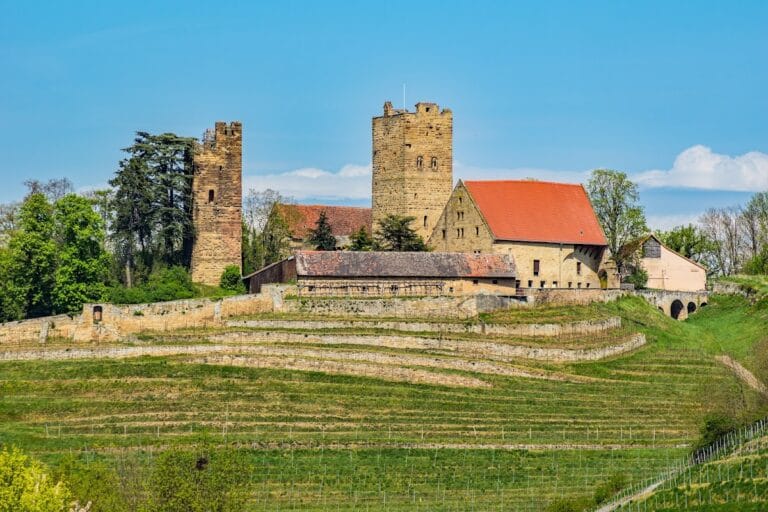
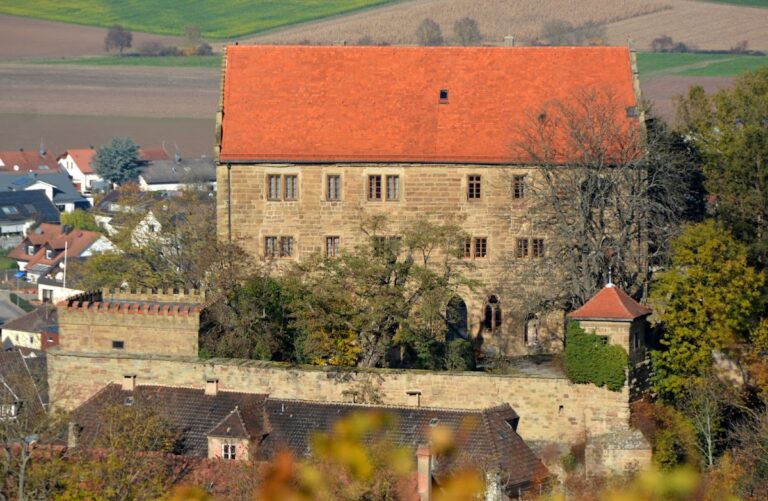
Schloss Stocksberg occupies an almost square plateau on Stocksberg, a southeastern spur of the Heuchelberg northeast and above Stockheim. The central area measures approximately 29 by 30 meters. A neck ditch, bent almost at right angles, separates the plateau from the rest of the hill on the west. The two-winged main building and a 30-meter-high tower stand on the plateau, while several economic buildings extend westward along the opposite side of the ditch. A park-like garden continues farther west.
Early castle layout
Building evidence provides the basis for reconstructing the medieval complex. The palas, the principal residential or representative building of a medieval castle, probably stood where the present main building is located. The existing tower derives from the former bergfried, a tall defensive tower intended primarily as a stronghold rather than a permanent residence. The bergfried stood at the angle of the bent neck ditch. The narrow north wing may have been built over an earlier shield wall, a particularly strong section of fortification protecting a vulnerable side. The area now occupied by the economic buildings west of the ditch formerly contained the outer bailey.
Sixteenth-century residence
The rebuilding completed in 1574 created the two-winged arrangement that defines the complex today. The main wing retains the interior furnishings associated with Eduard Gießler’s ownership in the late nineteenth century. The buildings have undergone later repair, restoration, and technical modernization in cooperation with heritage authorities.
Approach and associated buildings
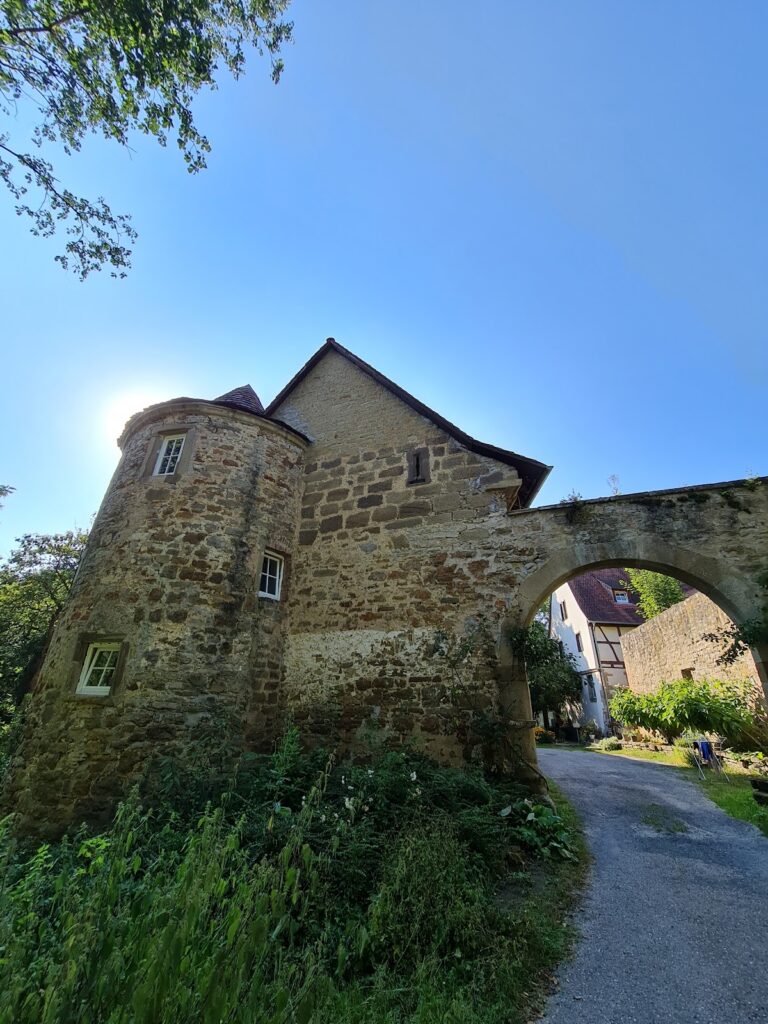
A stone arched gateway in the vineyards marks the former end of the municipal sunken road leading up to the castle. West of the neck ditch, the economic buildings occupy the area of the former outer bailey, and the park-like garden extends beyond them. Together, these surviving elements preserve the relationship between the elevated main residence, its defensive boundary, and the former service area.