Burghalde: A Fortified Hill and Castle Site in Kempten, Germany
Site at a Glance
- Rating
- 4.2
- Popularity
- Very Low
- Country
- Germany
- Primary era
- Medieval
- External website
- Open
- Eras represented
- Classical, Medieval, Modern
- Civilizations
- Holy Roman Empire, Roman
- Site type
- Military
- Remains
- Wall
On this page21 sections
History
Burghalde is a historic hill in Kempten, Germany, occupied from Late Antiquity onward and probably developed in the late Roman period as the fort and settlement of Cambidanum. The site succeeded the unfortified Roman settlement of Cambodunum on Lindenberg and became a defensible center near an important crossing of the Iller.
From Cambodunum to Cambidanum
Cambodunum came under increasing pressure from Alemannic incursions after AD 233. From the mid-third century, the Romans moved the settlement to Burghalde, where the hill offered stronger defensive advantages and better control of the river crossing. After the abandonment of the Limes, the Roman frontier system, Cambidanum became a frontier town.
Part of the Third Italic Legion occupied the fort, while the associated settlement expanded around the hill. Its substantial defensive wall incorporated material taken from the abandoned settlement of Cambodunum, both as building material and as quarry stone. The settlement covered approximately 0.75 hectares and included people of Germanic origin, indicated by two Elbgermanic crossbow brooches found there.
The fort was probably abandoned in the early fifth century. Later traditions connected Burghalde with Queen Hildegard, the wife of Charlemagne, and with Charlemagne himself, but these stories are not considered historically well founded. The claim that a monastery once stood on Hilarmont is likewise treated as a legend. Even so, the hill appears in Kempten’s coat of arms as the alleged earliest location of the monastery.
The medieval castle
In the High Middle Ages, a castle belonging to Kempten’s lord, the prince-abbot or his bailiff, occupied the hill. A prince-abbot combined leadership of a major religious institution with territorial rule, while a bailiff served as his administrative or military representative. The castle occupied the western side of Burghalde and was separated from the rest of the hill by a cross wall.
A powerful residential tower probably formed part of the castle from the first half of the thirteenth century. The position of the prince-abbot’s stronghold above the imperial city of Kempten created continuing tension. In 1363, during the traditional annual feast of Saint Martin, Kempten’s citizens seized the castle by force and drove out the prince-abbot and his bailiff.
The resulting legal dispute before the imperial court lasted fifteen years. The prince-abbot won the case, and the imperial city was ordered to rebuild the destroyed castle and pay a penalty. Prince-Abbot Heinrich von Mittelberg later waived enforcement of the judgment and sold the castle, the hill, and its associated quarries to the city “for the sake of peace.” By 1379, Burghalde had come to the imperial city through purchase.
Fortifications and religious buildings
The city used the hill as pasture and continued to quarry stone before incorporating it into the city’s fortifications in 1488. A Wolfgang chapel was consecrated on Burghalde in 1487 and was reportedly transferred to St. Mang Church in 1518. The ring wall was raised in 1496 and again in 1525, strengthening the hill’s defensive role.
During the Thirty Years’ War, a European conflict fought between 1618 and 1648, imperial and Swedish troops occupied the fortifications in turn. In January 1633, Bavarian troops under Joachim Christian von der Wahl captured and plundered Kempten. Parts of the population took refuge on Burghalde, but the refugees were later forced to pay high ransoms.
Fortress, ruins, and civic park
In 1703, French forces converted Burghalde into a fortress during the War of the Spanish Succession, a conflict over the inheritance of the Spanish monarchy. Imperial troops demolished the fortress in 1705 on the orders of Prince Eugene of Savoy, a leading Habsburg commander.
After the imperial city was mediatised, meaning that it lost its direct status within the Holy Roman Empire and was absorbed into a larger state, the Bavarian government attempted to auction the ruins. Kempten’s municipal council sought to prevent the extensive property from passing into private ownership. On September 22, 1814, a municipal councillor bought the threatened ruins from the state for 200 florins on behalf of the city.
The Burghalde Association, founded between 1865 and 1868, transformed the neglected ruins into Kempten’s first citizens’ park and a place for recreation and public events. The association laid paths, planted hundreds of selected trees, and erected new buildings. Festivals and performances soon took place on the hill.
Twentieth-century changes and interpretation
In 1942, the National Socialists planned an NS Ordensburg on Burghalde, a political training complex that would have required the demolition of all buildings and historic walls. The advance of the Second World War prevented the scheme. In 1950, the site was adapted for an open-air theater, and the associated earthmoving exposed medieval and late Roman masonry.
The Allgäu Castle Museum was founded in 1985 and moved into the renovated gatekeeper’s house in 2004. Operated by the Allgäu Castle Association, its permanent exhibition follows the development of Allgäu castles from the twelfth and thirteenth centuries to the present. It presents castles as administrative centers, estates, residences, and military installations.
The entire Burghalde area is legally protected as a historic monument. The hill and its ruins remain part of Kempten’s old town as a recreational and events area. A tradition also claims that a cannon captured during the assault of 1363 was recast as the so-called Child’s Bell of St. Mang Church. This story remains associated with Burghalde but is not established as fact. The alleged Celtic hillfort has been archaeologically disproved, despite a commemorative inscription that continues to assert its existence.
Remains
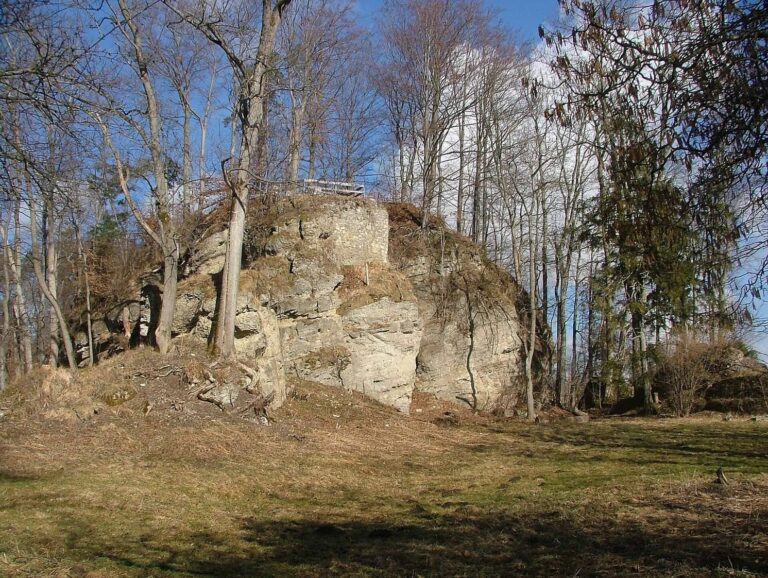
Burghalde is a free-standing, trapezoidal hill approximately 690 meters above sea level, now west of the Iller. Its upper area contains remains of Roman and medieval defenses, later military structures, nineteenth-century park buildings, and the open-air theater. The hill is formed by Upper Marine Molasse, while younger river deposits occupy the surrounding valley. A geological fault runs from west to east through its middle.
The lower ground was gradually raised to create areas safe from flooding. The former river course survives as the depression of Freudental. More recent research identifies one river course between the Roman period and the Middle Ages, rejecting the earlier belief that Burghalde was an island surrounded by the Iller. Lower Freshwater Molasse appears farther upstream and at Georgsinsel, while glacial moraine deposits separate the two solid-rock formations near the present König-Ludwig Bridge.
Late Roman settlement
Settlement wall and cemetery
The late Roman settlement of Cambidanum occupied and extended around the hill. A small section of its city wall survives on Burgstrasse, where the later medieval city wall crossed it at a right angle. The Roman wall also continued through the Protestant Cemetery, established in 1535 on a terrace west of Burghalde.
A small cemetery belonging to the civilian settlement lay near the present town hall. The settlement’s archaeological remains therefore extended beyond the hilltop fort and included both defended and civilian areas around Burghalde.
Large late Roman building
Excavations in 1941 uncovered parts of a large late Roman building north of the cemetery area. Its original function remains uncertain. Its size and two apses, semicircular architectural ends, have led to the interpretation that it may have been the audience hall of a governor’s palace. An earlier interpretation as an early Christian church is no longer accepted.
Medieval defenses
Ring wall and connecting walls
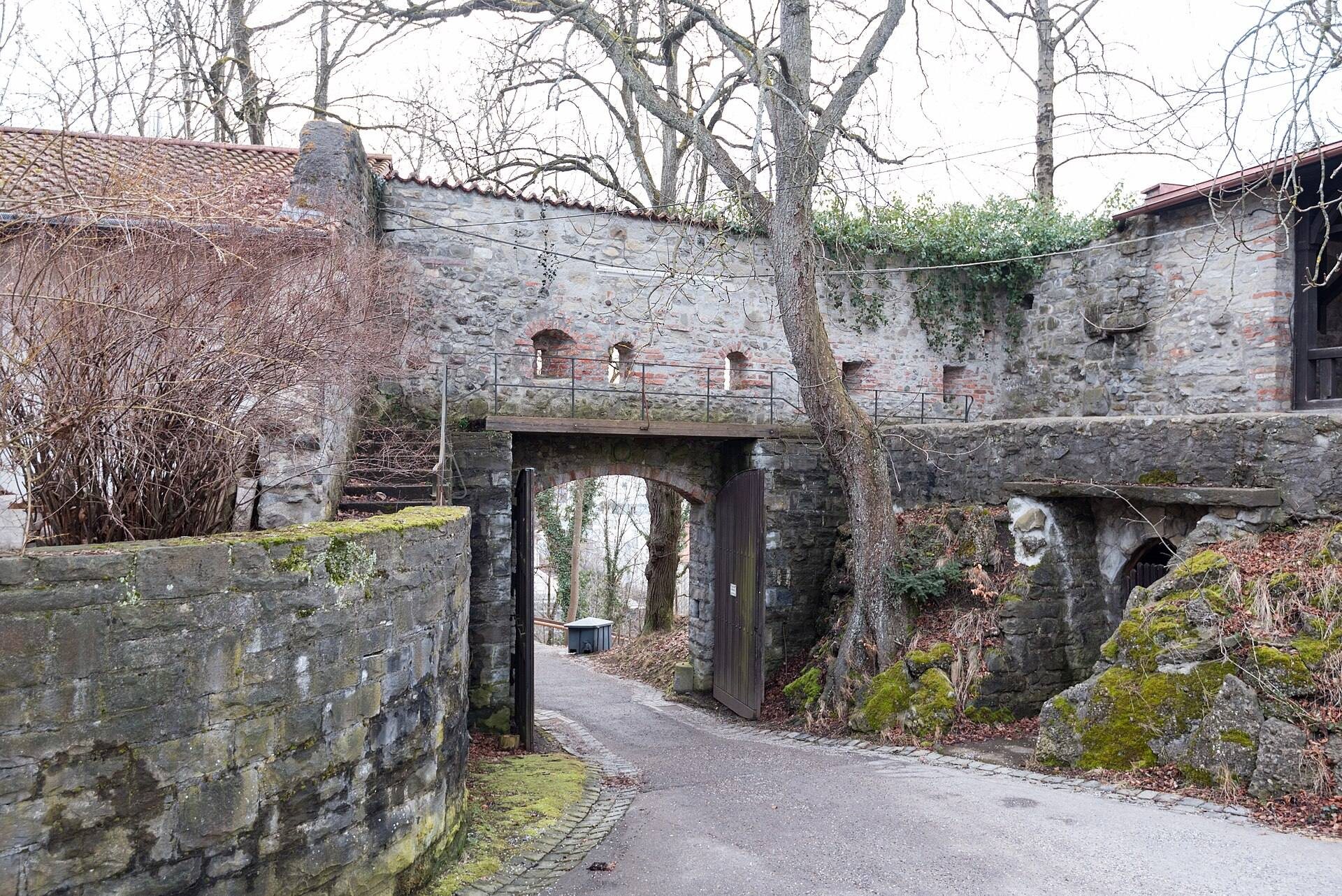
A medieval ring wall follows the hilltop in an approximately trapezoidal circuit. Its upper courses are modern, while lower surviving sections preserve parts of the historic fortification. Connecting walls once joined the ring wall to the medieval walls of the imperial city. These connecting walls survive, while the city wall itself remains only in fragments.
Northwestern tower
A square city-wall tower stands at the northwestern corner of the fortifications. It belongs to the 1488 phase of work and has a pointed roof.
Residential tower
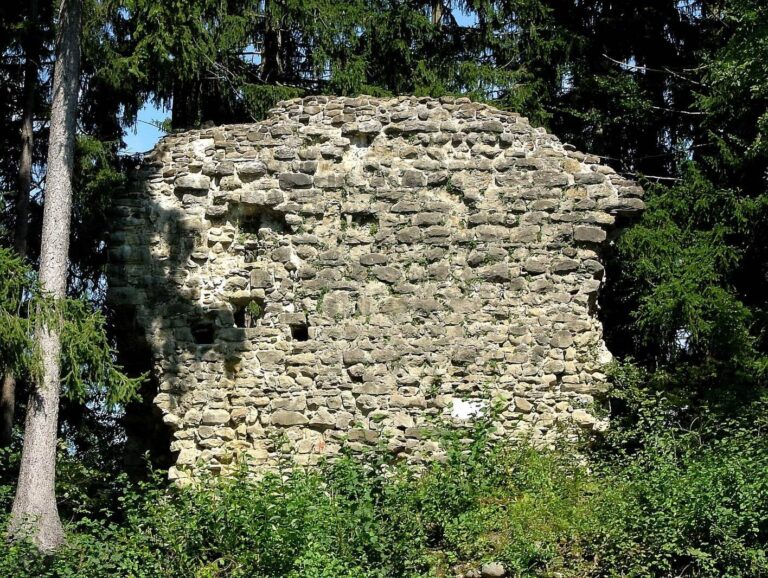
The western wall of the medieval residential tower, probably built in the first half of the thirteenth century, survives for approximately 15 meters. It is preserved within the 1909 pavilion, linking the later park structure with the remains of the prince-abbot’s castle.
Later military features
Well and gun towers
Behind the stage of the open-air theater is a well or cistern shaft probably dug in the sixteenth century. It reaches approximately 30 meters in depth and was restored in 1931. Two circular gun-tower stumps survive behind the shaft at wall height and probably belong to the fortification enlargement of 1525.
Powder tower
The southeastern connecting wall ends at a low, round powder tower with a shallow conical roof. The tower probably dates from the fifteenth century and forms part of the surviving defensive structures on the hill.
Park buildings and theater
Gatekeeper’s house
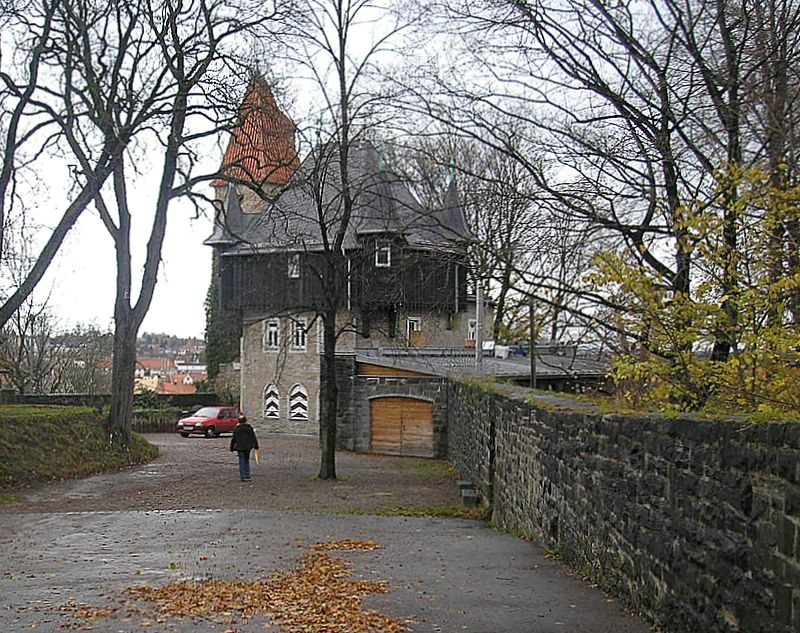
The gatekeeper’s house was built in stone beside the medieval ring wall on the northern side of the hill in 1870. Designed as a neo-Gothic artificial ruin, it originally provided a residence for the Burghalde keeper. Its internal flat roof was replaced in 1889 by an additional timber story and a distinctive roof with four corner turrets. The two-story building now has a hipped roof and is partly clad with timber boards.
The renovated building houses the Allgäu Castle Museum. A garden of scented and medicinal herbs was established beside it.
Fountains and pavilion
The city installed a fountain at the western approach in 1894. The Burghalde Association financed the City Gardener’s Fountain there in 1926, with a design by the architects Otto and Leonhard Heydecker. Electrical service reached the hill in 1908, and a pavilion was built on the western side in 1909 as an additional covered dining area.
Open-air theater
The open-air theater occupies the southern part of the hill. Built in 1950 to designs by Sepp Zwerch, it required the medieval castle gate to be widened and involved extensive earthmoving. That work brought medieval and late Roman masonry to light, making the theater part of the modern physical history of Burghalde as well as its civic use.